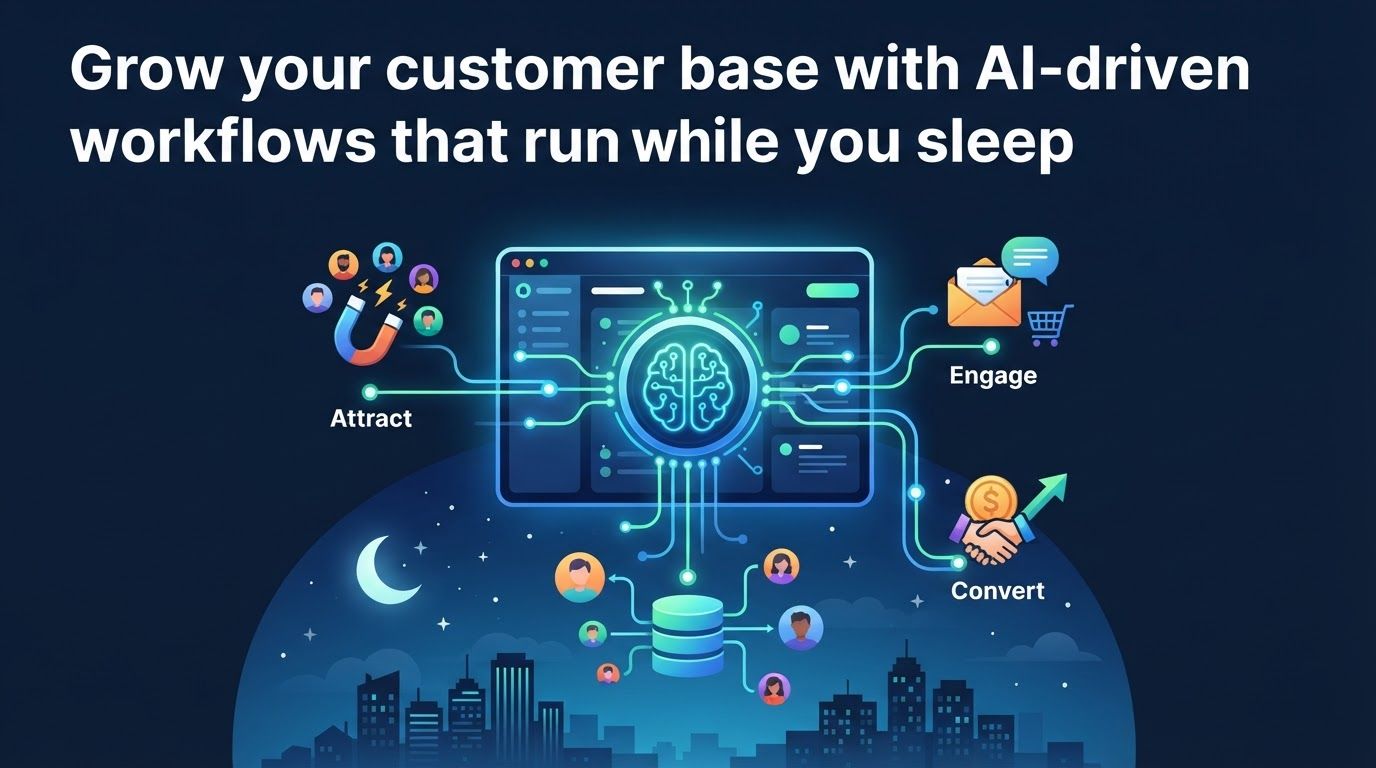
You do not need to be awake every time a potential customer finds your business, asks a question, or requests help choosing a product. AI-driven workflows can capture that interest, provide an appropriate first response, and prepare the next step for you while you sleep.
The goal is not to put an unsupervised chatbot in charge of your income. For an affiliate marketer or home-based entrepreneur, the practical opportunity is to connect discovery, lead capture, follow-up, and human review into a process that keeps moving outside business hours. Here is how to build one without sacrificing accuracy or trust.
What AI-driven workflows can do while you sleep
An AI-driven workflow is a repeatable sequence in which an event starts a process, AI helps interpret or create something, and connected tools carry out defined actions. A visitor might submit a question on your site; AI can identify its topic and draft a relevant reply, while your email platform sends an approved resource or your task system flags the conversation for review. The workflow runs because you designed its triggers and boundaries in advance, not because AI independently decides how to grow your business.
The useful promise of a 24/7 workflow is simple: keep routine conversations moving, and make it easier for a person to step in when judgment matters.
That distinction separates a dependable growth system from a collection of clever prompts. A prompt can help you write one email. A workflow can recognize a new opt-in, check what the person requested, deliver the right starting resource, and put a question needing your expertise in your review queue. Each action has a purpose, a rule for when it should happen, and a way to check the result.
OpenAI describes enterprise AI moving beyond assistance toward agents connected to company context, tools, and repeatable workflows. Its enterprise analysis found that frontier firms generated 8.3 times as many output tokens per active user as typical firms, which it presents as a proxy for deeper use. That is not a small-business growth benchmark. It does, however, illustrate the difference between occasionally asking AI for an idea and making it part of ongoing operations.
You can start much smaller than an enterprise team. A useful first workflow needs four pieces:
- A trigger: a form submission, email reply, booking request, or new question.
- Reliable context: your offer details, approved answers, audience segments, and relevant customer information.
- A bounded action: categorize the request, send a known resource, draft a reply, or create a task.
- An escalation path: send uncertain, sensitive, or high-stakes cases to a person.
The best overnight workflow does not try to replace every customer interaction. It prevents a useful next step from waiting until morning. Gartner describes a related design pattern in which generative AI understands intent while traditional automation completes a transaction in the background. You can apply the same principle with a modest email system and a review queue: let AI help decide what a message is about, and let well-defined automation perform only the actions you have authorized.
Make your business discoverable before automating the follow-up
An always-on response system cannot grow your customer base if people cannot find you. For affiliates and small online businesses, that means thinking about both traditional search and AI-mediated discovery. Someone might still find your comparison article through a search engine, but another shopper may ask an AI assistant to explain which option fits a particular need.
Salesforce reported that use of agentic search as the first step in the shopping journey grew 200% year over year. Its research also found that, between August 2025 and May 2026, discovery through brand-owned properties fell 7% and traditional search fell 15%, while newer channels including AI assistants, social media AI, and delivery apps grew 38%. Those findings point to a changing mix of discovery channels; they do not mean you should abandon your website or assume every audience behaves the same way.
Build pages that answer a buying question completely
Answer-engine optimization begins with useful, specific content rather than a special phrase repeated everywhere. If you promote home-office software, a page that explains who needs the tool, which limitations matter, how alternatives differ, and what to check before subscribing is more helpful than a page built only around a product name. Clear offerings and direct answers also make it easier for a human visitor to judge whether to keep reading.
For each important page, ask whether a reader can identify the problem, understand the available options, and take an appropriate next step without guessing. State relevant product details plainly and keep them current. Where your income depends on a recommendation, make your affiliate relationship clear and distinguish your firsthand observations from claims supplied by a vendor. AI can help you organize and revise the page, but it should not invent product experience or verify facts it has not checked.
HubSpot reported that customers optimizing for AI search generated 20% more AI traffic, 170% more marketing-qualified leads, and 82% more deals than comparable customers not optimizing for AI search. This is a comparison reported by HubSpot, not a guarantee that changing one page will produce those results. Treat it as a reason to test whether clearer, more useful answers improve discovery and lead quality in your own business.
Connect discovery to a sensible next action
A visitor who reads an article about choosing a tool may not be ready for a sales pitch. Offer a checklist, a comparison guide, or a short email series that continues the same decision. Give each resource a distinct sign-up path so you can see which topic drew the visitor in. That simple connection gives your follow-up workflow useful context: it can deliver the promised material immediately and avoid sending a generic message unrelated to the reader’s question.
Keep existing SEO work in place while you test AI-search visibility. Your website remains the place where you can maintain accurate information, explain disclosures, collect permission to follow up, and measure what happens after discovery. New channels change how people arrive; they do not remove the need for a trustworthy destination.
Turn visits into qualified leads with helpful intake
Lead capture works better when it asks for enough information to help, not every detail you might eventually want. A visitor considering a product recommendation may be willing to share an email address and their main challenge. Asking for a long profile before providing the promised guide can create unnecessary friction. Design intake around the first useful action your workflow can actually take.
OpenAI’s small-business reporting highlights customer intake and booking tools, along with market and online-ad keyword research, as AI applications. You do not have to build a complex agent to use that pattern. A short form can collect the visitor’s selected topic, pass the response to your email platform, and create a record for future follow-up. AI becomes useful when it interprets a free-text question or prepares a concise summary that saves you from reading through a disorganized inbox.
Match the intake method to the decision
- For an educational offer: ask which problem the subscriber wants to solve, then send the matching resource.
- For an affiliate comparison: ask about the visitor’s use case, then provide a relevant comparison and invite them to review the limitations.
- For a consultation or service: collect the project goal, timing, and an appropriate contact method, then offer available booking options.
- For a support question: let the visitor describe the issue, provide an approved answer if one exists, and route anything uncertain for review.
Imagine you publish a guide to email tools for solo business owners. A reader clicks through from a search result at night, downloads your setup checklist, and selects ‘I need help choosing a platform.’ The system can send the checklist immediately, label the lead by topic, and queue a comparison email. If the reader adds a detailed question about moving an existing list, AI can summarize it for you instead of pretending it knows the right answer for that person’s data and provider.
This is also where permission and data restraint matter. Tell people what they are signing up for, store only the information needed for the next step, and honor the communication preferences they give you. Avoid passing sensitive details into tools merely because an integration makes it possible. A smaller, better-understood intake workflow is easier to test and maintain than one that collects everything and has no clear purpose for it.
The immediate win is not that every visitor becomes a lead. It is that a suitable visitor can get a relevant response without waiting for your working hours, while someone who needs personal attention arrives in your queue with enough context for you to respond well.
Use AI to nurture interest without pretending every lead is sales-ready
Once someone opts in, the next question is not ‘How often can I message them?’ It is ‘What would help them make a better decision?’ An automated sequence can explain a common problem, show an appropriate comparison, answer an objection, and invite a reply. AI can help draft or sort that material, but your approved sequence should set the direction.
Start with the reason the person joined. A subscriber who requested a beginner’s guide needs orientation; a visitor who asks about pricing may need a clear explanation of costs and trade-offs. If your system treats both as identical sales opportunities, automation merely scales the wrong conversation. A small number of meaningful paths is usually easier to manage than dozens of segments you cannot keep accurate.
OpenAI gives an example of a sales plugin that combines a team’s playbook with CRM access to draft a tailored response for human review. The important detail is the review. For your business, the equivalent might be an AI draft that draws on the lead’s selected topic and your approved product notes, then waits for you to confirm the recommendation before it is sent. That can be more valuable than a fully automatic message that sounds confident but misses a qualification.
Decide what can send automatically
Use a simple risk test: would an incorrect message merely be unhelpful, or could it mislead the customer or damage trust? A promised checklist, a booking confirmation, or a link to a published article may be suitable for automatic delivery once you have tested it. Personal product advice, unusual refund questions, complaints, and messages involving private circumstances deserve closer review. Put a clear stop or handoff rule in the workflow instead of asking AI to improvise an answer to every question.
Customers appear open to AI assistance, but access to people still matters. In Gartner’s 2026 survey, 50% of customers said interactions are easier when companies use generative AI, while 87% said access to a human agent is essential. For a solo entrepreneur, ‘human agent’ may simply mean you. Make it easy to reply to an email, request a call if you offer one, or ask for personal help when the automated path does not fit.
Good nurture content also leaves room for ‘not yet’ and ‘not a fit.’ If a tool has a steep learning curve or does not suit a certain budget, say so where relevant. An honest comparison may lead to fewer impulsive clicks, but it gives the right readers a better basis for choosing and gives you a more trustworthy relationship with them. That is a stronger foundation for customer growth than a sequence built entirely around urgency.
Build your first overnight workflow in manageable steps
Pick one narrow situation before choosing software. A strong starting point is a recurring event you already understand: someone requests a guide, asks a common question, or books a conversation. Do not begin by trying to automate discovery, content creation, lead scoring, customer service, and sales all at once. One working path will teach you more than a diagram of a system you cannot audit.
- Choose the outcome. Write down what should happen when the trigger fires. For example: ‘A new subscriber receives the requested guide, and a question about platform migration creates a task for me.’ This states both the automatic action and the handoff.
- Map the current journey. Follow the visitor from the page or message that brings them in through the form, confirmation, email, and possible reply. Note what information each step needs and where the conversation currently stalls.
- Prepare a trusted knowledge set. Gather the relevant article, offer terms, product notes, disclosures, and approved answers. Remove outdated claims. Give AI only the context needed for its role, and make clear when it must say it lacks enough information.
- Set up the trigger and rules. Connect the form, inbox, booking tool, or CRM to the next action. Use straightforward rules for known cases, such as sending the resource that matches the form choice. Reserve AI for interpreting text or drafting where fixed rules are not enough.
- Define escalation before launch. Route uncertain questions, complaints, sensitive information, and requests outside your approved scope to a review queue. Decide what acknowledgment the visitor receives while waiting for you.
- Test real scenarios. Submit a normal request, an unclear request, a duplicate request, and a message that should reach a human. Check both what the visitor sees and what appears in your own records.
- Launch a limited version and inspect it. Review outputs regularly, correct mistakes at their source, and expand only when the basic path works reliably. Keep a manual way to pause the workflow if an offer or policy changes.
Here is a modest version for an affiliate blog. The trigger is a sign-up on a comparison article. The form asks what the reader is trying to accomplish, the email platform delivers a relevant checklist, and AI drafts a brief summary of any free-text question. A rule sends ordinary resource requests through automatically; questions that require a tailored recommendation wait for your review. When you return to work, you see the lead’s topic and actual question rather than a pile of unorganized notifications.
That setup may use tools you already have. The critical investment is not an elaborate stack but clear content, dependable connections, and time to check whether the workflow behaves as intended. If your volume is low, a form plus a simple email sequence and manual replies may be the better starting choice. Add AI only where interpreting, summarizing, or drafting genuinely removes a bottleneck.
Measure customer growth, not just automation activity
An overnight workflow can send messages successfully and still fail to help your business. Track the path from discovery to a useful outcome so you can distinguish busy software from improved customer experience. You do not need a complicated dashboard: a small set of measures tied to the original problem is enough to begin.
- Discovery: which pages, search channels, or campaigns bring relevant visitors to your offer?
- Lead capture: which resources attract sign-ups, and are those subscribers interested in what you actually provide?
- Responsiveness: how quickly does someone receive the promised resource or an appropriate acknowledgment?
- Conversation quality: how many replies need correction, escalation, or a better explanation?
- Business outcomes: which paths lead to qualified inquiries, bookings, appropriate affiliate clicks, or customers?
Read those measures together. More sign-ups do not help much if they come from the wrong audience. Faster replies are not a win if the information is inaccurate. A larger review queue may mean your content is attracting engaged prospects, or it may mean the automatic path does not answer a basic question. Look at a sample of actual conversations before changing the workflow.
There are encouraging reports from larger organizations, but they need context. Salesforce found that 70% of customer service organizations adopting AI agents observed measurable value within 60 days of deployment. In its 2026 service research, customer satisfaction was the most improved KPI after deployment, a of productivity, handle time, retention, and first-response time. Those findings show why customer experience deserves attention alongside efficiency; they do not forecast the results of an individual affiliate site.
Salesforce also reported that adoption of AI agents in customer service organizations rose from 39% in 2025 to 66% in 2026. OpenAI says customer service and content generation together account for about 20% of API activity in its enterprise reporting. These are signs that customer-facing automation is being used in practice, not instructions to copy an enterprise system. Your own test is whether the right people get useful help and whether the resulting work is sustainable for you.
Review results on a regular schedule that fits your volume. Note where visitors abandon the path, which questions repeat, and which automatic messages prompt useful replies. Sometimes the best improvement is not a smarter agent: it is a clearer article, a shorter form, or a more precise explanation of who your offer is for.
Know the limits of a business that runs while you sleep
‘While you sleep’ is a good description of availability, not a promise that every decision should happen without you. AI may misread intent, draft an answer with unsupported detail, or rely on product information that has changed. Connected tools can also fail or send a message to the wrong path if their rules are poorly tested. Give the system a defined job and check its output rather than treating automation as proof of correctness.
Choose the right level of automation
There are three useful options. With simple automation, fixed rules deliver a resource or confirmation; this is often enough for predictable requests. With AI-assisted preparation, AI classifies a message or drafts a response that you approve; this suits nuanced questions. With bounded AI execution, AI handles a narrow routine interaction within approved information and routes exceptions to you. Choose the least complex option that solves the customer’s problem.
This approach also keeps your workload realistic. OpenAI’s research into more than 800,000 ChatGPT messages from U.S. users found that 16.8% of work-related messages and 43.5% of occupation-specific messages involved tasks associated with another occupation. It notes that a salesperson might explore customer data that once required an analyst, or a marketer might troubleshoot a website without waiting for a developer. For a home-based entrepreneur, that flexibility is useful, but it does not turn you into a specialist in every field. Use AI to prepare and investigate, then seek qualified help when a decision exceeds your expertise.
Be especially careful with claims about products you promote. Keep offer details current, check pricing and terms against the provider before publishing or sending a tailored recommendation, and never manufacture a customer story or personal test. If an affiliate offer changes, pause or update any sequence that mentions its old terms. A workflow that distributes outdated information efficiently is still a poor workflow.
There is a broader competitive reason to get the design right. Salesforce reports that 86% of commerce leaders believe AI is raising customer expectations, while 61% say meeting those expectations is harder than ever. Faster availability can help you respond to that pressure, but a timely, irrelevant answer is no substitute for a useful one. Your advantage as a small business can be a combination of dependable first steps and the personal judgment to handle what does not fit a template.
Keep ownership of the relationship visible. Make your identity and contact options clear, tell subscribers what to expect, and review where the system is losing people or creating confusion. The aim is not to disappear from your business. It is to protect your time for the recommendations, conversations, and decisions where you add the most value.
Start with one path your audience already takes: a useful page, a relevant opt-in, an immediate promised resource, and a clear route to you for questions. Once that path works, improve the content that attracts visitors and add only the AI steps that make their experience clearer or faster.
AI-driven workflows can help your business remain responsive after you log off, but customer growth still depends on earning attention and trust. Build the smallest workflow you can test, review what it actually sends, and let each improvement make the next customer interaction more helpful.