
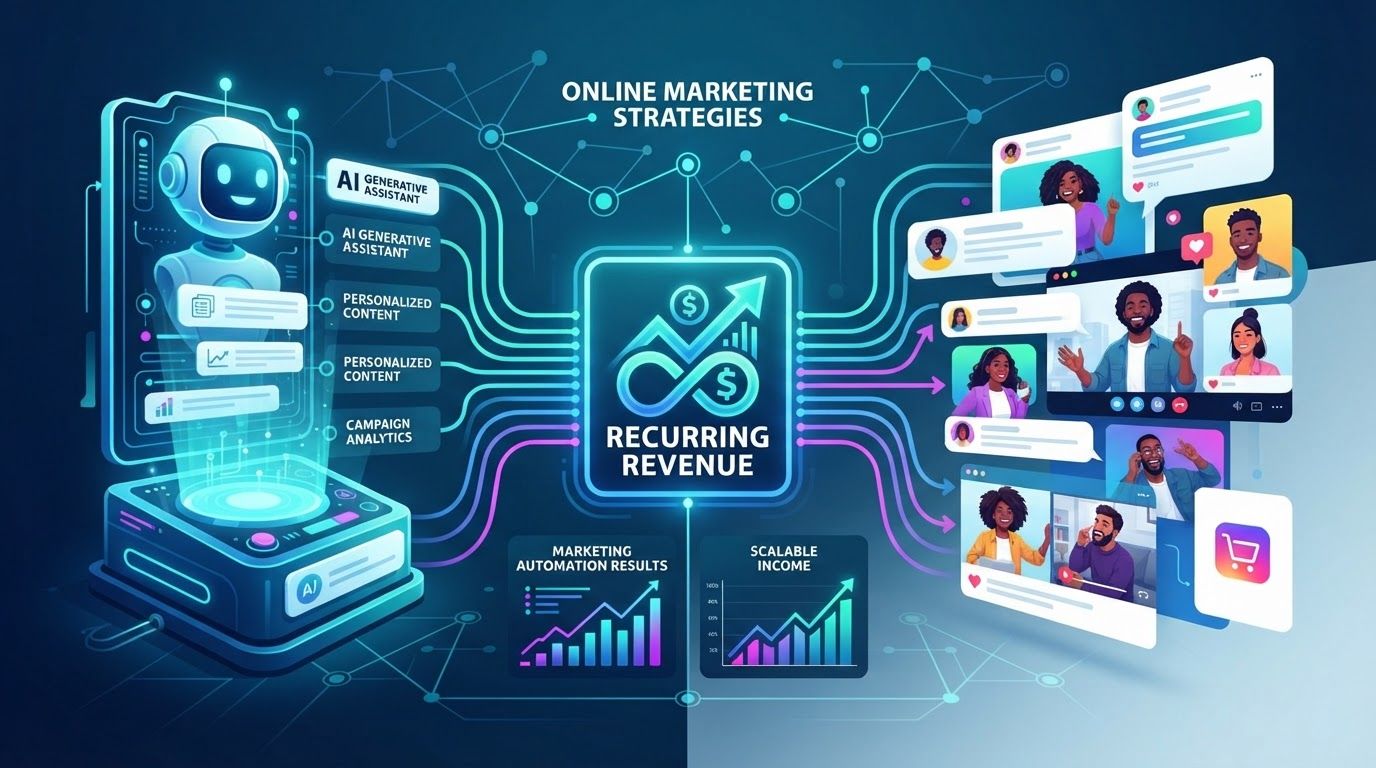
A one-off creator post can introduce a product, but it rarely gives a brand a dependable way to bring customers back. To build recurring revenue with generative assistants and creator networks, brands need an ongoing system: trusted creators make useful content, AI helps the team run that work consistently, and a clear path lets audiences buy again or subscribe when the offer fits.
That system is becoming more relevant to small brands, affiliate marketers, and home-based entrepreneurs. IAB projects U.S. creator economy ad spend will reach $37 billion in 2025, while Later reports that 70% of leading brands prioritize ongoing creator partnerships over one-time activations. Neither figure promises recurring income for an individual business. Together, they explain why it is worth learning how to turn creator relationships into a measurable, repeatable channel rather than treating every collaboration as a fresh campaign.
What recurring revenue from creator networks actually means
Recurring revenue is income that returns because customers continue paying, renew a subscription, or make repeat purchases. Creator networks can help generate that demand, but the arrangement with creators is not itself a revenue model. A brand could pay creators every month and still lose money if their audiences do not buy, stay, or come back.
Brands use generative assistants and creator networks to support recurring revenue by partnering with trusted creators over time, using AI to speed up research and content operations, and directing interested audiences to products, subscriptions, or storefronts designed for ongoing purchases. They measure repeat behavior and retention, not just views from the first post.
Consider an illustrative home-based business selling downloadable meal-planning resources. One creator might demonstrate a weekly planning routine; another might explain how to adapt it for a busy household. An AI assistant can help organize common questions and draft follow-up ideas. If the business offers a genuinely useful membership with fresh resources, those creator introductions could lead to monthly subscribers. If it sells only a single download, a repeat-purchase path might make more sense than forcing a subscription.
The important distinction is between recurring creator activity and recurring customer value. A steady publishing schedule creates opportunities to be discovered. Customers keep paying only when the product continues to solve a problem. Before recruiting anyone, write down what a buyer would reasonably want next month and why the creator’s audience would care.
There are also two different beneficiaries. A brand may earn repeat sales or subscription fees from customers. Creators may earn ongoing partnership payments, affiliate commissions, or fees from their own communities. Epidemic Sound’s 2025 report shows how varied creator income has become: it lists live streaming at 32%, ad revenue at 29%, fan subscriptions at 27%, platform creator funds at 27%, and brand partnerships at 27%. Those categories describe creator income streams; they do not mean a brand earns a subscription every time it works with a creator.
Choose creator partners for fit, trust, and repeatable work
A creator network is more useful when its members can explain the product credibly than when it simply reaches the largest possible audience. IAB says 58% of brands prioritize creator reputation and 56% prioritize audience alignment when choosing creators. For a beginner with a limited budget, those priorities offer a practical filter: find people whose existing content, audience questions, and communication style match the offer.
Start by describing the customer’s problem in everyday language. Then look for creators who already help that kind of customer make decisions. An affiliate marketer promoting software, for example, might look for educators who demonstrate real workflows instead of creators who mostly post broad lists of deals. The first group may be better placed to answer follow-up questions and show why the tool remains useful after signup.
- Audience fit: Does the creator regularly speak to people who have the problem your product solves?
- Reputation: Are recommendations explained clearly, with room for drawbacks and realistic expectations?
- Product familiarity: Can the creator use or review the offer well enough to answer questions without relying on a script?
- Content durability: Could their tutorials, comparisons, or demonstrations remain useful beyond launch week?
- Working fit: Can both sides agree on feedback, approvals, compensation, disclosures, and a sustainable cadence?
A small network of complementary creators can cover different customer questions without asking every person to deliver the same pitch. One might excel at first-use tutorials, another at practical comparisons, and another at answering objections from an established community. That variety creates more useful entry points into the buying journey while preserving each creator’s voice.
Long-term work changes the relationship, too. Later argues that ongoing partnerships become more repeatable as creators absorb a brand’s voice and product expertise. That does not mean creators should sound like brand employees. It means the next demonstration can build on what they learned from customer questions, previous content, and actual product use.
Before offering a standing agreement, test a modest collaboration with a clear brief and an agreed way to assess results. Give the creator room to say what does not fit their audience. If the product requires exaggerated claims to sound appealing, more AI-generated copy or a bigger network will not fix the underlying offer.
Use generative assistants to support the creator workflow
Generative assistants are best treated as working tools for preparation, organization, and iteration, not as substitutes for a creator’s judgment. IAB says three in four brands are using or planning to use AI for creator-marketing tasks. Deloitte reports that 94% of brands working with content creators are currently using or planning to use generative AI. These findings come from different sources and describe different groups, so they should not be combined into one adoption rate.
Creators are experimenting as well. Adobe’s 2025 Creators’ Toolkit Report found that 86% of global creators use creative generative AI, 76% say it has helped grow their business and personal brand, and 60% used more than one creative generative AI tool in the past three months. Deloitte found that around three in five creators anticipate using generative AI in their businesses, with generating new content ideas the top expected use. The opportunity for brands is to build a workflow that helps creators work faster without taking authorship or trust away from them.
Give the assistant a narrow, useful job
For a small team, an assistant might turn approved product documentation and anonymized customer questions into a list of possible tutorial topics. It might group feedback by theme, draft an outline for a creator to change, or produce several versions of a brief for different audience needs. Someone who knows the product still needs to verify facts and decide which ideas deserve publication.
- Collect reliable inputs: Assemble current product details, pricing, common questions, brand boundaries, and examples of claims you can substantiate.
- Identify one customer question: Ask the assistant to suggest ways a creator could answer it through a demonstration, comparison, or explanation.
- Let the creator adapt the idea: The creator chooses the example, language, and format that will make sense to their audience.
- Review before publishing: Check product claims, links, required disclosures, and whether the content still sounds like the person sharing it.
- Feed learning back in: Use actual audience questions and buying behavior to refine the next brief rather than generating endless variations of the same post.
That process works for recurring programs because each round starts with something learned from the last one. A one-off launch often ends when the post goes live. An ongoing program can update tutorials, answer objections, and introduce relevant next steps as customer needs become clearer.
Keep people responsible for the final recommendation
AI can draft a persuasive description of a product it has never tested. That is precisely why the creator and brand need an explicit review process. Ask the creator to distinguish personal experience from information supplied by the brand, and do not encourage them to claim results they have not seen. A practical review protects the audience as well as the partnership.
Deloitte also notes that generative AI could allow creators to expand revenue streams without always being on camera, including possibilities around creator alter egos. That idea may suit some creators, but it is not a default shortcut for brand content. An AI-powered proxy needs the creator’s informed permission, clear boundaries for what it may say, and a way to correct mistakes. For many small programs, improving research and follow-up is a better first use of AI than trying to simulate a person.
Match the creator program to a real recurring offer
Not every product needs a membership. The right monetization path depends on what the customer genuinely needs after the first purchase. A creator can introduce an offer, explain how to use it, and remind interested people that help is available. The product must still earn the next payment.
Subscriptions and memberships are the clearest case of recurring payments. eMarketer describes creator subscription revenues as recurring fees charged for access to content. A brand might similarly offer continuing access to training, resources, software, or a community, but it should be clear what new or continuing value the customer receives. Creators can help potential members understand who the offer serves, what participation looks like, and when it would not be a good fit.
Repeat-purchase products take a different route. If customers regularly need a consumable item or updated resource, creator content can teach people how to choose, use, and replenish it. The return visit should arise from the customer’s need, not from relentless reminders. A brand should check whether repeat orders are actually occurring before calling this a recurring-revenue channel.
Affiliate and partner programs can create ongoing earnings for creators or home-based publishers when their recommendations continue to lead to eligible purchases. For the brand, those purchases may be first orders, repeat orders, or subscriptions; the payment arrangement alone does not tell you which. Put the commission terms, tracking window, refund treatment, and any recurring commission rules in writing so both sides understand what a successful referral earns.
Creator-owned communities offer another path. A creator may run a paid community or subscription independently and occasionally partner with a relevant brand. That can put a brand in front of an engaged audience, but the community relationship belongs to the creator unless the parties clearly agree otherwise. Brands should not assume access to members’ data or ongoing attention simply because they sponsored content.
These models can also work together. A creator might publish an educational tutorial with an affiliate link to a brand’s software, then help a new customer understand a feature that makes renewal worthwhile. The brand benefits only if the customer receives enough value to continue. The creator benefits when the terms fairly reward the work involved in the introduction and any continuing support.
Before building a network, choose the primary customer action you want to support. Is it a first subscription, a second order, an upgrade, or a return visit to a useful resource? Build the content and landing experience around that action. Trying to optimize every creator post for every possible revenue stream usually makes the recommendation confusing.
Connect creator content to storefronts and AI product discovery
Even strong creator content can lose momentum if an interested viewer cannot find the recommended product or understand what to do next. A dedicated creator storefront, product page, or clearly organized collection can make the transition from recommendation to evaluation easier. The destination should match what the creator actually discussed, rather than dropping everyone onto an unrelated homepage.
impact.com says creator storefronts can let creators keep their own voice while remaining on-brand. For a recurring-revenue offer, that suggests a useful design principle: allow the creator to organize recommendations around their audience’s needs, while the brand keeps product information, availability, and purchase terms accurate. A storefront can support repeat purchases by giving customers a familiar place to return, but it does not generate repeat orders by itself.
Creator commerce tools are also expanding beyond simple links. In June 2026, impact.com said it launched AI and creator capabilities intended to help brands discover partners, drive conversion, scale creator content, and automate partnership workflows. These are platform capabilities and stated goals, not proof that every user will see more revenue. A small business should evaluate tools by the specific work they remove and the visibility they provide into outcomes.
Discovery may begin before someone reaches a social post or storefront. MagicLinks launched AI Shelf in March 2026 to help brands appear in AI-generated product discovery, using creator content alongside metadata, compliance, and revenue optimization. That development points to a practical concern for publishers and brands: useful creator content needs accurate product names, descriptions, and links if it is going to be understandable and discoverable across different environments.
For an affiliate or home-based entrepreneur, a manageable starting point is to connect one useful piece of creator content to one relevant destination. Check that the page answers the question that brought the visitor there, states the price and commitment clearly, and provides an obvious next step. If the offer renews, explain what the customer receives over time. If it is a one-time purchase, do not imply it is a membership simply to make the revenue story sound stronger.
Later says creator-driven commerce can generate trackable, attributable revenue from recommendations through purchases. It also highlighted $1.4B in Mavely link revenue in 2025, an indication of the scale a creator network can reach. That figure is not a forecast for a new program, nor is link revenue interchangeable with a small brand’s profit. Use it as context for why connecting content, destinations, and measurement matters.
Measure repeat behavior, not just creator reach
Views and clicks can tell you whether a recommendation attracted attention. They cannot tell you whether customers stayed. A recurring-revenue program needs to follow the customer journey far enough to see what happened after the first conversion, while respecting the limits of its tracking tools and customer data.
Start with a simple measurement plan that both the brand and creators understand. Give each partner an appropriate trackable link, code, or landing page, and record when their content runs. Keep an eye on what the destination promises: a highly clicked post that leads to the wrong product page may create confusion rather than a durable customer relationship.
- First conversion: How many referred visitors buy or subscribe, and which offer do they choose?
- Repeat behavior: Do referred customers renew, reorder, or make another qualifying purchase?
- Customer value: Does the revenue from that customer cover the relevant creator compensation, discounts, fulfillment, and service costs?
- Content usefulness: Which tutorials or explanations bring qualified visitors and answer questions that otherwise block a decision?
- Partner experience: Are creators able to make accurate content without excessive revisions or unclear payment expectations?
If you sell subscriptions, compare retention among customers referred by different content or creator types, using a consistent time period. If you sell repeat-purchase products, look at whether a second order happens and what the customer bought. These comparisons are more informative than a single large sales number because they show whether the channel is attracting people who actually benefit from staying.
Attribution still has limits. A customer may watch a creator, search for reviews, receive an email, and then purchase through a different link. A code can identify some sales without proving that the code holder caused every purchase. Treat tracking as evidence for decisions, not as a perfect record of every influence. When evaluating a partner, combine transaction data with the quality of their explanations and the questions their audience asks.
Review economics at the level of a sustainable program. A creator fee, affiliate commission, AI tool subscription, editing time, and customer support all have costs. Repeated sales do not help if the business consistently spends more to acquire and serve those customers than it earns from them. Equally, cutting creator compensation to improve a spreadsheet can damage the very relationships that make an ongoing program possible.
Protect trust, creator rights, and the customer experience
AI can help a small team publish more consistently, but more content is not automatically better content. IAB identifies the possible loss of authentic human connection as a top concern around AI in creator marketing. The safeguard is not to ban every assistant; it is to decide which tasks can be automated without pretending that a machine has a creator’s experience or an audience’s trust.
Agree on rights and responsibilities before asking a creator to contribute reusable assets. Clarify where their content may appear, whether it can be edited or repurposed, how long the brand may use it, and whether any AI tool may process their image, voice, or work. An agreement to publish a tutorial should not be treated as blanket permission to create an alter ego or train a system on the creator’s materials.
Disclosure and accuracy deserve the same attention. Creators should be able to explain the commercial relationship clearly and follow applicable requirements. Brands should supply correct product information, flag changes promptly, and make it easy to remove outdated claims. These habits matter even more in an ongoing program, where old content may remain discoverable while the product changes.
Automation can also create an operational bottleneck if no owns the final decision. Set a clear approval path: the brand checks product facts and offer terms; the creator checks whether the message reflects their experience and audience; and a designated person resolves disagreements before publication. Keep feedback specific. Rewriting every sentence into generic promotional language is a quick way to erase the reason the partnership was valuable.
Finally, make it easy for a customer to leave or seek help. A subscription should explain renewal and cancellation plainly. A repeat-order program should not hide the difference between an optional reminder and an automatic purchase. Trust is not just a creator-selection criterion; it is what the customer experiences after clicking.
Build a small, repeatable program before scaling the network
You do not need a large marketplace, a virtual spokesperson, or a complex automation stack to begin. A modest program can test whether the offer, creator fit, and follow-up experience work together. Scaling comes after you understand what customers value and what it costs to deliver it.
- Define the ongoing value: Identify the subscription benefit, repeat-use case, or next purchase that would matter to a satisfied customer. If no credible reason to return exists, improve the offer before promoting a recurring-revenue strategy.
- Choose a focused partner group: Find a small number of creators with relevant audiences and complementary strengths. Discuss their product questions and preferred formats before setting output targets.
- Create a shared brief: Include verified product details, the customer problem, compensation terms, disclosure expectations, approved links, and boundaries for AI use. Leave space for creators to explain the offer in their own words.
- Support one content cycle with AI: Use an assistant to organize questions, suggest outlines, or summarize feedback. Have people verify every claim and approve the final material.
- Connect content to a useful destination: Send visitors to a product page, creator storefront, or membership explanation that matches the recommendation and makes the ongoing value clear.
- Review the full journey: Check initial purchases, repeat behavior, customer feedback, partner costs, and points of confusion. Keep what works, revise what does not, and agree with creators on the next useful question to answer.
Once that cycle is working, consider where additional partners would add a distinct perspective rather than duplicating existing content. AI-powered matching may eventually help with that search: Epidemic Sound found that 27% of creators anticipate AI-powered creator marketplaces that automatically match them with brands, briefs, and licensing opportunities. A match can introduce a promising partner, but a conversation about audience fit, creative freedom, and terms remains essential.
There are sensible alternatives to expanding the network, too. If customers abandon a confusing checkout, improve the purchase experience before recruiting more creators. If a single trusted partner produces strong tutorials, deepen that relationship rather than adding several shallow ones. If renewals are weak, talk to customers and improve the product instead of producing more acquisition content. AI is useful when it helps the team see and act on those decisions, not when it merely increases the number of posts.
Generative assistants and creator networks can make recurring revenue more achievable by helping brands keep useful recommendations, product education, and customer feedback connected. The durable advantage comes from the combination: a product worth returning to, creators whose audiences trust them, a workflow that preserves their judgment, and measurement that looks beyond the first sale.
Start with one recurring customer need and one creator partnership that can address it honestly. Build the content-to-purchase path, check what customers do next, and use AI to reduce the busywork you can safely delegate. If the experience earns a second purchase or a renewal, you have a foundation worth repeating.

No comments:
Post a Comment