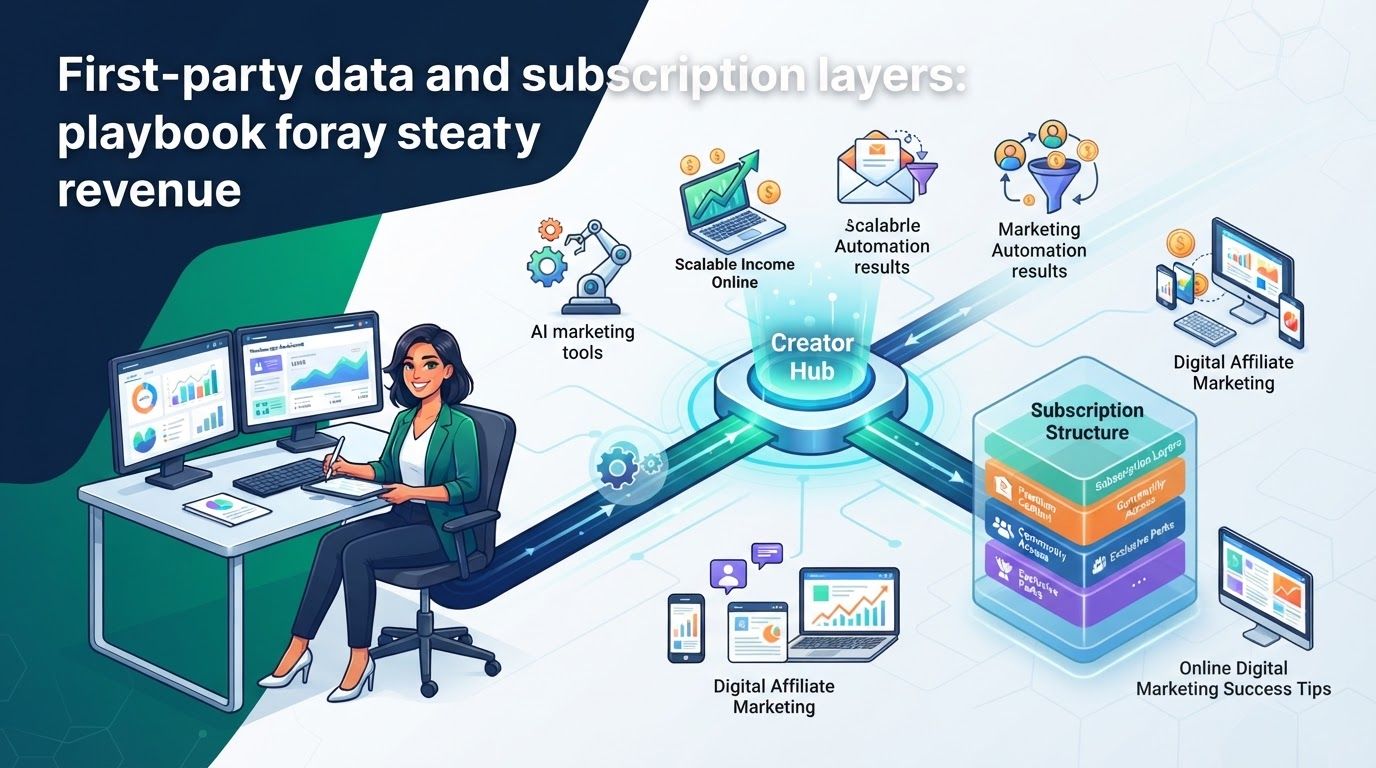
Social reach can introduce people to your work, but it cannot guarantee that you will reach the same people next month. A practical first-party data strategy gives creators a direct way to learn what their audience needs, while subscription layers turn some of that ongoing relationship into revenue that is less dependent on the next viral post.
For an affiliate marketer or home-based entrepreneur, this does not mean abandoning social media, sponsors, or affiliate links. It means giving each channel a job: use public content for discovery, collect useful audience signals with permission, offer a free relationship worth keeping, and make the paid option valuable enough to renew. Here is how to build that system without turning your business into a complicated data project.
Why first-party data belongs at the center of creator revenue
The short answer: Attract people through public content, invite them into a useful free email or membership experience, learn their preferences with consent, and offer a paid layer that delivers deeper or more consistent value. Measure engagement and renewals, not just follower counts or signups.
First-party data is information people share with you directly or generate through their interactions with your own site, emails, products, or membership. For a small creator business, it may be as simple as an email address, a stated topic preference, a purchase record, and a record of which emails a subscriber chooses to open or click. It is not a license to collect everything you can technically track.
The distinction matters because a follower on a social platform is not the same as someone who has chosen to hear from you directly. You can publish to followers, but the platform controls much of the distribution and the tools available for maintaining that relationship. An email list or member account gives you a more direct path to serve people, subject to their consent, your provider’s rules, and their ability to leave.
The broader market reflects this shift. IAB’s 2024 State of Data report describes the move toward first-party data as a response to legislation and signal loss. It reports adoption among publishers at 80%, compared with 67% for brands and 64% for agencies. Those figures describe different industry groups, not a promised outcome for an individual newsletter, but they show why direct audience relationships have become a strategic priority.
That priority does not make advertising irrelevant. IAB projects U.S. creator ad spend of $37 billion in 2025, up 26% year over year, and says creator advertising more than doubled from $13.9 billion in 2021 to $29.5 billion in 2024. Growing budgets create opportunities for sponsorships and affiliate partnerships. They do not remove the planning risk of relying on someone else’s budget, referral traffic, or algorithm for every payment.
Think of first-party data as the connective tissue of a diversified business, not as a separate product you need to sell. A person might find your tutorial through a short video, subscribe for a free checklist, tell you which business model they are building, buy a relevant tool through your disclosed affiliate link, and later join a paid workshop library. Each step should help that person make progress; each signal should help you make the next step more relevant.
Collect first-party data with a clear value exchange
The easiest place to begin is not a new analytics dashboard. It is the point where a visitor decides whether to give you a way to contact them. If your signup form asks for an email address, explain what they will receive, how often you intend to send it, and why joining is useful now. A vague invitation to receive updates makes both consent and future engagement harder.
Start with a small set of data you can actually use:
- Contact details: An email address lets you deliver the resource or publication the person requested. Ask for a name only if it improves the experience.
- Declared interests: A simple choice, such as affiliate content, AI workflows, or digital products, can guide future examples and recommendations.
- Relationship status: Knowing whether someone is a free subscriber, customer, or paid member prevents you from repeatedly pitching a product they already own.
- Useful interaction signals: Clicks on clearly labeled topics or responses to a short survey may reveal needs more directly than a long, mandatory intake form.
Make the first interaction light. You can ask one optional preference when someone subscribes, then invite more detail after they have received value. A subscriber who joined for an AI-assisted email workflow does not need to answer a detailed business questionnaire before receiving that workflow. Progressive questions also give people a reason to share information: they can see how it will improve what you send.
Consent should be understandable at the point of collection. IAB’s 2025 Consumer Privacy Report says awareness of privacy laws is growing, but only 40% of consumers know they can access or delete collected data. Do not assume every subscriber understands what a signup implies. Use straightforward language, make your privacy information easy to find, and provide a practical way to change preferences or stop receiving messages.
Data minimization is a useful operating rule for a solo business. IAB’s 2025 state privacy survey highlights industry attention to sensitive personal information, secondary-use limits, vendor due diligence, de-identification, and data minimization. In everyday terms, avoid collecting sensitive details you do not need, avoid repurposing an answer for an unrelated campaign without an appropriate basis, and review what each email, checkout, analytics, or automation vendor can access. If your operation has legal obligations you are unsure about, get appropriate professional guidance rather than treating a generic signup template as a compliance plan.
There is a business benefit to restraint. A small, understandable profile is easier to maintain than a sprawling database of stale tags. Before adding a form field or tracking event, ask: What decision will this help me make, and how will the subscriber benefit? If you cannot answer both questions, leave it out for now.
Build a free layer that earns attention and reveals intent
Your free layer has two jobs: help new people discover your expertise and give interested people a good reason to stay in touch. It is not simply the leftover content you do not think you can charge for. For many home-based entrepreneurs, a useful free layer includes public tutorials, searchable articles, social posts that demonstrate a result, and an email publication that turns scattered tips into a coherent learning path.
Begin with one audience problem rather than a broad promise to help everyone make money online. An affiliate marketer might teach beginners how to evaluate software before recommending it. An AI-focused creator might help solo operators turn a rough idea into a repeatable content workflow. Specificity helps visitors decide whether to subscribe, and it gives you clearer signals about what a paid offer could deepen later.
Give every discovery channel a next step
A public post can answer a question fully while pointing readers to a related resource. For example, an article about comparing email platforms could link to a free evaluation checklist. The checklist can invite subscribers to choose the obstacle they face next: setting up their list, planning emails, or measuring results. Those choices are more actionable than guessing from a follower count.
Keep the handoff honest. If a free resource is promised, deliver it without burying it behind an unexpected sales sequence. Then welcome subscribers with a short orientation: what you publish, where to find your strongest free material, and how they can tell you what they are working on. A reply invitation can be useful when you have the capacity to read and act on replies; otherwise, a brief preference link may be easier to sustain.
Do not confuse a large top-of-funnel audience with a committed one. IAB’s earlier data notes that publishers historically knew only around 20% to 30% of their audiences deterministically. That context helps explain the push toward signups and membership systems: many visitors are otherwise difficult to recognize across visits. It does not mean every anonymous visitor should be forced into a registration wall. A free article can still build trust even when the reader does not join immediately.
The right boundary between public and free email content depends on the business. If search traffic brings in new readers, keep enough genuinely helpful information public for them to assess your work. If your audience values an ongoing decision process, use email to organize lessons and follow-ups. The free layer should stand on its own while making the added value of membership easy to understand.
Design subscription layers around repeat value, not a paywall
A paid subscription is easier to maintain when it solves a recurring problem. Ask what your audience needs help with repeatedly: deciding which affiliate offer fits a particular reader, updating a workflow as tools change, reviewing work with a peer group, or getting regular feedback. The paid layer should deliver that continuing support, not merely move every useful free post behind a login.
Substack’s creator guides and case studies frame paid memberships around deeper analysis, extra content, and recurring access after a free audience has been built. That is a helpful design principle, not a universal recipe. A creator teaching automation might publish free explanations of what a workflow does, then offer paid implementation sessions, annotated templates, and a maintained library showing when to change the workflow. An affiliate educator might give free product-evaluation criteria and reserve detailed decision walkthroughs or live reviews for members.
Before selecting a platform or price, write a simple promise for each layer:
- Public: What can someone learn without signing up, and why would they trust your approach?
- Free subscriber: What useful resource or continuing perspective do they receive by inviting you into their inbox?
- Paid member: What deeper access, saved work, or recurring support makes the subscription worth keeping?
Each promise should be distinct without making the free audience feel tricked. A free subscriber might receive the strategy and a practical starting point; a paid member might receive guided application and ongoing updates. Avoid promising constant personal access if you cannot deliver it. A modest, dependable benefit is better than an ambitious calendar that collapses when client work or family commitments increase.
Subscription platforms are seeing meaningful activity, but platform-wide growth is not your individual forecast. beehiiv says paid subscription revenue on its platform reached $19 million in 2025 and projects $35 million in 2026, with the number of creators earning through subscriptions doubling. Substack reports that Scott Galloway’s No Mercy / No Malice newsletter reaches more than 400,000 subscribers as his media business moves more content into a subscription-first home. Both examples demonstrate possibilities at different scales; neither tells a beginner what their own list will convert or what they should charge.
One Substack case study reports 108 paid subscribers, 6,421 free subscribers, and a 1.7% free-to-paid conversion rate. Treat that as an example of how a modest share of a free list can support a paid layer, not as an industry benchmark or a target that guarantees profitability. Your own result will depend on the audience, offer, price, delivery costs, and how long members stay. Work backward from a benefit you can deliver consistently, then test whether real subscribers value it enough to join and renew.
Make retention part of the offer from day one
Acquisition gets the first payment; retention determines whether a subscription becomes dependable. A member who signs up for a promised library but cannot find the relevant lesson may leave even if your next launch brings in new customers. Design the first paid experience as carefully as the sales page.
Give new members a clear starting path. A short welcome message can explain where to find core resources, what happens next, and how to ask for help or send feedback. Organize older material around tasks rather than publication dates alone. For an AI automation membership, that might mean paths for planning a workflow, checking its output, and deciding what to automate next. Members should not need to search through months of posts to locate the benefit they purchased.
Choose a cadence you can keep
Recurring value does not require publishing every day. It requires a reliable rhythm and a reason to return. A membership might offer updated templates, regular implementation guidance, or a scheduled discussion around a specific challenge. State the rhythm plainly so people know what they are buying, and leave room to refine it based on member use rather than adding features each time someone requests one.
Look for signs of friction before a cancellation arrives. Are members finding the starting material? Which resources lead to questions or useful results? Are support requests revealing a missing explanation? Invite feedback without demanding that every quiet member engage publicly. Some people will pay to access a resource privately and still receive real value.
Deloitte’s 2026 Digital Media Trends says 57% of Gen Z canceled a subscription video-on-demand service in the previous six months, up seven points from fall 2025. Video streaming is not a direct comparison with a creator newsletter or community, so that figure should not be used as a forecast of your churn. It is a reminder that recurring billing alone does not create loyalty. Continued relevance, easy access to the promised value, and a clear sense of what comes next matter more than a clever checkout page.
Offer a way to leave without unnecessary friction, and pay attention to why members say they go. If many people leave after finishing a specific project, a one-time course or product may fit that need better than an indefinite subscription. If people continue to need guidance, updates, or community, the recurring model may be appropriate. Let the shape of the problem determine the billing model, not the other way around.
Combine subscriptions with affiliate, product, and sponsor revenue
A subscription layer should make the business less fragile, not force every reader into the same purchase. Some people want a free recommendation, others want a one-time template, and some want ongoing help. A useful revenue stack gives those preferences room while keeping your editorial judgment clear.
- Affiliate offers: Recommend relevant tools or services where they genuinely help a reader complete a task. Explain the fit, limitations, and commercial relationship rather than treating an affiliate link as the answer to every question.
- Digital products: Sell a focused template, guide, or workshop when the buyer needs a defined outcome they can work through at their own pace.
- Paid subscriptions: Charge for continuing analysis, updates, feedback, or access that remains useful beyond a single purchase.
- Sponsorships: Accept compatible partnerships when they support the publication without replacing the audience’s interests as the basis for content decisions.
beehiiv describes paid subscriptions, digital products, and community memberships as a financial foundation for independent media. IAB also says brands increasingly treat creators as a full-fledged channel. Together, those observations support a hybrid approach: direct reader revenue can sit alongside advertising and commerce. They do not mean every creator needs every revenue line at once.
For a new business, a sensible sequence is to establish the free relationship, observe what people ask for, and test the simplest paid answer. An affiliate link may suit a tool-comparison lesson; a downloadable product may suit a repeatable task; membership may suit a problem that evolves. If a sponsor is involved, keep the distinction between editorial advice and paid placement understandable. Trust is an asset across every layer, and confusing recommendations with sales pressure can weaken all of them.
There is also a platform trade-off. Hosted newsletter and membership tools can reduce setup work, but they can shape billing options, fees, discovery, and the ways you can connect data to other systems. Patreon, for example, said Apple renewed a requirement for creators to move to subscription billing by November 1, 2026. You do not need to predict every platform change; you do need to understand your current provider’s export, billing, and communication options before making it the only home for your business.
Choose tools according to the offer you can deliver now. A complicated community stack is unnecessary if members mainly want an excellent monthly implementation guide. Equally, an email-only setup may be frustrating if the core promise is hands-on discussion. Keep the audience relationship and your ability to serve it at the center of the decision.
Use simple automation and measurement to improve the relationship
Automation helps when it removes repetitive handoffs without pretending to replace your judgment. A beginner-friendly system might connect a signup form, an email platform, a checkout, and a place to organize member content. Each connection should answer a practical question: Did this person receive what they requested? Which layer are they in? What should they see next?
A minimal workflow could look like this:
- Capture: A person signs up for a specific free resource and sees a clear explanation of the emails that follow.
- Deliver: An automated welcome email sends the resource and points to an appropriate starting article.
- Learn: An optional preference choice helps route future examples without requiring a long profile.
- Recognize: A completed purchase changes the person’s status so they receive member onboarding instead of another new-member pitch.
- Review: You inspect engagement, questions, purchases, and cancellations, then improve the content or offer.
AI can help draft variations of a welcome message, summarize recurring questions, or outline lessons for different audience interests. Review the output before publishing, especially when it discusses income claims, privacy, or product capabilities. Do not paste sensitive subscriber details into a tool merely because it can generate a convenient summary. The goal is to spend less time moving information between systems and more time making sound decisions for readers.
For measurement, begin with events that correspond to real steps: signup completed, resource delivered, member checkout completed, onboarding started, and renewal or cancellation recorded. IAB’s 2025 internet ad revenue report says advertisers are embedding events and conversion APIs into proprietary data stacks to improve measurement and privacy-safe signal infrastructure. A small creator does not need an enterprise implementation to learn from that principle: define meaningful actions and keep their records accurate.
More advanced publishing businesses may need connections between a newsletter, customer relationship management system, checkout, and analytics. beehiiv’s 2026 enterprise post points to CRM sync, APIs, webhooks, cross-publication analytics, and attribution reporting as ways publishing data can become part of a broader business stack. For a solo operator, start by checking that contact status and purchases agree across the tools already in use. Add an integration only when a manual process is causing errors or consuming time you could use to serve the audience.
Attribution has limits. A reader may see several free posts, return through search, and subscribe later from an email forwarded by a friend. A dashboard can record the visible steps without proving which single touch caused the decision. Use reporting to find patterns and broken handoffs, not to claim that every conversion has one certain source.
Roll out the revenue playbook in manageable stages
You do not need a polished membership, elaborate segmentation, and a full automation system before you start. Build in stages so each decision is informed by what people actually do. The objective is a working relationship you can improve, not a launch with the most moving parts.
Stage one: clarify the audience and the free promise
Choose the specific person you can help and the recurring problem you understand. Publish a useful public piece, create a related free resource or email series, and make the invitation to subscribe clear. Check the signup experience yourself on the devices your readers are likely to use. If the promised resource is hard to access, fix that before seeking more traffic.
Stage two: learn without overcollecting
Ask a small optional question about the subscriber’s current goal, or invite a reply to an email with a specific prompt. Look for repeated needs in the responses, content interactions, and questions you already receive. Keep notes on patterns without building detailed personal profiles you do not need. Review your privacy explanation and vendor settings while the system is still simple.
Stage three: test one paid outcome
Describe a paid benefit that builds naturally on the free material. It might be a focused digital product if the problem has a clear endpoint, or a subscription if members need updates, access, or continued support. State what is included, what is not included, and how people will receive it. Ask early buyers which part they use, rather than assuming a sale proves every feature is valuable.
Stage four: improve renewals and only then add complexity
Make onboarding clear, deliver on the promised cadence, and review where members struggle or leave. If you see a recurring gap, improve the resource, explanation, or support path before adding another tier. Once the core offer works, consider more refined segmentation, integrations, or a complementary sponsor or affiliate arrangement.
Keep a small review routine centered on decisions you can make. Compare where subscribers came from, which free topics attract engaged people, which paid benefits members use, and whether the workload remains sustainable. Do not chase a single conversion figure in isolation. A higher signup count is not automatically better if the offer is unclear, and a new paid signup does not cancel out the loss of a member who could not find the promised value.
The plan can change as the business teaches you more. If your audience prefers one-off implementation help, keep a strong free publication and sell products or services rather than forcing a subscription. If people consistently return for guidance, a paid layer can give that work a dependable home. In either case, permission-based audience data helps you make the choice with more than guesswork.
Steady creator revenue comes from a useful relationship, not from replacing one dependency with another. Keep public content discoverable, make the free layer worth joining, collect only signals you can use responsibly, and reserve paid access for value you can deliver again and again.
Start with one clear signup promise and one audience question you genuinely need answered. Use what you learn to shape a focused paid offer, then improve the experience for people who join and stay. That is a more durable playbook than waiting for the next platform spike to decide what your business earns.