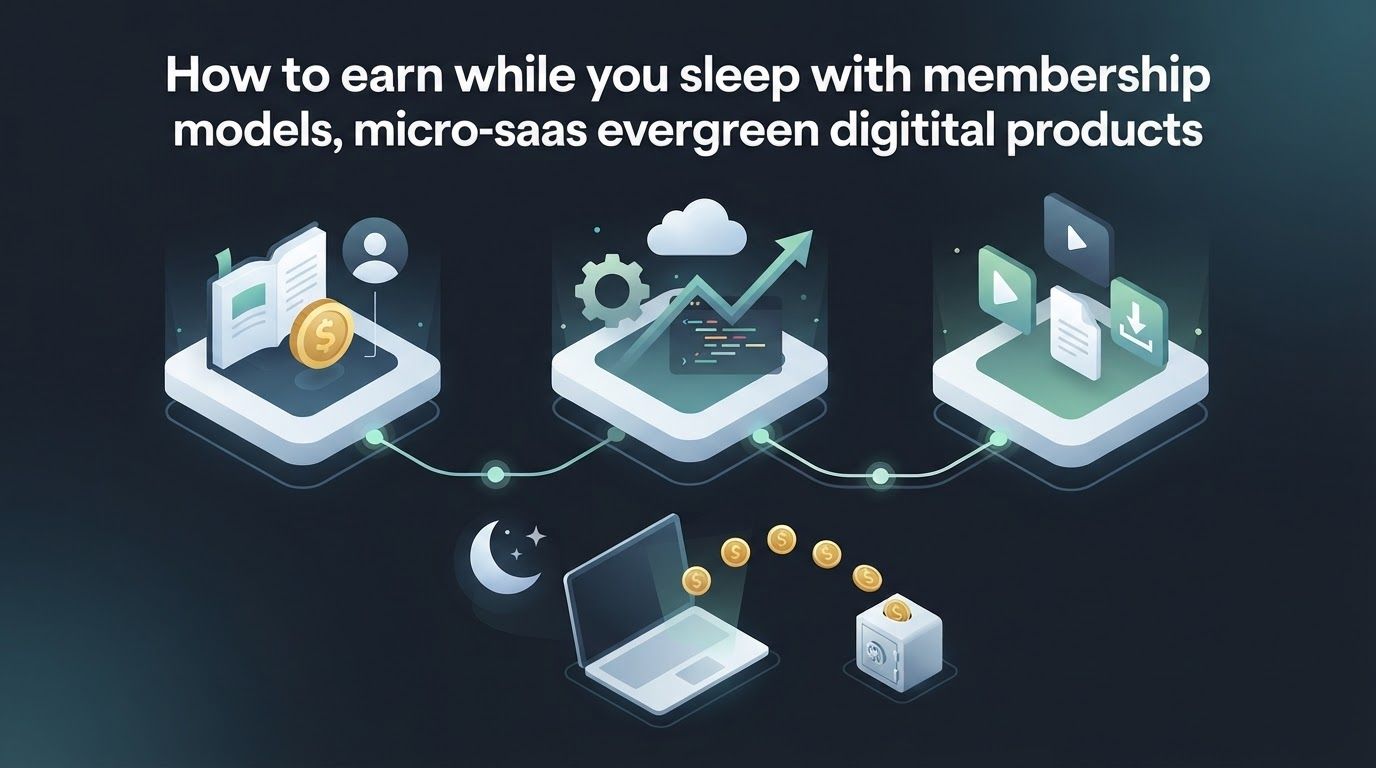
You want income that can arrive while you are offline, but a product that needs you to answer every question or deliver every order is still a job with an online checkout. To earn while you sleep, build an offer people can discover, buy, receive, and continue using without your real-time involvement.
Membership models, micro-SaaS, and evergreen digital products can each support that goal in a different way. The right choice depends less on which sounds most passive and more on what your audience needs, what you can deliver reliably, and how much ongoing support you are willing to provide.
What does it really take to earn while you sleep?
To earn while you sleep, sell a repeatable solution through an automated buying and delivery process. Use an evergreen product for a defined one-time outcome, a membership for ongoing value, or micro-SaaS for a task software can perform repeatedly. Then maintain the system through support, updates, and customer feedback.
The phrase describes when a sale or payment can happen, not a promise that the business runs without work. A customer might buy a guide at midnight, renew a membership while you are away, or subscribe to a small tool on a weekend. Behind each transaction are decisions about the offer, checkout, fulfillment, customer experience, and what happens when something breaks.
It helps to separate automated delivery from recurring revenue. A downloadable template can be delivered automatically but may generate only one purchase per buyer. A membership can collect recurring payments but still require you to create benefits and keep members engaged. A micro-SaaS tool can provide ongoing utility through software, yet demand maintenance and customer support.
- Evergreen digital product: A repeatable asset, such as a template, tutorial, or workbook, that customers can buy and access without a live appointment.
- Membership: A paid relationship built around continuing benefits, such as resources, community access, or new material.
- Micro-SaaS: A focused software product that solves a recurring problem for a specific customer group.
These are not mutually exclusive. An affiliate marketer could sell a campaign-planning workbook, invite buyers into a membership with updated examples, and eventually build a small tool that handles a repetitive part of the workflow. But you do not need all three to start. One clear promise and a dependable delivery path are more useful than three unfinished offers.
For home-based entrepreneurs, the practical test is whether each sale creates another obligation that must be fulfilled by hand. If it does, simplify the promise, package the work into a reusable resource, or charge enough to justify the service component. Automation should remove avoidable repetition, not hide work that customers were promised.
How do membership models create recurring income?
A membership is a good fit when customers benefit from continuing access rather than a single download. That might mean a curated library of marketing resources, a community for people working toward similar goals, or regularly updated implementation guidance. The recurring payment makes sense only if members can explain why staying is valuable.
Patreon describes paid memberships as a way to establish recurring income and a more sustainable creator business. Its reported scale, more than 10 million fans paying for memberships each month, more than 300,000 creators, and more than $10 billion earned by creators since 2013,shows that the model is established. Those figures do not tell you what a new membership will earn; they show that customers are willing to pay for ongoing creator relationships when the offer fits.
Build tiers around benefits you can actually sustain
Patreon identifies benefits and tiers as the two essential building blocks of a membership. Benefits can include bonus content, community access, behind-the-scenes material, and merch. For a solo entrepreneur, the safest starting point is often a small set of benefits that reuse your existing expertise without promising unlimited personal attention.
- Basic access: A resource library and a clear path to the most useful starting materials.
- Working level: Additional examples, updates, or structured discussion that help members apply the resources.
- Higher-touch level: Limited feedback or other personal access, with explicit boundaries on what is included.
These are illustrative tier structures, not prices or a requirement to offer three levels. If you cannot describe the difference between tiers in one sentence each, simplify them. A single well-defined membership can be easier to sell and manage than a complicated menu of benefits.
Pay close attention to premium-tier churn. Patreon has noted that a handful of joins or cancellations at a premium tier can change revenue significantly even if the overall member count barely moves. Track revenue by tier as well as total members, and avoid judging the health of your business by signups alone.
Make recurring billing and access predictable
Members should know what unlocks when they join, when they will be billed, and where to find their benefits. Patreon says members unlock membership access upon signup under its subscription-billing approach, and eligible creators can enable annual memberships. Its documentation also says the November 1, 2026 deadline to leave legacy billing has passed and remaining legacy accounts are being switched automatically. If you use a platform, check its current billing settings and explain the experience your own members will see rather than relying on an old setup tutorial.
The trade-off is that a membership creates a continuing promise. You may automate access, welcome messages, and resource organization, but members will still evaluate whether the benefits justify renewal. If you do not want an ongoing publishing or community obligation, an evergreen product may be a better first offer.
When is micro-SaaS a better fit than a membership?
Choose micro-SaaS when the customer needs a task done repeatedly, not just advice about how to do it. A focused tool might organize affiliate content ideas, turn a campaign brief into a reusable checklist, or monitor a workflow the user would otherwise repeat manually. The product should have a narrow job, an identifiable user, and a result that becomes obvious during early use.
The appeal is that software can deliver the core function whenever a customer logs in. The challenge is that software must continue working. Bugs, changing integrations, unclear onboarding, and support requests can consume time even when billing and account creation are automated. If your proposed tool depends on constant manual fixes or bespoke setup for every buyer, it may be a service wearing a SaaS label.
Start with a painful task, not a feature list
- Name the user. Be more specific than “marketers.” An affiliate publisher maintaining a large set of product recommendations has different needs from someone launching a first newsletter.
- Describe the repeated job. What does the customer do again and again, and what goes wrong when they do it by hand?
- Define the smallest useful result. Identify what a new user should accomplish before they decide whether to keep paying.
- Test willingness to pay. A compliment about an idea is not the same as a customer choosing to use and pay for a working solution.
ChartMogul’s 2026 research offers useful context for focused SaaS businesses: it reports that 53% of SaaS and AI companies reach $10,000 in monthly recurring revenue by targeting around 100 customers paying $100 a month. That is evidence that a relatively small base of paying customers can matter; it is not a forecast for your tool. The larger lesson is to identify a group with a valuable problem rather than assume you need a mass audience.
Design the first-use experience before adding extras
ChartMogul found that customers add seats at nearly ten times the rate in month one as in month eleven. For a tool that supports teams, this makes the first month an important window to demonstrate value and make collaboration easy. Even if your micro-SaaS sells to individuals, the principle is useful: show customers a meaningful outcome quickly, then let actual usage guide what you build next.
A practical onboarding flow might ask for only the information needed to produce a first result, show a sample output, and explain the next action in plain language. If a user must watch a long tutorial before receiving any value, revisit the product design before spending more on acquisition. Better onboarding cannot rescue a tool no needs, but confusing onboarding can prevent a useful tool from being understood.
How can evergreen digital products sell without live delivery?
An evergreen digital product is an asset that addresses a recurring buyer problem without requiring you to remake the solution for each sale. Examples include a campaign-planning template, a beginner’s implementation workbook, a recorded walkthrough, or a set of editable checklists. “Evergreen” does not mean permanent or never updated; it means the core offer remains useful beyond a single launch window.
The strongest products promise a specific outcome. “Everything I know about online marketing” is difficult to evaluate and maintain. “A worksheet for mapping one affiliate campaign from audience problem to follow-up emails” tells a buyer what the product helps them do. Specificity also makes your sales page, demonstration, and support materials easier to create.
- Choose a durable problem. Build around a task your audience will continue to face, not an interface screenshot or short-lived platform trick.
- Include instructions. A blank template can leave buyers guessing; a worked example shows them how to use it.
- Deliver access automatically. Make the purchase confirmation and download or access instructions easy to follow.
- Plan for maintenance. Keep a simple record of what needs updating when tools, policies, or examples change.
One-time products are especially useful when your audience wants a defined result without another subscription. They also let you test demand before promising ongoing benefits. Their limitation is that each sale does not automatically create the next one. You still need a way for new buyers to discover the product, and you may need additional products or an optional ongoing offer for customers who want more help.
A hybrid approach can bridge that gap. Patreon Shops, for example, lets creators sell digital products, posts, and collections as one-time purchases alongside memberships. Its supported formats include videos, podcast episodes, text, audio, images, and attachments. A standalone resource can serve buyers who are not ready to join, while the membership offers continuing value to those who are. Make the distinction clear so customers do not feel they must subscribe to use something advertised as a one-time purchase.
Evergreen delivery also creates a support opportunity: include a short “start here” note, a description of whom the product is for, and instructions for getting help if access fails. These small additions reduce confusion for buyers who purchase outside your working hours. They are part of the product experience, not merely administrative details.
Which model should you choose for your audience and capacity?
Start with the problem and the buying behavior, not the revenue model you find most exciting. If buyers want a finished resource they can use independently, sell a digital product. If they want continuing guidance, fresh resources, or connection with other members, consider a membership. If they repeatedly perform a task that software can simplify, investigate micro-SaaS.
Ask yourself what must happen after the first purchase. A one-time workbook can be updated when its instructions become outdated. A membership needs a dependable reason to renew. A software subscription needs a working product and a support path. Your available time, technical skills, and appetite for ongoing obligations should influence the choice as much as the potential revenue.
Match the first offer to the evidence you already have
If you already answer the same question for affiliate readers, turn the answer into a focused resource and see whether people use it. If customers repeatedly ask for new examples and peer discussion, a membership may be a natural next step. If they keep asking you to perform the same mechanical task for them, you may have found a candidate for software.
Look for behavior rather than enthusiastic comments alone. Which resource do readers return to? What do buyers struggle to implement? Which tasks do clients repeat despite having instructions? Those observations can reveal whether your next offer should provide information, continuity, or automation.
There is also a useful middle ground. You can sell an evergreen product without launching a membership, or run a membership without building software. You can use existing checkout and delivery tools instead of developing a custom platform. For a beginner, reducing operational complexity often gives you more room to learn what customers actually value.
Finally, keep any affiliate recommendations aligned with the customer’s goal. A tool recommendation can complement a tutorial or template, but it should not be the only way a buyer can make sense of what they purchased unless that dependency is clear before checkout. Trust is easier to maintain when your paid offer stands on its own merits.
What should AI and automation handle in the sales and delivery workflow?
Automation is most useful where a step is predictable and the correct outcome is clear. Connect the path from discovery to checkout, access, onboarding, and follow-up so a customer is not left waiting for you to wake up or come back online. Then review that path as a buyer would, including what happens when something goes wrong.
- Discovery: Publish helpful content that answers a real question and points readers toward a relevant offer when appropriate.
- Decision: Explain who the offer is for, what is included, how access works, and what ongoing payments, if any, mean.
- Purchase: Use a checkout that clearly confirms the transaction and sends the buyer to the right destination.
- Onboarding: Deliver a welcome message with a first action, access instructions, and a support route.
- Follow-up: Provide timely help based on the customer’s stage, rather than sending the same promotion to everyone.
For example, a workbook buyer might receive the download, a brief orientation, and a reminder of where to find the worked example. A new member might receive a guide to the resource library and a prompt to choose a starting path. A micro-SaaS customer might see a guided first task inside the product. Each message should help the person get the result they paid for, not simply move them into another sales sequence.
AI can help draft product descriptions, turn your notes into clearer onboarding instructions, organize common support questions, or suggest gaps in an existing tutorial. It can also help you repurpose a useful explanation into different formats. Review the output yourself, especially where instructions affect payments, technical setup, or claims about what a product can do.
Do not automate a confusing process without fixing it. If buyers frequently ask where their purchase is, improve the access page and confirmation first. If trial users cannot reach a first result, clarify the product experience before adding more reminder emails. Automation magnifies a workflow; it does not make a weak promise accurate or a broken journey helpful.
Keep a human route for exceptions. Refund questions, billing problems, account-access failures, and unusual support needs do not disappear because you have a welcome sequence. A practical system lets routine transactions proceed without you while making it easy to spot and resolve issues that require judgment.
How do you price, convert, and retain customers without guessing?
Conversion benchmarks can provide context, but they are not instructions to copy another company’s pricing. ChartMogul’s 2026 report found a median free-to-paid conversion rate of 8% across 200 B2B products, with free trials converting slightly better than freemium overall. That sample concerns B2B products; it should not be treated as an expected result for your creator membership or digital download.
The same research found that 57% of products used a free trial as the primary landing point and that 14 days was the most common trial length. Trials requiring a credit card upfront converted at 30% from free to paid, more than five times the rate of trials that did not require a card. Requiring payment details can signal commitment, but it also adds friction before someone tries the product. The better question is whether your audience understands the value well enough at signup to accept that step.
For micro-SaaS, measure whether trial users complete the action that demonstrates the product’s value, not only whether they register. For a membership, watch whether new members find and use the promised benefits. For a digital product, look for access problems and questions that suggest the instructions are incomplete. These observations help you improve the offer before you draw conclusions from a sales count.
Pay attention to renewals and customers who leave
ChartMogul reports that 40% of first-year plan upgrades happen in month twelve, when customers revisit renewal and upgrade decisions. If you offer annual software plans, prepare a clear account of what customers have gained and what an upgrade would add. Do not wait until a renewal notice to explain the value they have been receiving.
A cancellation is also a chance to learn. ChartMogul’s 2026 winbacks report says 45% of returning customers come back within 30 days and 66% within 90 days. Only 25% return on a lower-ARR plan, so a discount is not the answer to every departure. A timely, relevant follow-up may be more useful: tell former customers about a resolved problem, a meaningful improvement, or a feature that addresses their original need, while respecting their communication preferences.
For any model, keep a small, understandable set of measures: purchases, active subscribers where relevant, cancellations, support requests, and evidence that customers are using what they bought. Review results by offer or tier rather than relying on a single line number. A system that attracts buyers but does not help them succeed is not yet a durable income stream.
How can you launch one automated offer without building everything at once?
Begin with the smallest offer that delivers a complete result. You are not trying to prove that an entire portfolio of passive-income products works. You are trying to learn whether a particular audience will pay for a particular solution and whether you can deliver it reliably when you are not present.
- Pick one audience and problem. Write down who the offer serves and the task they need to complete. If your description could apply to anyone, narrow it.
- Choose the matching format. Use a product for a defined outcome, a membership for ongoing benefits, or micro-SaaS for a repeated task that needs a tool.
- Build the delivery path. Test the sales page, checkout, confirmation, access, and first-use instructions from the customer’s point of view.
- Publish genuinely helpful content. Answer a question your intended buyer has before purchase, then explain when your offer would help them go further.
- Collect feedback after use. Ask what customers tried, where they got stuck, and what result they reached. Use the answers to improve the core offer.
Resist the temptation to add a high-tier community, a complicated funnel, or an AI agent before the basic experience works. Each extra component creates another promise to maintain. A clear sales page and dependable onboarding often matter more than a sophisticated automation stack that sends people toward an unfinished product.
Once customers consistently understand and use the first offer, consider the next logical step. A popular workbook might lead to a paid library of updated resources. Repeated member requests might reveal a task worth turning into a tool. A working micro-SaaS product might support a tutorial that teaches customers how to use it effectively. Expansion should follow demonstrated needs, not a belief that every business must have every revenue model.
Before you step away, run one final offline test: Can a new customer understand the promise, pay, gain access, complete a useful first action, and find help if needed? If the answer is yes, you have built something that can serve people beyond your working hours. If not, fix the missing step before increasing traffic.
Earning while you sleep is a result of designing for repeatable value and reliable delivery, not removing yourself from the business entirely. Memberships reward ongoing relationships, micro-SaaS rewards a well-solved recurring task, and evergreen digital products reward a clear solution that can be delivered again and again.
Choose the model that fits your audience and your capacity, make the first customer experience work without your immediate involvement, and improve it using real customer behavior. That is a more dependable path to automated income than launching several offers you cannot yet maintain.