Getting attention is not the same as earning income from it. For creators and affiliate marketers, creator monetization works best when useful content leads naturally to a relevant offer, rather than making every post feel like an ad.
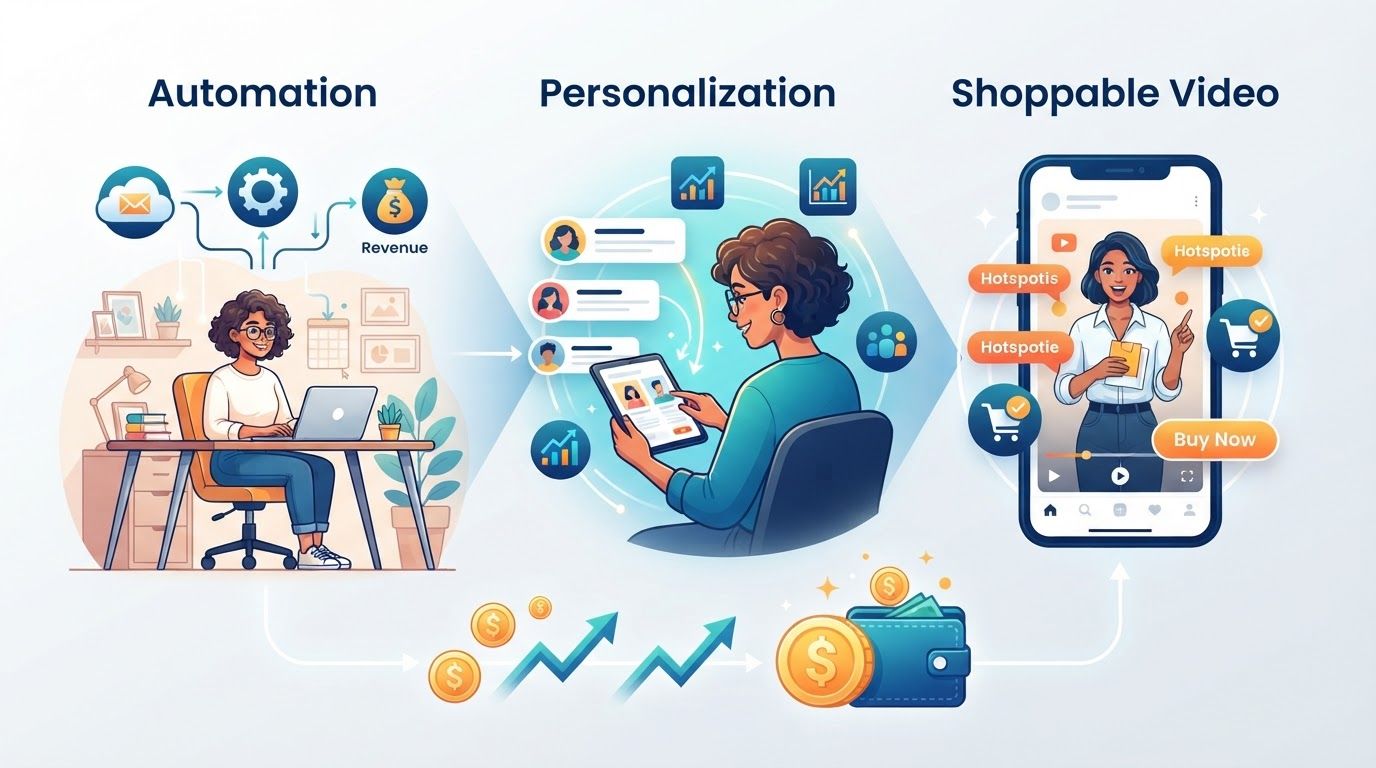
Automation can make that content easier to produce, personalization can help it reach the right people, and shoppable video can shorten the path from discovery to purchase. The practical question is how to connect all three without wasting time on tools, promoting poor-fit products, or losing the trust that made an audience valuable in the first place.
How creator monetization connects content, audience needs, and commerce
Direct answer: Creators monetize audiences by using automation to handle repeatable work, personalization to make recommendations more relevant, and shoppable video to connect helpful demonstrations with affiliate links, product tags, storefronts, or their own offers. The strongest approach starts with audience trust and measures what happens after a viewer clicks.
A creator's income path does not have to begin with a huge audience or a sponsorship. Someone teaching home organization could demonstrate a storage product, link to it through an affiliate program, and offer a deeper organizing guide to viewers who want more help. Each step addresses a different level of interest: the video inspires, the link enables a purchase, and the guide serves people seeking a fuller solution.
This is why relevance matters more than chasing the broadest possible reach. Sprout Social reports that only 17% of consumers check a creator's follower count before deciding to engage; subject relevance and content style matter more to audiences. A smaller creator who consistently answers specific questions may therefore have a clearer route to useful recommendations than a larger account whose audience follows for unrelated reasons.
Social platforms are also where many people begin researching purchases. According to Shopify, 63% of Gen Z shoppers use sites such as TikTok and Instagram as top channels for researching new products and brands, while 23% of Gen Z audiences start online product searches on TikTok. Those figures describe Gen Z behavior, not every buyer's journey, but they explain why a useful product demonstration can meet a viewer before that viewer ever reaches a store.
Think of monetization as a connected sequence rather than a single link:
- Discovery: A short video, post, or search-friendly tutorial answers a question the audience already has.
- Consideration: A demonstration, comparison, or personal use case helps someone decide whether the offer fits.
- Action: A product tag, affiliate link, storefront, or direct offer gives an interested viewer a clear next step.
- Continued value: Follow-up content helps buyers use what they purchased and gives nonbuyers a reason to stay.
That last step matters. Deloitte's Digital Media Trends describes strong fandoms as opportunities to connect year-round social content, shopping, and exclusive experiences within a creator's or media owner's own environment. For an independent creator, the lesson is not to build an elaborate membership immediately. It is to treat the relationship after a post or purchase as part of the business, rather than assuming every video must start from zero.
Automate creator workflows without automating your judgment
Automation is most valuable when it removes repetitive work while leaving the creator responsible for accuracy and taste. Deloitte says creators are testing generative AI for concept development, production management, content creation, caption generation, and personalization. These are practical starting points for someone running a business from home and handling their own filming, editing, publishing, and customer questions.
Start with a repeatable content brief
Before asking an AI tool for a script, write down the audience question, the promised takeaway, the product's role, and the proof you can actually show. A brief for an affiliate video might say: demonstrate how to set up this desk light in a small workspace, show the controls on camera, explain who might find it useful, and avoid claiming it improves productivity unless there is evidence. That brief gives automation boundaries; without them, polished output can still be unhelpful or misleading.
Then use tools to create variations for a human to review. An AI assistant can turn a long tutorial into possible short-video hooks, draft captions for different platforms, or suggest questions for a follow-up demonstration. A scheduling tool can maintain a publication calendar, while templates can make product disclosures and link placement easier to handle consistently. None of these tasks requires handing over the final recommendation.
- Capture once: Record a useful demonstration or explanation, including the details a buyer would need to see.
- Repurpose selectively: Draft a short clip, caption, and longer explanation from the same material, adjusting each to its platform.
- Check the facts: Verify product details, price-dependent statements, availability, and any claims in AI-generated copy before publishing.
- Publish with a purpose: Decide whether each piece is meant to answer a question, invite comparison, or help someone purchase.
- Learn from responses: Save recurring comments and questions as prompts for the next piece of content.
This workflow reduces blank-page time, but it does not guarantee output worth watching. Generic scripts tend to hide the creator's experience: the awkward setup step, the feature that surprised them, or the reason they would choose an alternative. Those specifics are often what makes a recommendation useful. Film or document what you genuinely know first, and let automation organize and distribute it.
AI can also help behind the scenes by sorting audience questions into themes or preparing a checklist for a product review. Be careful about feeding private customer information into a tool without understanding how it handles that data. For a beginner, a simple spreadsheet of questions and content ideas may be enough; more software is not automatically more scale.
Shopify reports that 49% of influencers use AI tools for content creation. That shows the tools are part of current workflows, not that AI-generated posts outperform thoughtful human work. Set a modest goal for automation: spend less time on formatting and repetitive drafting so you can spend more time testing products, answering viewers, and making sound recommendations.
Use personalization to make recommendations genuinely useful
Personalization is not simply inserting a subscriber's name into a message. It means noticing what someone came to learn, then making the next piece of content or offer relevant to that need. A creator teaching beginner photography, for example, might separate people looking for a first camera from those who already own one and need lighting advice. Sending both groups the same product pitch misses the reason they joined the audience.
Deloitte reports that 27% of fans would like generative AI to create a personalized digest of updates about favorite shows and franchises. It also reports that 22% would use streaming services more if those services used generative AI for personalized recommendations. These findings concern entertainment fans and streaming, so they are not a forecast of creator sales. They do illustrate an important expectation: people can value help filtering an overwhelming amount of content when that help reflects their interests.
Personalize from signals people choose to give you
For a small creator business, useful signals may be simple: which topic someone subscribed for, which tutorial they clicked, what question they asked, or which optional preference they selected. A welcome email can invite subscribers to choose between beginner setup tips, product comparisons, and advanced techniques. Future messages can then answer the chosen question instead of pushing the same offer to everyone.
Try matching content to a decision point:
- New learners may need definitions, setup steps, and low-commitment ways to try a method.
- Active researchers may want demonstrations, limitations, comparisons, and links to specifications.
- Ready-to-buy viewers may benefit from a clearly labeled product link, a current offer, or instructions for choosing the right version.
- Existing customers may want usage tips, troubleshooting, and related recommendations only when those additions solve a real problem.
Automation helps deliver those paths without manually writing each message. It should not turn every action into an aggressive sales trigger. If someone watches a troubleshooting video, their next useful step may be a fix, not a replacement product. The more closely a recommendation follows the viewer's actual intent, the less it feels like an interruption.
Make personalization understandable and easy to change. Let people know why they receive a type of update, offer a straightforward way to adjust preferences, and avoid collecting information you do not need. Also review automated suggestions for mismatches: a viewer interested in budget options may not welcome a premium recommendation simply because it carries a better affiliate payout.
Deloitte's outlook describes AI-enabled hyper-personalization as increasingly common and points to audience signals shaping content, commerce, and partnerships. For an independent creator, the useful version is a small, manageable system that helps answer the right question. If you cannot explain why a person received a recommendation, revisit the rule behind it.
Turn short-form content into shoppable video that helps viewers decide
Shoppable video connects a product shown in content to a buying action, often through a product tag, affiliate link, storefront, or in-app shopping feature. Its advantage is convenience: someone can move from seeing an item in use to finding its details without searching for the product themselves. Its risk is that convenience can make a weak recommendation easier to act on, too.
Shopify reports that creators posted more than 10 million shoppable videos during the previous holiday season. It also describes social shopping as spanning both in-app and off-platform journeys. You do not have to rely on a single checkout experience: a viewer might tap a platform product tag, visit a storefront, or follow an affiliate link to a retailer. Choose the route that is available for the product and clear to your audience.
Show the decision, not just the product
A useful shoppable video answers questions that packaging alone cannot. Show scale, setup, important controls, or a before-and-after process where you can demonstrate it honestly. State the use case early, then include a limitation that could change a buyer's decision. A short kitchen-tool video, for instance, could show how it handles one common task and mention the cleanup effort rather than merely calling it a must-have.
Sprout Social says short-form video under 60 seconds remains the highest-converting format across the board in its reporting. Shopify also says advertisers who promoted creator-led videos on YouTube Shorts saw an average 30% increase in conversion lift. Those findings support testing short demonstrations; they do not mean every creator should abandon longer reviews. A brief clip can spark interest, while a longer explanation may give a cautious buyer the context needed to purchase confidently.
Build the shopping path around the video:
- Choose one viewer question. A focused video about whether an item fits a small desk is easier to follow than a broad pitch about improving an entire workspace.
- Show the item in use. Make the featured product identifiable and distinguish it from other items in the frame.
- Explain who it suits. Include the conditions under which you would recommend it and when you would not.
- Add the appropriate buying route. Use a supported product tag, clearly identified affiliate link, storefront, or link to your own product.
- Check the journey yourself. Confirm that the tag points to the correct item and that the destination gives viewers the information they expect.
Link placement is becoming more automated. Shopify reports that YouTube uses AI to display a product tag at an optimal time in a video to help viewers discover featured products. That can reduce friction, but the timing of a tag cannot replace a clear demonstration or fix a mismatch between the video and the item linked.
Product tags and affiliate links serve different needs. A platform tag can keep discovery close to the viewing experience; an affiliate link may send a viewer to a retailer with more detailed specifications. Shopify highlights both creator affiliate links in Instagram Stories and product-tag-driven shopping as social commerce tactics. If a feature is unavailable on your account or for a particular item, a well-labeled link alongside useful buying information is a workable alternative. Do not make viewers hunt through unrelated links to find the product you showed.
Choose affiliate offers and brand partnerships for fit, not just payout
There are several ways to earn from the same expertise: affiliate commissions on relevant products, paid collaborations, a creator's own digital products, and exclusive experiences. They are not interchangeable. Affiliate links can be a practical way to test whether an audience wants product recommendations, while a paid partnership may provide agreed compensation for a defined campaign. An owned product gives more control over the customer experience but requires the creator to build and support it.
For affiliate marketers, the first filter should be whether the offer solves a problem the audience actually has. Review the product's suitability, purchasing terms, and the experience after the click. A high commission cannot compensate for a confusing page, a poor-fit subscription, or a product you cannot explain credibly. If you have not used an item, be clear about the basis for discussing it rather than implying firsthand experience.
Brands have reasons to look beyond account size, too. Sprout Social says influencer content outperforms brand-owned content across reach, engagement, and conversion in its reporting, and 64% of social users say they are willing to buy more from a brand when it partners with an influencer they like. That willingness depends on the relationship with the creator; it is not permission to promote anything with an available budget.
Make a partnership easy to evaluate
A niche creator can present a concise picture of audience interests, the content formats they make well, and examples of how they explain products. When approaching a brand, propose a specific use case rather than offering a generic sponsored post. A gardening creator might pitch a sequence covering setup, a real task, and later maintenance for a tool, if they can actually document those stages.
Shopify reports that nearly 27% of marketers identified AI-driven creator matching as a top focus area in 2026. Sprout Social also describes brands shifting toward AI-powered workflows for discovery, brand fit, and performance measurement as the influencer marketing industry is projected to exceed $26 billion by the end of 2026. These trends make accurate niche positioning more important: describe what you cover and whom you help so a potential partner can judge fit beyond a keyword match.
Ask practical questions before accepting a deal:
- Can you give an honest assessment, including relevant drawbacks?
- Does the agreement specify deliverables, usage rights, review requirements, and payment terms?
- Is there a clear way to distinguish the paid content from independent recommendations?
- Will success be assessed against a realistic goal, such as qualified interest or sales, rather than views alone?
Deloitte notes that a well-matched brand can benefit from a creator's trust and credibility, and that long-term partnerships can improve ROI measurement over time. A longer relationship can also let the creator show a product across real situations instead of making a single forced announcement. But repeat sponsorships should remain conditional on the product continuing to serve the audience; consistency with a brand is valuable only when it is consistent with your standards.
Protect audience trust when AI and sponsorships enter the picture
Trust is not a soft extra in creator commerce. It determines whether someone believes the demonstration, clicks the link, and returns for the next recommendation. Tubefilter reports that 35% of creators name a lack of consistent brand deals as their top growth barrier, while 15% say they fully trust sponsored content from other creators. Together, those findings show the tension: creators need income, but sponsored content can face skepticism.
The most reliable response is to make the commercial relationship visible and the recommendation specific. Identify sponsored work and affiliate relationships clearly, follow the disclosure requirements that apply to you, and make the explanation easy to notice rather than burying it. Separate what you observed from what a brand supplied, and avoid presenting an AI-generated summary of product claims as your own test.
A trustworthy review can still earn money. It might say that a tool is convenient for a beginner but not suitable for heavy use, then link to the product for people who fit that use case. It might offer a lower-cost alternative where appropriate, even if that alternative pays less. Such details help a viewer decide; they are not a failure to sell.
Set rules before revenue pressure tests them
Write a short personal policy for what you will promote, what evidence you need, and which claims require verification. For example, you could require hands-on testing before making performance claims, current product information before publishing a buying guide, and an explicit disclosure whenever compensation could influence a recommendation. Apply the same rules whether the offer is a brand deal, an affiliate product, or your own course.
Review automated content against those rules. AI can draft an appealing caption that overstates results or implies firsthand experience you do not have. Check captions, on-screen text, translated versions, and scheduled follow-ups as carefully as the original script. If an offer changes or a product becomes unavailable, update or remove the buying path instead of leaving an old recommendation in circulation.
Finally, allow room for content with no immediate sales ask. A troubleshooting post, a comparison that concludes no purchase is necessary, or a response to a common question can deepen the relationship that later supports commerce. Deloitte describes fans moving across multiple social networks, with fans using an average of six compared with four for nonfans. People may encounter a creator in several places; consistent, useful advice helps those encounters feel like one credible relationship rather than repeated pitches.
Measure the full journey instead of celebrating clicks alone
A video with many views can fail to help qualified buyers, while a modest tutorial can answer a specific purchase question well. Measurement should reflect the job of each piece of content. Discovery posts may introduce the topic; comparisons may generate informed clicks; a tagged demonstration may lead directly to a transaction. Judging all three only by immediate sales hides what each contributes.
Start with a simple record for every offer you promote: the audience question, content format, product, destination, disclosure, and intended next action. Then look at the signals available to you. These may include watch behavior, meaningful comments, link clicks, product-tag activity, sales credited by an affiliate program, returns or complaints you can see, and questions from people who have purchased. Not every platform or partner will provide every measure, so do not pretend you have a complete view of the customer journey.
When results look weak, diagnose the step rather than immediately making more content:
- People leave early: Check whether the opening names a real problem and shows why the video is relevant.
- People watch but do not click: Check whether the product's role and next step are clear, or whether the content is serving an earlier research stage.
- People click but do not buy: Review product fit, destination clarity, availability, and whether the page matches what the video promised.
- People buy but express regret: Reassess the recommendation and whether the content gave them enough information to decide.
Shopify says retail brands using Reels and creators have seen 71% higher brand intent lift and 19% lower acquisition costs in its reporting. Those are results for the cited retail brand campaigns, not a benchmark an individual creator should promise a partner. Use such findings to understand why brands care about creator video, then ground your own decisions in results you can observe.
When negotiating repeat work, share evidence that matches the agreement. A brand testing awareness may care about qualified engagement and useful audience questions; an affiliate campaign may care more about attributable purchases and the quality of the traffic sent. Deloitte notes that long-term creator partnerships can help brands measure ROI over time. Repeated, comparable work can reveal more than a single post, provided both sides agree on what success means and what data is available.
YouTube's creator-commerce discussion highlights shoppable video, storefronts, affiliate programs, and retail media integrations as ways the path from inspiration to purchase is changing. That path may cross platforms or devices, so attribution will not always be tidy. Use directional evidence, audience feedback, and product fit together. The aim is not to claim credit for every purchase; it is to make the next recommendation more useful and the business more sustainable.
Build a manageable creator monetization system, one layer at a time
You do not need to launch an AI workflow, segmented email program, storefront, and brand outreach campaign in the same week. Choose one audience problem you can explain well and one offer you can evaluate honestly. Create content around the decision a buyer needs to make, then add tools only when they remove a bottleneck you have actually encountered.
A sensible progression is to begin with a helpful demonstration and a clearly labeled buying route. Next, use a content brief and light automation to turn recurring audience questions into a manageable publishing schedule. Once people respond, organize those questions into a few interest groups and offer more relevant follow-ups. Finally, use what you have learned to assess additional affiliate products, your own offer, or a potential brand relationship.
Keep the system small enough to maintain:
- Pick a defined topic. Be specific about the people and problems your content serves.
- Document your standards. Decide what you must know before recommending an offer and how you will disclose compensation.
- Publish one useful shopping path. Pair a demonstration or comparison with a correct tag, link, or storefront destination.
- Automate one repetitive task. Start with caption drafting, content planning, or organizing questions, then review the output.
- Personalize one follow-up. Offer a relevant next resource based on a viewer's expressed interest, without requiring unnecessary data.
- Review what happened. Look beyond views to the questions, clicks, purchases, and concerns your content generated.
Shopify's ecommerce video trends bring AI video tools, personalization, shoppable video, and livestreaming together, but they do not require every creator to use every format. Livestreaming may suit someone comfortable answering questions in real time; a carefully edited tutorial may suit someone teaching a technical process. Likewise, a simple affiliate link may be a better starting point than an elaborate storefront if you only recommend a few products.
The goal is a system you can improve, not a collection of features you feel pressured to activate. When each tool has a clear job, you can see whether it saves time, helps a viewer make a decision, or improves the experience after a purchase. If it does none of those things, it can wait.
Automation, personalization, and shoppable video work together when each supports a real audience need. Automate repeatable production tasks, tailor follow-ups to interests people have shown, and make it easy to find a product only after your content has helped someone judge whether it fits.
Start with one relevant offer and one honest demonstration. Check the buying path, learn from the questions viewers ask, and expand only when you can maintain the same standard of usefulness and trust across more content.