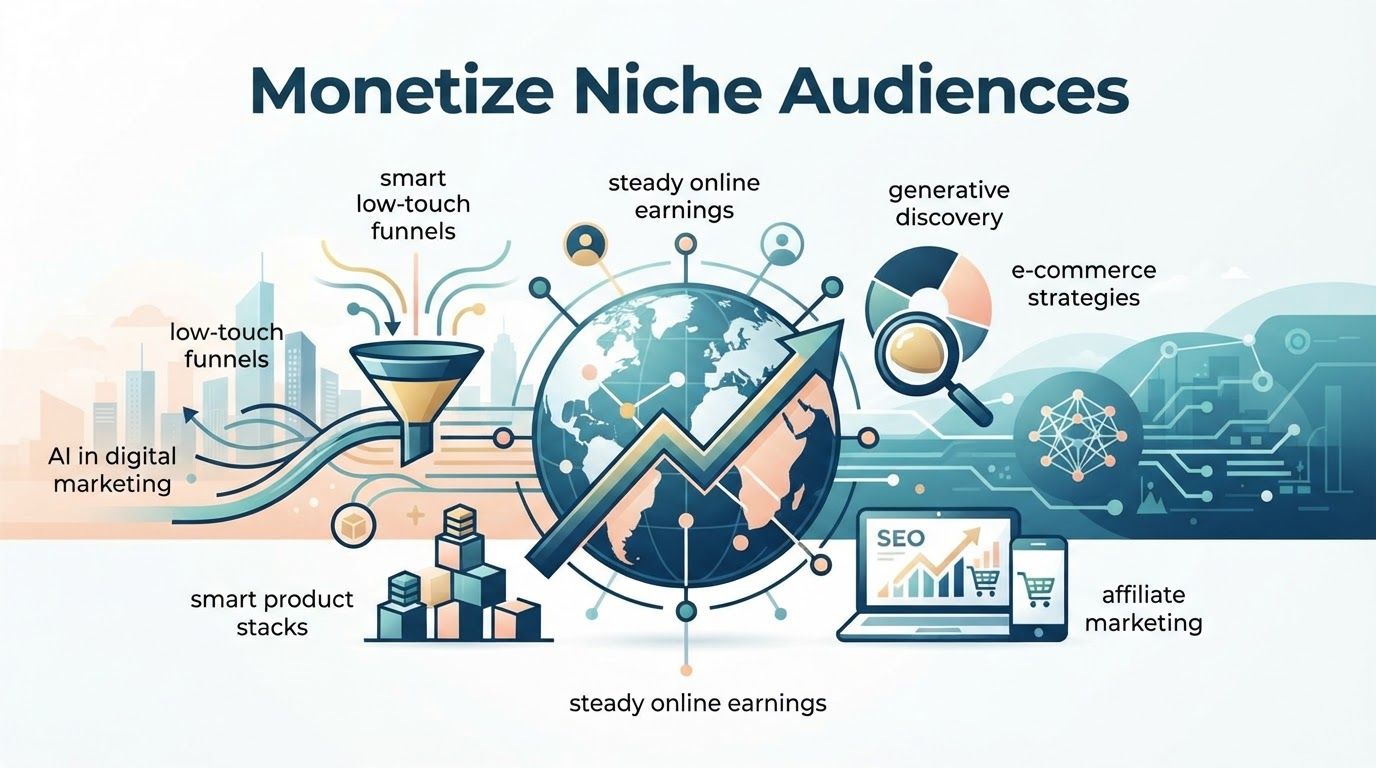
A niche audience can be deeply interested in a topic and still be hard to monetize if people cannot find the right recommendation when they are ready to act. Niche audience monetization now depends on more than collecting followers: it requires useful content that can surface during AI-assisted research, a product stack that matches different needs, and a funnel that helps buyers decide without a long sales conversation.
That does not mean replacing your website, email list, or judgment with AI. It means designing them around the questions people already ask, from Which option fits my budget? to What should I buy first? The practical approach is to choose a specific audience problem, publish trustworthy decision aids, offer a small set of relevant next steps, and automate only the parts that benefit from consistency.
Why generative discovery matters for niche audience monetization
Product discovery increasingly happens inside conversational tools as well as search engines and social feeds. OpenAI says retail and ecommerce conversations on ChatGPT exceed 1.7 billion prompts per week, and that U.S. product-search activity on ChatGPT rose 52% during the 2025 holiday season. Those figures show substantial shopping activity on one platform; they do not tell an individual affiliate marketer how much traffic to expect.
Direct answer: To monetize a niche audience through generative discovery, publish clear answers to specific buying questions, connect those answers to a focused mix of affiliate offers and owned products, and guide interested visitors through a short, measurable funnel. Optimize for helpful decisions, not just mentions in AI responses.
AI-assisted research also changes what a useful first touch looks like. OpenAI’s 2026 holiday guide says about 43% of shopping-related ChatGPT conversations involved comparing and evaluating options. A visitor who arrives after asking for a comparison may need a recommendation framework, limitations, and a relevant product page rather than a broad introduction to the category.
Other research points in the same direction without making every channel interchangeable. Semrush reports that AI traffic grew 66% in 2025 while total web traffic was essentially flat, and its March 2026 study of 1,030 U.S. shoppers found AI tools and Google’s AI search experiences woven into product research. Shopify says AI-referred shoppers on its storefronts grew more than eightfold year over year as of Q1 2026. Each source measures a different population, so treat the figures as evidence of a channel worth testing, not as a forecast for your own site.
Traditional search, social communities, newsletters, and direct visits still matter. Generative discovery adds another path into the same buying journey: someone asks a detailed question, encounters possible options, and looks for a source that helps them verify the choice. Your opportunity is to become that useful source, whether the person first sees your content in an AI-generated response, a search result, or a community discussion.
Choose a niche by its decisions, not just its audience size
A large audience is not automatically a valuable one. A smaller group can support a business when members repeatedly face meaningful decisions, can describe their constraints, and are willing to pay for a useful solution. Shopify reports that the number of its stores selling sports trading cards grew more than sixfold from 2021 to 2025, with the category becoming a $500 million-plus industry. That example illustrates the commercial potential of a focused interest, not a promise that every hobby niche will follow the same path.
Start with a problem that has visible stages. A home-based creator selling a guide for trading-card sellers, for instance, might address organizing inventory, choosing supplies, photographing listings, and comparing selling tools. The exact offers should follow what the audience actually asks for; the example is a way to map decisions, not a claim that any particular product sells well.
Look for a repeatable question with a useful next step
- Identify the audience: Define who needs help and under what circumstances. A beginner buying their first setup has different questions from an experienced seller streamlining a workflow.
- List decision points: Note the comparisons, budget constraints, compatibility questions, and mistakes people bring up before choosing.
- Check the available offers: Look for reputable products, relevant affiliate programs, or a small digital resource you can make well. A niche with interest but no appropriate next step may be better suited to an email community than immediate sales.
- Assess your ability to help: Choose a subject you can research carefully, explain clearly, and update when products or terms change. Credibility matters more than having a long list of monetization links.
Community size and buying intent are separate questions. A creator community may attract enthusiastic conversation without frequent purchases; a narrower group facing an expensive or confusing decision may need detailed help at the moment it matters. Write down what someone must decide next, what evidence would help, and what outcome your content can realistically support.
If you are new to the niche, do not manufacture expertise by having AI generate confident recommendations from thin information. Begin with a modest scope, examine product details and terms directly, and state where your knowledge ends. An honest, narrow resource can be more useful than a sweeping guide that cannot justify its rankings.
Build smart product stacks around one customer journey
A smart product stack is not a pile of affiliate links. It is a small set of complementary ways to solve the same audience problem at different levels of commitment. For a beginner, that might mean a free comparison checklist, an affiliate-linked tool with clear suitability criteria, and a paid template that makes implementation easier. Each element should have a distinct job.
Think in terms of a path rather than a catalog. The free resource helps someone frame the decision; the recommended product helps them act; the owned resource helps them use or organize what they chose. A service can sit at the end of the path if the audience needs more help, but it should not be treated as mandatory for everyone.
Give every offer a reason to exist
- Entry resource: Offer a useful worksheet, checklist, or short email lesson that solves a limited problem without requiring a purchase. This gives visitors a reason to stay connected if they are not ready to buy.
- Core recommendation: Select one or a few products that fit defined use cases. Explain who each is for, what it costs or requires when you can verify those details, and when it is a poor fit.
- Owned add-on: Consider a template, guide, calculator, or lightweight productized service that addresses an adjacent task. It should add value even if the visitor buys through another route.
- Optional upgrade: Reserve higher-touch help for cases that genuinely need it. A paid review or setup service can be useful, but it should not be disguised as the only way to make the lower-cost solution work.
OpenAI’s 2025 usage research describes ChatGPT’s value in part as decision support and the generation of digital outputs such as writing, code, and spreadsheets. That makes it easier to draft and prototype modular resources. It does not remove the need to test a spreadsheet, check instructions, verify product claims, or decide whether a generated output is useful enough to sell.
There are trade-offs between revenue models. Affiliate offers can be quicker to add, but you do not control the merchant’s product, terms, or checkout. Owned digital products give you more control but create support, maintenance, and refund responsibilities. A service can command more attention from buyers while reducing the low-touch nature of the business. A focused mix lets you learn what customers value without building an elaborate catalog first.
Be especially careful when combining recommendations and incentives. Disclose affiliate relationships clearly, distinguish your own product from a third-party offer, and do not rank a weak fit first because it pays a commission. A trustworthy stack should still make sense if a reader ignores every affiliate link.
Create comparison content that AI-assisted shoppers can evaluate
Generative discovery rewards content that resolves a concrete question, but there is no guaranteed way to make a tool cite or recommend your page. Your controllable task is to publish pages that are understandable, specific, and supported by information a visitor can check. Start with the question behind the search or prompt, then organize the answer around the decision a person must make.
A useful comparison page can explain selection criteria before naming a winner. If the audience is choosing a tool, describe relevant constraints such as budget, required features, ease of setup, ongoing work, and situations where a simpler alternative is enough. State what you examined and avoid presenting an untested product as a personal favorite.
Make the evidence easy to find
- Use descriptive headings: A heading such as Best option for a one-person workflow tells a reader more than Our top pick without context.
- Answer the main question early: Give a short recommendation with its qualifying condition, then provide the reasoning for readers who want more detail.
- Show meaningful differences: Explain what changes when someone chooses one option over another, including any learning curve or limitation you can substantiate.
- Connect related resources: Link a comparison to setup guidance, a checklist, and the relevant product page so visitors can continue without repeating their research.
- Maintain the page: Recheck important features, availability, and affiliate terms before relying on old recommendations.
Google said in 2026 that it was using AI to understand content and audiences better, match brands with creator communities, and introduce Direct Offers in AI Mode. Those developments signal that commercial discovery is evolving, but they are not a reason to write pages solely for a platform feature. Clear explanations and accurate product information help readers across search, AI tools, email, and your own site.
Do not confuse visibility with endorsement. A page can be discoverable yet fail because its claims are vague, its links interrupt the explanation, or it hides a key drawback. Conversely, a carefully written page might not receive an AI referral every time someone asks a related question. Build content that earns a visitor’s trust once they arrive, then evaluate how different discovery channels contribute.
Consider the alternative to publishing another broad best products post: create a decision aid for a narrow scenario. A guide for someone who works alone, has a limited budget, and needs a setup they can maintain may have a clearer purpose than a list intended for everyone. The narrower page can also support more precise email follow-up and a better-matched offer.
Design a low-touch funnel that helps people decide
A low-touch funnel reduces unnecessary manual work; it does not remove human responsibility. Its job is to move a visitor from a specific question to an informed next action with as little friction as possible. For many niche businesses, that means a helpful article, a relevant resource, a short follow-up sequence, and a product page that answers the remaining objections.
Begin with the point where someone arrives. A visitor reading a comparison may want to know which option fits their situation; someone reading a setup tutorial may need a checklist to complete the task. Giving both visitors the same generic pop-up or sales pitch ignores the reason they came.
Map each step to one question
- Discovery page: Answer the initial comparison or how-to question and make your evaluation criteria visible.
- Optional email resource: Offer a checklist or short guide that helps with the next decision. Explain what subscribers will receive, and do not require an email address to access basic facts the article promises.
- Follow-up: Send a short sequence that addresses common constraints, shows how to use the resource, and introduces a fitting offer. Give people a clear way to stop receiving messages.
- Offer page: Describe the outcome, what is included, who it suits, who it does not suit, and what happens after a purchase or affiliate click.
- Post-purchase help: Provide the instructions or support route needed to get value from the product, rather than treating the transaction as the end of the relationship.
OpenAI’s 2026 holiday guide places a substantial share of shopping conversations in comparison and evaluation. That makes decision aids a logical funnel entry point. Shopify also reports that AI-referred visitors who begin on a product page convert at nearly 50% higher rates than organic-search visitors in its Q1 2026 commerce data. That is a finding about a specific visitor group on Shopify storefronts, not proof that sending every visitor directly to checkout will improve your results.
Keep the funnel short enough to understand. A visitor should know why they are receiving an email, why an offer relates to the page they read, and what they can do without buying. If your sequence needs many messages to explain a simple product, the offer or the landing page may need work before you add more automation.
Some audiences will prefer a conversation, especially for complex or costly decisions. In that case, an optional consultation or reply-to-email path may be more useful than forcing everyone into a fully automated purchase. Low-touch is a design choice for repeatable questions, not a rule against personal help.
Use AI to speed production without outsourcing judgment
AI is useful when it turns repeatable work into a draft, a first-pass classification, or a resource you can improve. OpenAI’s 2025 paper says Practical Guidance, Seeking Information, and Writing account for nearly 80% of ChatGPT conversations, while non-work usage rose from 53% to more than 70% through July 2025. People use these tools for practical questions outside work, which makes clear explanations and useful outputs relevant to home-based businesses.
For your own operation, AI can help cluster audience questions, outline a comparison, turn approved notes into an email draft, or create a first version of a checklist. It can also help generate a spreadsheet or simple code for an owned tool. The time-saving step is drafting; the quality-control step is yours.
- Feed it reliable inputs: Supply verified product notes, your audience’s real questions, and the purpose of the page rather than asking for unsupported rankings.
- Review claims line by line: Check prices, features, compatibility, terms, and any statement presented as personal experience before publishing.
- Test the output: Use a calculator, spreadsheet, or automated email path yourself to catch broken logic and confusing instructions.
- Keep a human support route: Tell customers how to report an error or ask for help when the automated path does not fit.
OpenAI’s enterprise AI report says customer-facing applications, including in-product assistants, search, and automation, are common API use cases; customer service and content generation together account for roughly 20% of API activity. That shows these workflows are being deployed, not that every small business needs an API integration. A carefully reviewed email template or self-serve guide may be the more sensible starting point.
Google’s 2026 commercial-experiences update highlights AI-generated creative and audience matching, and Google says advertisers used Gemini to generate nearly 70 million creative assets in Q4 alone. The scale is striking, but more creative does not automatically mean better creative for a niche buyer. Use automation to test a clear message or adapt approved material, not to flood channels with near-duplicate promises.
Privacy and consent belong in the workflow from the start. Avoid feeding sensitive customer details into tools without understanding how those tools handle the information, and do not send automated messages people did not agree to receive. The goal is a dependable system that frees your attention for research, product quality, and customer feedback.
Measure discovery, decisions, and revenue separately
If you only track pageviews, you may miss whether AI-assisted discovery brings qualified buyers. If you only track sales, you may miss the page that helps someone decide before they return through another channel. A simple measurement plan separates visibility, engagement, and commercial outcomes so you can improve the weakest step.
Start with what you can observe on your own properties: referral sources when available, landing pages, clicks to merchants or offers, email sign-ups, product purchases, and questions sent by visitors. Some visits influenced by an AI answer may not appear as a neatly labeled AI referral, so avoid claiming a precise contribution that your data cannot establish.
Match the metric to the decision
- Discovery: Which pages receive relevant visits, and what questions appear to lead people there?
- Decision support: Do visitors use the comparison, click supporting explanations, or continue to a relevant next page?
- Offer fit: Do people click the recommendation or buy the owned resource, and do their support questions reveal a mismatch?
- Business value: After costs and your time are considered, is the stack worth maintaining and improving?
Semrush says AI visitors were worth 4.4 times as much as traditional organic-search visitors in certain marketing and SEO topics, while noting that the gap can narrow depending on methodology. That is a reason to measure revenue or useful actions by source where possible, not to assume every AI-referred visitor is more valuable. Shopify’s product-page conversion finding is similarly specific to the visitors and context it studied.
Review the funnel as a sequence rather than blaming the last page. A comparison page with relevant traffic but few offer clicks may need clearer recommendations. Strong offer clicks with weak purchases may signal a mismatch between the promise and the merchant’s product. Purchases followed by confusion may indicate that your instructions or audience qualification need improvement.
AI visibility is also an operational discipline, not a one-time publishing task. Semrush found that only 22% of marketers had fully integrated AI search and SEO by June 2026. For a small business, integration can begin modestly: keep product information accurate, make pages easy to navigate, maintain useful comparisons, and review what your own analytics and customer questions tell you.
Start small, validate the stack, then expand what works
You do not need a large content library or a complicated automation platform to begin. Pick one audience decision with a credible offer attached, create one strong page that addresses it, and build one useful next step. Then watch where visitors get stuck before producing more content or adding more products.
A manageable first pass might be a comparison article, a checklist, an email that explains how to use the checklist, and a clearly disclosed affiliate recommendation. If visitors ask the same implementation question repeatedly, that may justify a template or short guide. If they need individualized help, consider a limited service instead of pretending a self-serve product can solve every case.
Use feedback to decide what to build next
- Listen for repeated questions: Note the constraints and objections people raise, not just the keywords you hoped to rank for.
- Improve the decision page: Clarify missing criteria, explain trade-offs, and remove claims you cannot verify.
- Refine the next step: Adjust the resource or offer so it addresses the question that follows naturally from the article.
- Automate a stable process: Once the instructions and answers work for real visitors, turn repeatable parts into templates or email follow-up.
- Expand selectively: Add related pages or products only when they serve a distinct stage of the same customer journey.
There are attractive but less dependable alternatives. Chasing every new AI discovery feature can consume the time needed to maintain useful pages. Publishing large volumes of generated content can create more pages without improving decisions. Adding unrelated high-commission offers may increase the number of links while weakening the reason someone trusts your recommendations.
Creator communities and richer discovery experiences may broaden future opportunities. Shopify’s 2026 social commerce report forecasts social media creator revenue of $20.6 billion in 2026, while OpenAI has highlighted conversational video and sports-stat discovery in JioHotstar as an example of product experiences extending beyond text. Those examples show the range of possible channels, but a home-based business is usually better served by making one clear customer journey work before trying to be everywhere.
The guiding question is simple: can a person with a specific problem find your explanation, understand their options, and take an appropriate next step without waiting for a sales call? If not, strengthen that path first. A low-touch business becomes more durable when automation supports a helpful offer rather than concealing a confusing one.
Niche audience monetization works best when discovery, offers, and follow-up serve the same decision. Generative tools may introduce more people to the question, but your content still has to earn confidence through clear criteria, accurate details, honest trade-offs, and a relevant next step.
Choose one question your audience already asks and build the simplest useful path from answer to action. Measure what happens, correct what confuses people, and expand only when the next resource or offer makes that path genuinely better.