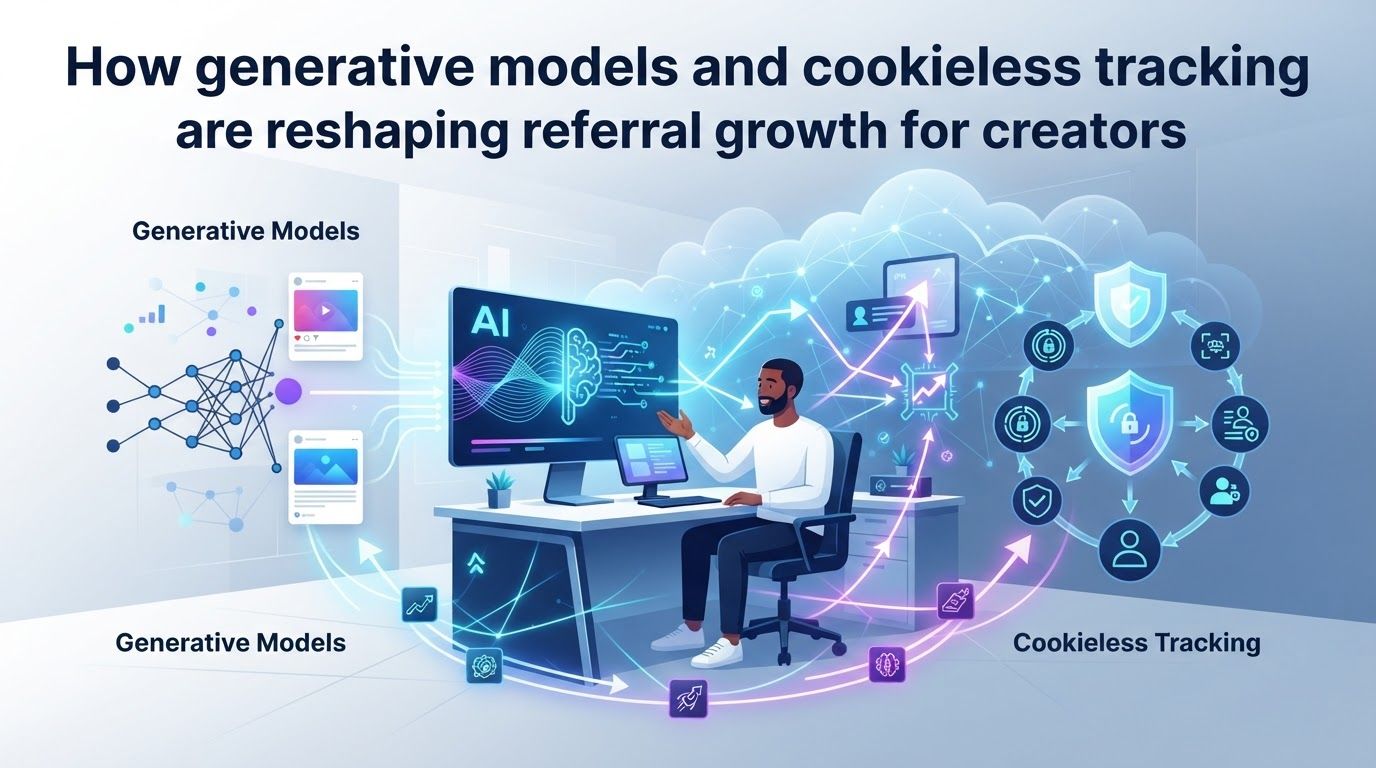
Creators can no longer assume that a customer will find a post through search, click an affiliate link, and remain identifiable through checkout. Generative models are introducing products inside conversations, while browser restrictions make some familiar referral signals harder to retain. For affiliate marketers and home-based entrepreneurs, the opportunity is to pair AI-friendly creator content with cookieless tracking that shows which visits, signups, and sales can actually be connected to that content.
This does not mean abandoning search optimization or declaring cookies obsolete. It means recognizing a longer discovery journey: someone may ask an AI assistant for ideas, compare options in a creator’s guide, visit a merchant, and return later through another channel. A useful growth plan gives each stage a job, measures the evidence available at that stage, and avoids claiming credit for a sale when the connection cannot be verified.
How generative models change creator referral growth
Traditional referral planning often starts with a known destination: a reader searches for a specific product review, lands on a creator’s page, and clicks a tracked offer. AI-assisted discovery can begin earlier and more broadly. A shopper might ask for gift ideas for a particular hobby, then refine the request by budget, skill level, or shipping needs before visiting any website.
That broader path can create more openings for useful creator material. In its holiday-shopping analysis, Google describes AI expanding a query into multiple gift categories and recommends involving creators in context-rich discovery. Its reported finding that 85% of U.S. holiday shoppers using Google and YouTube say those tools help them find inspiration, discover, or expand ideas describes that surveyed group; it is not a conversion rate for creator links.
A creator who only publishes a short product pitch may miss the questions that precede a purchase. Consider a home-based coffee affiliate. A page devoted solely to one grinder can serve a shopper who already knows what to buy, but a guide to choosing a grinder for a small kitchen can also address noise, cleanup, counter space, and differences between beginners and enthusiasts. Those details give both people and discovery systems clearer context for deciding when the page is relevant.
The practical shift is from trying to win one product keyword to answering the sequence of decisions that leads someone to a useful recommendation.
Commerce data suggests these visits deserve attention, though not blind optimism. Shopify reports that referral sessions from AI chatbots grew more than eightfold year over year on Shopify storefronts as of Q1 2026. That figure describes activity on those storefronts, not a promise that every creator will see the same growth.
Creators also have a reason to stay involved rather than hand the entire process to a model. Adobe’s June 2026 Creators’ Toolkit Report says 87% of creators believe creative AI is growing their business and audience, while 85% say the final creative decision should remain with the creator. AI can help organize research or draft outlines; the creator still needs to check claims, explain personal judgments honestly, and decide which recommendation deserves an audience’s trust.
Cookieless tracking: what changes and what still works
Direct answer: Cookieless tracking measures referral activity without depending on third-party browser cookies. For creators and merchants, the practical approach combines tagged links, first-party information people choose to share, server-side measurement where appropriate, and platform reports to connect discovery with outcomes as accurately as possible.
The problem is not that every browser cookie has disappeared. According to Adobe’s cookieless analytics documentation and its cookie documentation, third-party cookies are blocked in many browsers, while first-party cookies can face limited expiry under Safari’s Intelligent Tracking Prevention and other browser policies. A referral journey that depends on a third party recognizing the same person across sites can therefore lose continuity.
For an affiliate, that gap matters when a reader clicks a link on Monday, researches elsewhere, and buys later. The merchant may record a purchase but fail to associate it with the earlier click under a particular program’s rules. A creator should distinguish that attribution gap from a content problem: a missing credited sale does not prove the guide failed to influence the customer, and an apparent spike in referrals does not prove every visit was incremental.
Shopify’s cookieless-tracking guidance points to first-party data, data layers, and server-side tracking as ways brands can collect and use customer information without depending on browser cookies. Adobe frames the broader shift as a move away from anonymous third-party tracking toward explicit sharing between people and brands they trust. That makes clear signup language and sensible data practices part of the growth strategy, not an afterthought.
- Still useful: A tagged URL can tell a site where a visit came from when its parameters survive the journey.
- More durable: A voluntary email signup or customer account can help a business understand repeat engagement within its own relationship with that person.
- Not guaranteed: A server-side event cannot reconstruct a referral source that was never captured, and no method automatically proves a creator caused a later sale.
If you are an affiliate using someone else’s checkout, you may not control the merchant’s data layer or server setup. Start with the tracking options your program actually provides, ask how it handles attribution, and build an audience relationship you control where appropriate. Merchants and creators with their own storefronts can go further by connecting landing-page, signup, and purchase events through their first-party systems.
Measure AI assistant referrals without confusing clicks with influence
Generative discovery is becoming easier to inspect as its own source of traffic. Google Analytics documentation identifies a dedicated AI Assistant channel and an ai-assistant medium for visits from assistants such as ChatGPT, Gemini, and Claude. Rather than burying every identifiable AI-origin visit inside organic search or a generic referral bucket, a creator or merchant can review that channel separately.
Google Search Console also reports generative AI performance; Google says those insights were rolled out globally by August 31, 2026. The two tools answer different questions. Search Console helps a site owner examine how pages surface through Google’s generative features, while Analytics helps examine visits that reach the website and what those visits do afterward.
Build a small, readable measurement view
Begin with the destination you own, whether it is a content site, lead page, or storefront. Check that your analytics setup can capture landing pages, relevant acquisition channels, and meaningful events. Then review AI Assistant traffic beside organic search, other referrals, email, and direct visits rather than treating it as an isolated score.
- Check discovery: Look for pages appearing in available generative AI performance reporting and note which topics receive attention.
- Check arrival: Review AI Assistant visits and their landing pages in Analytics. Compare the pages people enter with the pages you expected assistants to recommend.
- Check action: Examine relevant next steps, such as a product click, newsletter signup, or completed order, using the events your site actually records.
- Check downstream referrals: Where you use affiliate links, compare your outbound click records with the merchant or network’s credited results.
A difference between these views is normal. A page can be surfaced without receiving a click, a visitor can leave without taking an action, and a person can encounter a recommendation inside a model without visiting the creator’s site at all. Adobe’s AI-search analysis argues that brands need better visibility into how language models recommend products and which responses lead to clicks; that visibility remains distinct from proving the full purchase journey.
As a simple working example, imagine your comparison guide receives identifiable AI Assistant visits, but few visitors click its product links. That is a reason to inspect the guide’s relevance, clarity, and call to action, not immediately a reason to produce more AI-written pages. If outbound clicks rise but credited sales do not, inspect offer fit, merchant landing pages, and attribution terms before blaming the discovery channel.
Create content that helps people decide across multi-step AI discovery
Generative models can make creation faster, but publishing volume alone is a weak referral strategy. People still need a reason to trust a recommendation when options have trade-offs. A useful creator page explains who an option suits, what it does not solve, and what a reader should verify before buying.
Start with questions that arise before a product search. For a creator teaching home-office setup, those questions might include how much space is available, whether the buyer needs portability, which accessories are compatible, and what daily use looks like. A guide that answers those questions can support an AI-assisted research journey without pretending to know every shopper’s priorities.
Give each page a clear decision-making role
- Discovery guide: Explain the problem, common choices, and the circumstances in which each choice makes sense.
- Comparison page: Compare a manageable set of alternatives using criteria readers can apply to their own needs.
- Hands-on review: Describe what you tested or observed, and separate firsthand experience from manufacturer information.
- Offer page: Make the next step obvious, including price-checking or merchant links, without disguising a commercial relationship.
A generative tool can help turn audience questions into an outline, identify gaps in a draft, or produce alternate explanations for a difficult concept. Review every output against the product information you can verify. If you have not tested an item, do not let polished AI copy imply you have; clear sourcing and honest limits are more useful than invented authority.
Product details also matter beyond prose. Shopify says AI-referred shoppers converted about twice as well when merchants used structured Shopify Catalog data rather than scraped or third-party feeds in Q2 2026. That is a merchant-side comparison, not evidence that adding markup to any creator article will double conversions. It does, however, reinforce the value of accurate, structured product information when a creator and merchant want discovery systems to understand what is actually for sale.
For creators who control product listings, keep names, variants, availability, and descriptions consistent with the offer. For affiliates who do not, link to the correct product or category page and periodically check that the destination still matches your recommendation. Good content may create initial interest, but a mismatched product page can interrupt the referral before a buyer makes a decision.
Build first-party measurement around consent and useful events
Once a visitor arrives, focus on evidence you can legitimately collect rather than trying to recreate invisible cross-site surveillance. If you own the site, define the few actions that show progress: viewing a guide, clicking a merchant link, requesting a resource, joining an email list, or purchasing. Choose events because they answer a business question, not because your analytics tool can count them.
A first-party relationship can be as simple as a reader choosing to receive a buying checklist or joining a newsletter for updates on a topic. Explain what they will receive and make the exchange worthwhile. If you use server-side measurement or a data layer, follow the consent and privacy requirements that apply to your business; technical capability is not a substitute for permission.
Follow the signal from content to outcome
- Label links consistently: Use a naming scheme for campaigns, creator partners, and placements so reports do not split one initiative across several spellings.
- Record arrival context: Where available, retain the landing page and referral information needed for your own reporting.
- Track meaningful next steps: Define outbound clicks, qualified inquiries, signups, or orders in the systems you control.
- Reconcile records: Compare site events with affiliate-network or merchant reports, allowing for different attribution rules and reporting windows.
- Limit collection: Keep only information needed for the stated purpose and communicate your practices clearly to visitors.
Consider a creator who publishes a guide to starting an indoor herb garden. The guide receives an AI Assistant visit, the reader signs up for a plant-care email series, and later clicks a tagged affiliate link for a grow light. The creator can see a sequence of observed actions within the systems they operate. If a merchant later credits a sale, that is stronger evidence of a tracked referral; if it does not, the creator should report the engagement without presenting an unverified purchase as a confirmed conversion.
For a small business, this setup need not begin with an elaborate stack. A clear landing page, consistent link tags, one or two relevant events, and a readable affiliate report are enough to expose basic gaps. Add server-side capabilities when they solve an identified measurement problem and you have the resources to maintain them, rather than treating them as a required badge of sophistication.
Use structured partnerships to make creator referrals easier to evaluate
AI-assisted recommendations can introduce a buyer to a merchant without producing a neat last-click path through every creator who shaped the decision. This is one reason structured referral programs matter. Shopify’s referral-marketing roundup describes formal programs as a way to track and incentivize advocacy, giving marketers a clearer framework than informal word of mouth alone.
If you are approaching a brand, ask practical questions before promoting its offer. Is there a unique link or code? What actions earn credit? How does the program handle delayed purchases or a customer who visits on more than one device? Which promotional claims, disclosures, and placements are permitted? Those answers affect both your content plan and how honestly you can describe performance later.
A brand choosing creator partners should look beyond follower counts. A creator with a focused audience and detailed, trustworthy explanations may be better suited to a complex product than one whose reach is broad but unrelated. Google’s holiday-shopping guidance gives creators a seat at the table for context-heavy discovery, which suggests collaboration on the actual buying questions a guide should answer, not merely paying for a product mention.
- Agree on the audience problem: Define which buyer question the partnership will help answer.
- Supply accurate product context: Give creators current details and room to state limitations in their own voice.
- Set measurement expectations: Decide whether success means qualified visits, signups, credited orders, or a combination.
- Review the destination: Ensure the merchant page supports the promise made in the creator’s content.
Codes can help when a shopper remembers a recommendation but does not click the original link, although a code is only one piece of evidence and can circulate outside its intended audience. Links are useful for observable visits but can miss later influence. A program that considers both, while being explicit about its rules, is more informative than treating either signal as a perfect measure of creator impact.
Read referral benchmarks carefully before changing your budget
There are encouraging signs that AI-assisted visitors and referral visitors can be valuable. Shopify reports that, in Q1 2026, AI-referred visitors who started on a product detail page converted at nearly 50% higher rates than organic search visitors in the comparison it describes. Shopify also says the distinct behavior of AI-referred shoppers has remained consistent since it began tracking it in 2026. Neither observation guarantees that an individual affiliate’s traffic will convert at the same rate.
Referral traffic has a broader efficiency argument, too. Shopify’s roundup cites Elogic Commerce benchmarks of roughly 0.5% to 1% conversion for paid social traffic and 2.5% to 3.5% for referral traffic. Those are cited benchmarks across different traffic types, not a controlled test of your creator program against your ads. Audience fit, offer, page quality, and what counts as a conversion can change the result.
Adobe’s October 2026 consumer survey found that 83% of consumers said they stick with a brand they first discovered through AI. That self-reported finding suggests why merchants may care about AI discovery beyond a first click, but it does not establish that a particular model recommendation caused loyalty. Use it to frame a question for your own business: are AI-associated visitors returning, subscribing, or buying again where you can observe those actions?
Compare quality, not just traffic totals
For your own decisions, look at a short set of connected measures: relevant visits, engaged readers, outbound product clicks, qualified leads, credited sales, and customer value where you have reliable access to it. Segment by landing page and offer so a successful guide does not hide an underperforming one. When sample sizes are small, describe patterns as early signals rather than announcing a winning channel.
Also check for selection effects. Someone arriving directly on a product detail page may already be close to buying, regardless of whether the visit came from AI or traditional search. Likewise, a creator audience that knows and trusts you may convert differently from a broad, unfamiliar audience. The right next move is usually a focused improvement to a page, partnership, or landing experience, followed by another measurement period,not an immediate wholesale shift of the budget.
Put AI discovery and cookieless tracking into a manageable workflow
You do not need a large team to test this approach. Pick one audience problem, one content asset, and one offer you can explain confidently. Keep the scope narrow enough that you can review what happened rather than publishing a pile of unverified pages and hoping a dashboard reveals the answer.
- Map the buyer’s questions: Write down what someone needs to understand before choosing the offer. Include alternatives and reasons it may not suit them.
- Publish a helpful asset: Use AI for planning or editing if it saves time, but verify the details and keep the final recommendation yours.
- Check the destination: Confirm that your affiliate or merchant link reaches a relevant, current page with a clear next step.
- Set up observable signals: Review available generative AI reporting, AI Assistant visits, outbound clicks, and the conversion data your program shares.
- Invite a direct relationship: Where appropriate, offer an email resource or other opt-in that makes sense for readers who are not ready to purchase.
- Review and refine: Compare the questions your content answers with the pages people visit and the actions they take. Improve the weakest handoff before expanding the campaign.
If you are a creator without a storefront, prioritize content quality, link integrity, affiliate terms, and first-party audience building. If you are a merchant, add clean product information, partner-specific reporting, and server-side or data-layer measurement where appropriate. If you do both, keep creator-content reporting and checkout reporting connected while making clear which results are directly observed and which are only plausible influence.
This workflow also gives you an alternative when an AI channel produces little visible traffic. You can still create helpful search-friendly content, build email referrals, and work with partners whose audiences match your offer. AI discovery is an additional route to consideration, not a replacement for every channel that already serves your readers.
The strongest referral strategy joins two disciplines: content that earns a place in a buyer’s research process and measurement that respects the limits of what you can observe. Generative models may broaden discovery, while first-party and server-side approaches can make more of the resulting journey understandable. Neither removes the need for trustworthy recommendations, clear offers, and honest reporting.
Start with one guide your audience genuinely needs, verify its product links, and review both AI-related visits and the actions that follow. Use what you can measure to improve the next decision, and be candid about influence you cannot yet attribute.