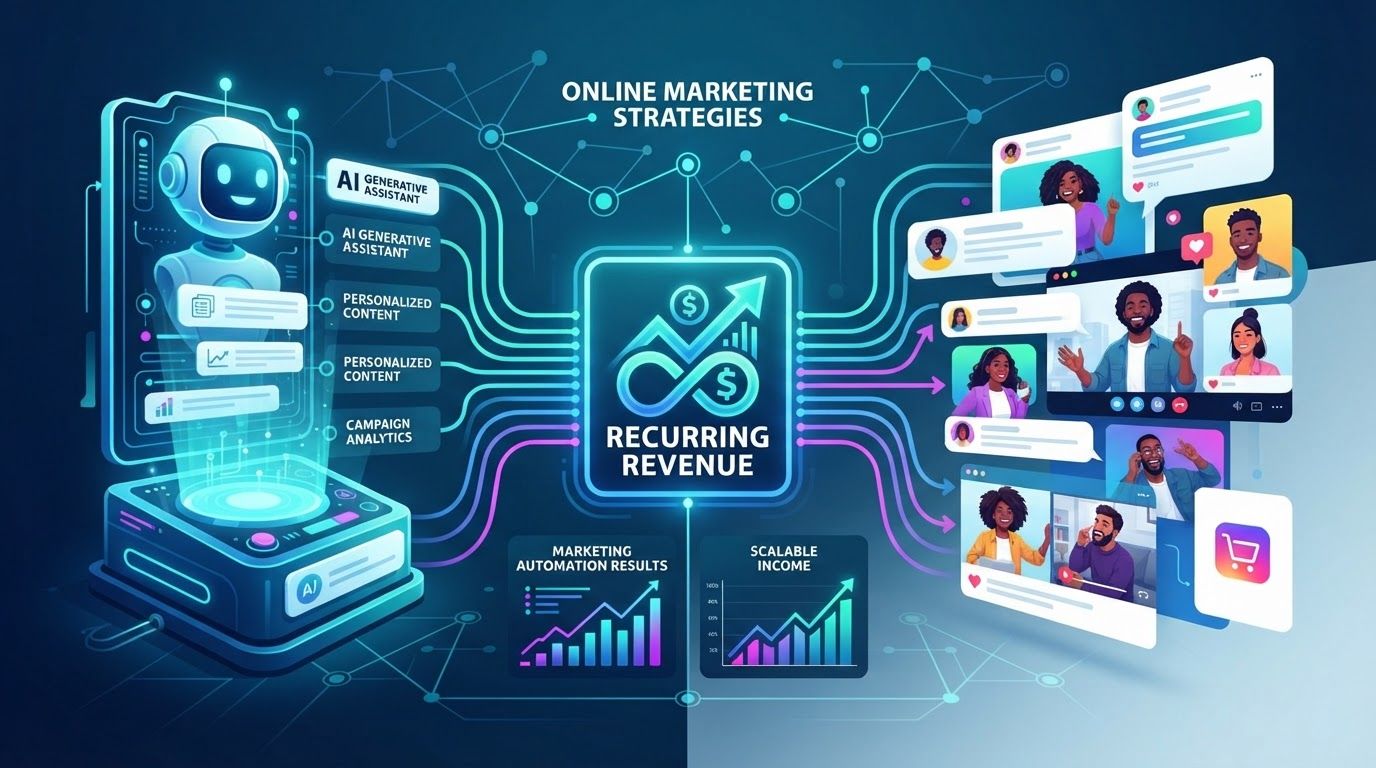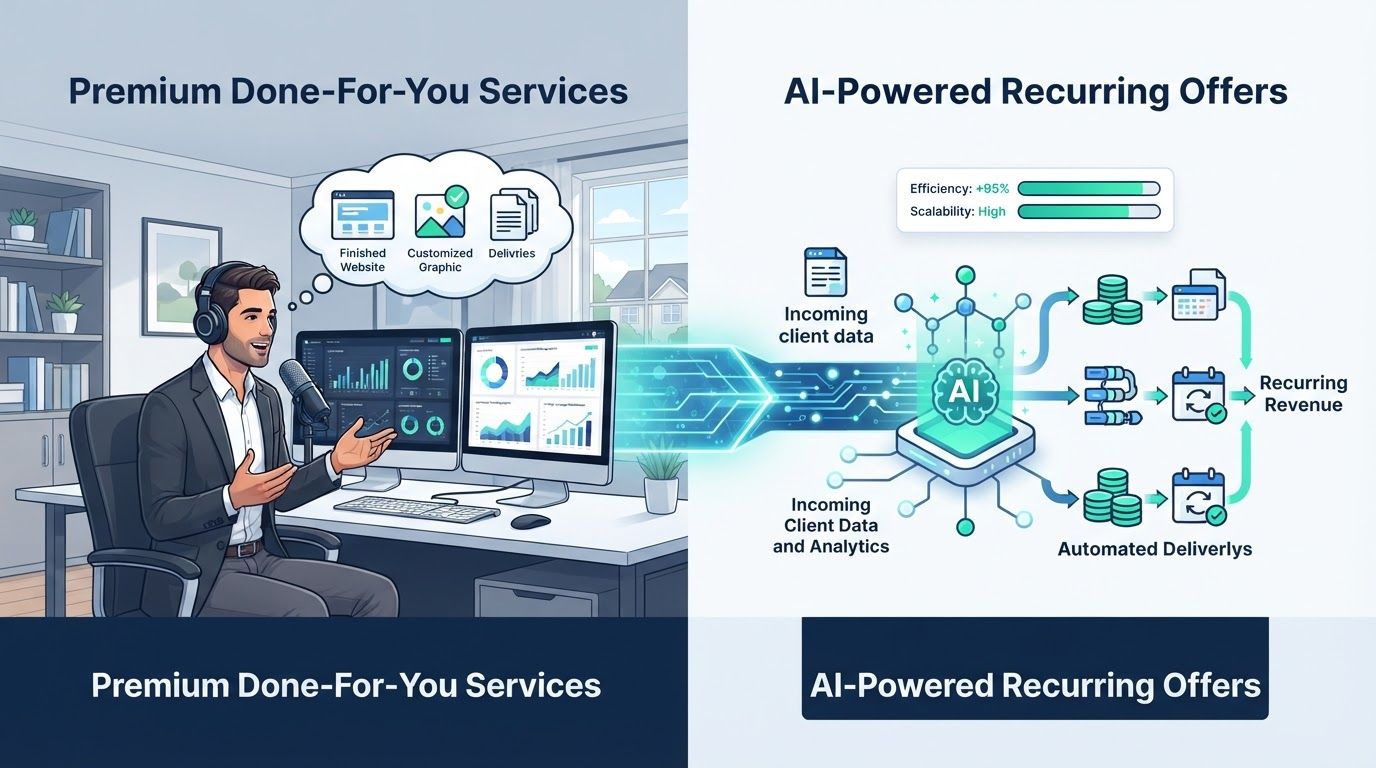
Clients rarely want another AI tool to configure, supervise, and troubleshoot. They want the work handled, which is why done-for-you remote services can command a premium when they deliver a useful result with less effort from the client.
For a home-based entrepreneur or affiliate marketer, the opportunity is not to sell access to artificial intelligence. It is to build a repeatable service around a recurring business problem, use AI to make delivery more efficient, and stay accountable for quality, decisions, and results. The key is knowing where that premium comes from,and what you must do each month to earn it.
Why clients pay more for done-for-you remote services
A do-it-yourself AI tool may be inexpensive, but the subscription is only one part of the client's cost. Someone still has to decide what to use it for, connect it to existing work, check its outputs, train the people involved, and fix the exceptions. A done-for-you provider takes responsibility for much of that coordination.
McKinsey's 2026 analysis describes the value of agentic AI as intelligent orchestration rather than full automation. That distinction matters for pricing: the premium is not for a prompt or a software license. It is for keeping a workflow moving from request to finished outcome while protecting service quality and customer trust.
Demand for outside help is visible in how buyers approach AI. McKinsey reports that roughly 80% of B2B customers prefer to source agentic AI through off-the-shelf solutions, managed services, or third-party-delivered custom builds. That does not mean every buyer wants a small remote agency, but it does challenge the assumption that clients all want to build and run these systems internally.
Convenience matters to individual users, too. In a Deloitte UK survey of 25,000 workers, 17% of GenAI users said they pay for at least one GenAI tool themselves for work purposes. Paying for a tool is not the same as buying a managed service, but it shows that some people will spend money to remove friction from work.
The strongest premium offer does not promise, “We use AI.” It promises, “We manage this specific outcome, including the parts AI cannot safely handle alone.”
For example, a business owner could generate draft customer replies with a tool. A provider charging more would organize incoming requests, prepare replies within an agreed scope, route sensitive cases to a human, review recurring problems, and report whether response times improved. The client pays for a dependable service layer, not the existence of draft text.
What makes a remote service worth a premium rather than a cheaper tool?
Premium pricing becomes defensible when the client can identify a meaningful difference between owning software and getting an outcome. Forrester argues that broad “agency services” positioning is less compelling than specialized capabilities backed by measurable outcomes and real-world proof points. If your pitch could describe hundreds of generalist providers, it will be difficult to explain a premium.
Look for value in the work surrounding automation. A client may be willing to pay more when your service removes implementation burden, makes delivery predictable, and frees their team to focus on decisions only they can make. McKinsey's B2B research similarly emphasizes disciplined execution, clear value articulation, and reliable operation at scale over simple access to technology.
- Speed: A lead gets a useful response while interest is still fresh, rather than waiting for someone to notice an inbox.
- Consistency: Routine work follows an approved process instead of depending on who is available that day.
- Judgment: A person checks ambiguous outputs and handles cases that require context, empathy, or authorization.
- Visibility: The client can see what was handled, what needs attention, and whether the agreed measure is moving.
- Ownership: The provider monitors failures and improves the workflow instead of declaring the job finished when the automation goes live.
Time-to-value is another useful way to think about the offer. HubSpot describes how AI can substantially compress the time required for a content task while maintaining quality. The lesson is not to bill for hours that no longer need to be worked. It is to make a useful deliverable available sooner and be clear about the quality checks that remain.
There is a trade-off. If a task is simple, low-risk, and easy for the client to perform with a tool, a premium managed service may be unnecessary. If results are hard to define or your intervention adds more meetings than it saves, the client may rightly choose software, a one-time setup project, or an internal hire instead.
Choose a recurring AI service clients already need every month
A recurring offer needs a recurring job. Contact-center and customer-service automation, along with content support for marketing strategy, are among the common use cases identified in McKinsey's 2026 AI survey. These functions make practical starting points because new requests, content needs, and operational exceptions keep arriving after the initial setup.
Start with a business function you understand rather than with a fashionable AI capability. An affiliate marketer who knows email campaigns might manage the preparation, review, and reporting of a merchant's recurring email content. Someone with support experience might manage a narrow set of customer inquiries and escalate anything outside approved guidance.
Pick a niche, a repeated task, and one primary measure
A useful positioning statement combines three elements: who you serve, what recurring work you manage, and what indicator the client will watch. “AI automation for businesses” says little. “We manage first responses to inbound inquiries for local service teams and report on response speed” gives a buyer a clearer decision.
Potential measures include lead response speed, support resolution time, renewal follow-up completion, or AI spend. These are examples of offer design, not promises that every provider can improve every metric. Choose a measure you can actually observe and influence. If you control only the first response, do not price or describe the service as if you control the final sale.
- Lead response operations: Capture incoming inquiries, prepare or send approved first replies, flag priority leads, and review unanswered requests.
- Customer-support triage: Sort routine questions, suggest answers from approved material, pass complex issues to a person, and track recurring gaps.
- Content operations: Turn approved ideas into drafts, coordinate review, publish within agreed channels, and report on delivery and engagement measures the client can access.
- AI cost operations: Monitor usage, identify unusual spending, recommend changes, and apply approved cost controls where the provider has permission.
Cost operations can be especially relevant when AI usage is unpredictable. Gartner identifies AI FinOps managed services as a way to address spending volatility and says real-time metering and autonomous remediation could potentially reduce clients' AI spend by 35% to 40%. Treat that figure as a potential described by Gartner, not a saving to guarantee in your sales page. The specific systems, permissions, and baseline spend would determine what any client could achieve.
The best starting niche is usually the one where you can reach buyers, understand their workflow, and spot errors before clients do. A narrower offer may feel less exciting than serving everyone, but it makes your delivery easier to repeat and your results easier to explain.
Build the managed workflow: intake, AI, quality checks, and reporting
A recurring retainer cannot rest on “we set up an automation and hope it runs.” The service needs an operating cycle. A practical structure is intake, workflow automation, quality assurance, optimization, and reporting. That structure is an inference from the emphasis Gartner places on managed services, McKinsey places on orchestration, and Forrester places on measurable outcomes.
- Define intake. Document where work enters the system, who can submit it, what information is required, and what counts as in scope. For a lead-response offer, that might mean a form or shared inbox, approved service information, business hours, and a rule for missing contact details.
- Design the AI-assisted steps. Give AI bounded jobs such as classifying requests, drafting a response from approved information, summarizing a case, or identifying an exception. Specify which actions are suggestions and which, if any, may happen automatically.
- Add human quality assurance. Decide what gets reviewed before it reaches a customer, what can be sampled afterward, and what must always be escalated. Keep an accessible record of corrections so the same mistake does not become routine.
- Optimize the workflow. Review repeated exceptions and bottlenecks. Update instructions, approved content, routing rules, or the client's internal handoff instead of merely generating more drafts.
- Report on the agreed outcome. Show work completed, exceptions, relevant measures, and decisions needed from the client. Make the report useful for action, not just a list of AI activity.
Consider a small online retailer receiving recurring product questions. AI could identify the topic and draft an answer based on approved policies. Your service would check uncertain replies, send shipping or refund edge cases to the right person, note gaps in the policy material, and share a short account of response patterns. That is a managed operation; a standalone chatbot is only one possible component.
Decide where automation stops
Gartner says customers expect the option to reach a human agent when companies use AI in customer service. Build that route into the service before you promise faster support. Requests involving sensitive information, unusual account changes, complaints, or unclear policy may need human handling, depending on the client's rules.
Also agree on access and responsibility. Who approves customer-facing language? Who owns the underlying account and data? Who responds if a connected tool fails? These details may seem less marketable than an AI demo, but they are essential to reliable remote delivery and client trust.
Price recurring offers around scope and outcomes, not AI-generated hours
AI can reduce the labor required for parts of a service. That does not force you to charge less if you are taking responsibility for a valuable result. It does mean you should avoid justifying a fee with hours you no longer spend. Explain the workflow you operate, the capacity you reserve, the oversight you provide, and the measure you report.
Begin with a defined monthly scope. Specify the channels covered, types of requests or deliverables included, expected input from the client, review arrangements, reporting cadence, and what happens when volume exceeds the agreement. A setup fee may cover discovery, access, approved materials, and testing; the recurring fee covers ongoing operation and improvement. State these separately so the client can see what continues after launch.
There are several reasonable pricing approaches. A fixed retainer offers predictable billing for a clearly bounded workload. A base fee plus usage tier can fit a service whose request volume changes. An outcome-linked component may suit a measure you can verify and meaningfully influence, but it needs careful agreement on the baseline, attribution, and factors outside your control.
Imagine two proposals for the same support team. One sells “AI chatbot management” with no stated review process. The other covers an agreed category of questions, defines a human escalation route, reviews recurring errors, and reports on resolution time. The second has a stronger case for a premium because the buyer can see what is being managed. Neither proposal should guarantee a particular improvement before the provider understands the starting point.
Protect margin without making the client carry hidden work
- Cap or tier the volume of requests, drafts, channels, or accounts you will manage.
- List client approvals and source materials needed to keep work moving.
- Price unusual integrations, new channels, and major process redesign separately.
- Track the time spent on quality assurance and exceptions, not only the time AI saves.
- Review scope when the client's business or tool costs change materially.
These boundaries protect both sides. The client knows what they are buying; you can deliver it without quietly absorbing unlimited revisions or support. Premium pricing works better when the service is transparent and sustainable, not when the proposal sounds unlimited.
Sell proof of execution instead of promising an AI transformation
Many agencies already use AI. Forrester found that nine in 10 US marketing agencies use generative AI, while half use agentic AI for marketing execution. It also found that 31% plan to monetize agentic AI within 24 months. Those findings suggest tool use alone is unlikely to distinguish your offer; showing how it creates business value is more useful.
Start sales conversations with the client's current process. Ask where work arrives, how long it waits, what gets missed, who checks quality, and what happens when a case falls outside the normal path. Then explain the smallest recurring service that could improve that process. If the client does not yet know their baseline, propose a short measurement and setup phase before discussing performance-based claims.
Forrester says agencies that help clients generate business value from AI are best positioned to grow their clients' investment budgets. You can make that value concrete without inventing a case study or a guaranteed return. Show a sample workflow, a sample report using clearly labeled demonstration data, and the decisions a client would need to make before launch.
- Show the before state: Map the current handoffs and identify the recurring friction the buyer recognizes.
- Describe the managed after state: Explain what your team handles, what AI assists with, and what remains with the client.
- Define a proof period: Agree on scope, starting measures, review dates, and criteria for continuing or changing the service.
- Make limitations visible: State which cases require escalation and which outcomes depend on the client's products, staff, or approvals.
A proof period can lead naturally to a retainer if it demonstrates that you can operate the workflow reliably. HubSpot describes strong partners moving from episodic implementation work toward embedded strategic relationships. The transition happens when you continue spotting problems, improving the process, and helping the client make better decisions,not merely when you ask for a monthly payment.
As you gain genuine results, ask permission to use them as proof points. Until then, describe your process and expertise accurately. A carefully scoped first client is more useful than a broad sales claim you cannot substantiate.
Know when a project, a tool, or an internal hire is the better choice
Not every client needs an ongoing provider. A one-time project may be right when the goal is to document a process, configure a simple workflow, or train a team that can confidently run it afterward. A self-service tool may be enough when volume is low and mistakes are easy to catch. An internal hire may make more sense when the work requires daily access to sensitive systems or close coordination across many departments.
A recurring done-for-you service fits better when the underlying work repeats, the client lacks time or specialist capacity to operate it, and continued monitoring can improve the outcome. Gartner's 2026 Market Guide says service and support leaders use outsourcing to scale capabilities, reduce costs, and speed automation and AI adoption. Those are reasons to consider managed delivery, not a reason to outsource every function.
Scale also has limits for the provider. More automation can increase the number of cases reaching you, but it may also increase the number of unusual cases you must review. If your service relies on unchecked output, an inaccessible client decision-maker, or a tool whose costs you do not monitor, adding accounts can weaken quality rather than increase profit.
Keep the human escape hatch practical. For customer-facing services, tell the client when a person takes over and who that person is. For marketing work, establish who approves claims and final publication. For AI spend management, agree which changes you may make and which require authorization. These rules give both parties a realistic picture of what “done for you” means.
The wider adoption picture supports a measured approach. McKinsey found regular AI use in at least one business function rose to 33% in 2025, from 28% in 2024 and 15% in 2023. Yet its 2026 AI research says only about 6% of respondents qualify as AI high performers. Adoption is growing, but reliable execution remains harder than opening an account and trying a tool.
Turn one repeatable service into a durable remote business
Once an initial offer works, standardize the parts that should not be reinvented for every client. Create a consistent discovery checklist, intake requirements, workflow map, approval process, exception log, and reporting template. Keep room for each client's policies and customers, but avoid custom-building the entire operation each month.
Use AI to support your own delivery as well. It can help organize incoming information, draft materials for review, summarize recurring issues, and prepare reporting notes. The efficiency benefit is real only if the finished work remains accurate and the client can understand what happened. Your repeatable process,not the tool alone,is the asset that allows you to serve clients reliably from a home office.
Expand only after you know what makes the first service succeed. A lead-response provider might later add follow-up operations, but only if it can define the new scope and show how the work connects to the client's goal. A support provider might add analysis of recurring questions before taking on a completely different marketing function. Related additions can deepen an embedded partnership without turning the offer back into vague “agency services.”
Review each account for three signals: whether the client is getting a useful outcome, whether your delivery is sustainable, and whether responsibilities remain clear. If one signal weakens, adjust the workflow or scope before selling more capacity. Recurring revenue is valuable only when the recurring obligation is manageable.
McKinsey's orchestration finding and Forrester's emphasis on measurable outcomes point to a straightforward long-term position: be the operator who makes AI useful in a specific business function. Tools will change. A trusted process for intake, execution, human judgment, improvement, and reporting gives clients a reason to continue working with you.
Clients pay a premium for done-for-you remote services when the provider removes work, manages risk, and delivers an outcome the client can recognize. AI can help you do that efficiently, but it does not replace a defined scope, sound judgment, or accountability.
Choose one recurring problem you understand, define the measure you can influence, and map the full workflow before naming your offer. If you can run that workflow consistently and show what improves, you have the foundation for a recurring service worth buying.