
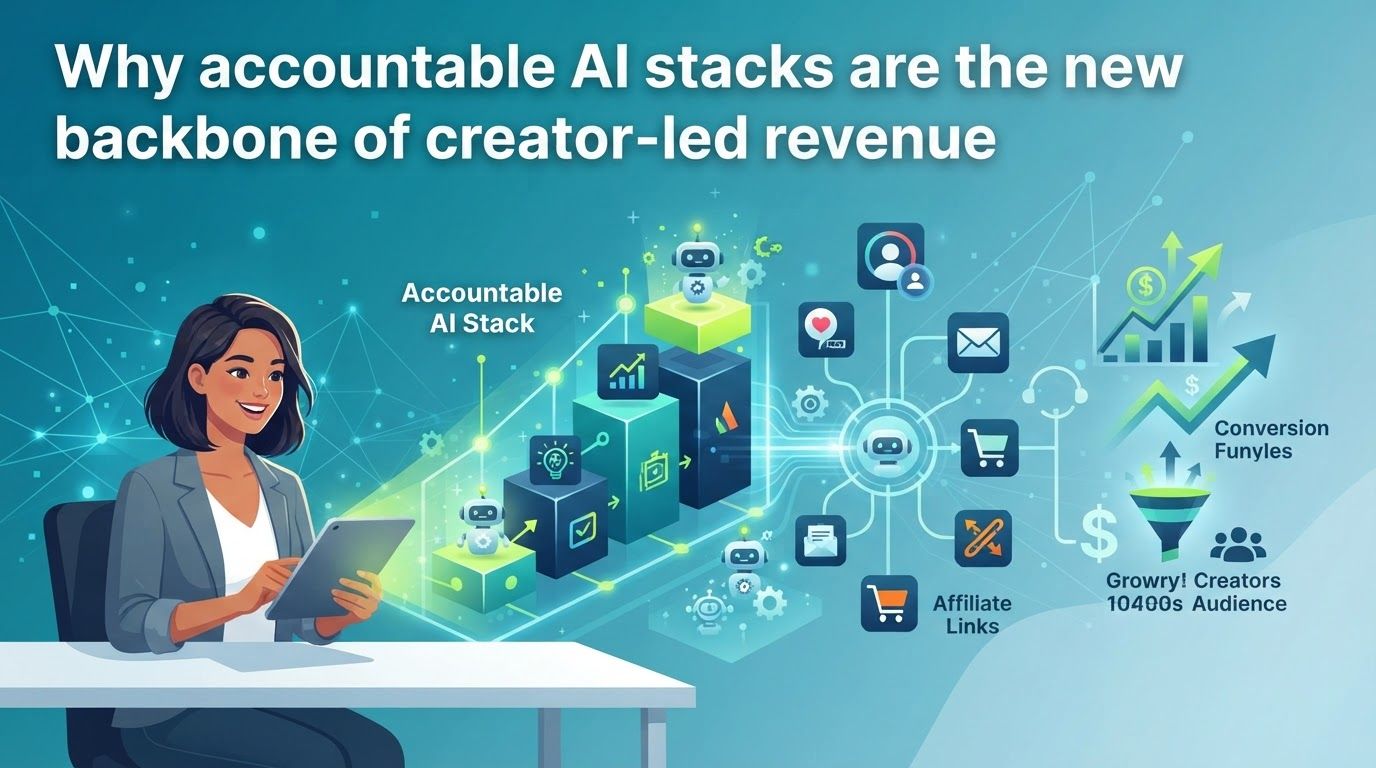
AI can help you publish more creator content, but more output does not automatically mean more reliable income. Accountable AI stacks connect the speed of AI with human review, clear records, and audience trust so a creator-led business can grow without losing the voice people came for.
That matters whether you run an affiliate blog from home, make short videos for a brand, or manage a small group of creators. The useful question is no longer simply which AI tool writes fastest. It is how you decide what AI may do, check what it produces, and keep responsibility for every recommendation you publish.
Why accountable AI stacks matter for creator-led revenue
Creator marketing is growing, and brands have reason to invest in it. CreatorIQ’s 2026 marketing study reported that 48% of brands see at least three times their return on investment from creator marketing, while budgets rose 33% year over year. As more money and content move through these channels, a misleading claim or an off-brand AI video becomes a commercial problem, not merely an editing mistake.
At the same time, creator income is not automatically stable. CreatorIQ’s 2026 creator study found that 67% of creators earn under $10,000 annually and 62% do not treat creator work as their primary income source. Its compensation research describes revenue as episodic and unpredictable, often tied to one-off campaigns rather than repeatable programs. Strong results for brands, in other words, do not guarantee a dependable business for every creator.
AI offers a way to make a small operation more productive. CreatorIQ found that 72% of creators use AI tools, most often for brainstorming, writing, or editing. In Adobe’s 2026 Creators’ Toolkit Report, 87% of creators using creative AI said it accelerated business or audience growth, and 75% described it as integrated or essential to their work. Those findings describe the creators surveyed; they are not a promise that adding AI will increase your own revenue.
Direct answer: An accountable AI stack is a connected set of rules, workflows, records, and human decisions that lets creators use AI efficiently while checking accuracy, protecting their voice, and making published work answerable to someone.
The business case is about preserving the value behind an audience relationship. Gartner found that 35% of U.S. consumers rely on influencers less frequently because of the prevalence of AI-generated content. CreatorIQ also reported that 44% of brands see AI-generated content, AI influencers, and lack of disclosure as a major threat to trust in creator marketing. If an audience cannot tell what you know, what you tested, or why you recommend something, faster production may work against the revenue it was meant to support.
Consider a home-based affiliate creator who turns product research into a newsletter, a comparison post, and several short videos. AI can help adapt the material for each format. But if it invents a feature in the original comparison, that error can spread into every version. An accountable workflow catches the claim before distribution, records the correction, and keeps the creator responsible for the final recommendation.
What belongs in an accountable AI stack?
A stack is not necessarily a collection of expensive subscriptions. It is the way your tools and working rules fit together. A solo creator can start with a document, a shared folder, an AI assistant, and a publication checklist; a larger team may need formal permissions and review stages. The important point is that each stage has an owner and a purpose.
TikTok’s responsible AI framework, cited by the World Economic Forum, describes five layers: governance, standards and rules, transparency systems, responsible creation, and controls and choice. A creator business cannot copy a platform’s entire infrastructure, but it can translate those layers into practical decisions:
- Governance: Decide who owns AI policy, who approves sensitive content, and who handles corrections. In a one-person business, write down that you are the approver rather than treating approval as an invisible step.
- Standards and rules: Define what AI can draft, what requires firsthand knowledge, and which claims must be checked against product information or other reliable evidence before publication.
- Transparency systems: Keep a record of significant AI involvement, source material, sponsorship relationships, and changes. Use that record to make accurate disclosures where relevant.
- Responsible creation: Protect your audience from fabricated experiences, misleading demonstrations, and synthetic voices or likenesses presented in ways that confuse people.
- Controls and choice: Give the creator a way to reject, revise, or withdraw AI-assisted work. Give the audience meaningful context rather than forcing them to guess how content was made.
These layers support one another. A disclosure may tell a reader that AI was involved, but it cannot fix an unsupported product claim. A review rule is similarly weak if no one has time or authority to apply it. TikTok and WEF’s 2026 discussion argues that disclosure of AI-generated creative content alone is insufficient; authenticity also depends on safeguards for creator values, context, and human judgment.
The human decision point is especially important. Adobe’s 2026 creator research found that 85% of creators say the final creative decision should always remain theirs. Adobe’s responsible AI materials likewise frame accountability through leadership review, oversight, and corrective action. For an independent creator, that can be as simple as a firm rule: the person whose name and reputation appear on a recommendation must read and approve it before it goes live.
Write your stack down in plain language. Name the tools you use, the information they may receive, the work they may produce, the evidence needed for approval, and where you log corrections. If a collaborator joins next month, they should be able to follow the same process without guessing what you meant by “use AI responsibly.”
How to keep AI speed without losing the creator’s voice
AI is most useful when it removes repetitive work around a creator’s real insight. It can organize notes, propose outlines, suggest alternate lines, and turn an approved idea into drafts for different channels. It should not quietly become the source of your experience, product testing, or opinion. Those are the reasons an audience follows you rather than a generic content feed.
Start by making a short voice and values brief. Include whom you help, the problems you address, words you avoid, how you handle uncertainty, and the kinds of recommendations you will not make. Add examples of your own approved work. The goal is not to freeze your style into a template; it is to give an assistant useful boundaries before it starts drafting.
Separate source material from generated copy
For a product-focused affiliate post, give your drafting tool a clearly marked set of inputs: product documentation you have checked, notes from your own use if you have any, the audience question you are answering, and the terms of a relevant partnership. Ask it to flag missing evidence instead of filling gaps with plausible-sounding details. If you have not used the product, do not let a draft imply that you have.
A simple working sequence helps keep that distinction intact:
- Capture the reader question. Write down the decision your reader is trying to make, such as whether a tool fits a home office workflow.
- Collect approved inputs. Separate verified product details, your own observations, partner information, and open questions so they do not blur together.
- Draft with limits. Ask AI to outline or rewrite from those inputs and to mark any claim it cannot support.
- Review as the creator. Check claims, tone, examples, and whether the conclusion matches your genuine judgment.
- Adapt only the approved version. Make your email, post, or video script from a checked master draft rather than from an unchecked first output.
This order matters when one idea becomes many assets. CreatorIQ’s safety research found that creators produced 33 times more posts than the highest-revenue brands did on owned channels. That comparison helps explain why even a small quality problem can travel widely when creator content is repurposed across formats. A master draft and an approval point give you speed without multiplying the same mistake.
Human review also means being willing to say no to a smooth draft. If a line overstates a result, an example sounds unlike you, or a product claim would make you uncomfortable saying it on camera, change it. Your stack should make rejection an ordinary part of production, not an embarrassing interruption to automation.
Why disclosure, provenance, and review are different jobs
Trust is easier to protect when you do not ask one safeguard to do everything. Disclosure tells people something important about a piece of content or a commercial relationship. Provenance helps you trace where a claim, image, or script came from. Review checks whether the finished work is accurate, appropriate, and genuinely yours. They work together, but they are not interchangeable.
For an affiliate creator, disclosure may involve making a commercial relationship clear to the audience. If AI has materially shaped creative work, you also need to consider the relevant platform requirements and the context in which the audience encounters it. A label should be accurate and understandable; it should not be treated as permission to publish content you have not checked.
Provenance is your behind-the-scenes trail. Keep the source for a product specification, the version of a script sent to a brand, the approved image or asset, and a note when a claim changes. You do not need to show an audience every working document. You do need enough information to answer a reasonable question from a reader, collaborator, or partner about how a claim reached publication.
Review is where the creator’s judgment becomes visible in the workflow. Before publishing, ask:
- Can I support the specific product and performance claims in this piece?
- Does it imply I used, tested, or endorsed something I did not?
- Are commercial relationships and significant synthetic elements presented clearly in context?
- Could an image, voice, or edited example mislead someone about a real person or event?
- Would I make the same recommendation if the affiliate payment or brand brief were removed?
The wider AI ecosystem is moving toward this kind of accountable deployment. OpenAI’s 2026 policy direction supports protections against harmful misuse of voice and likeness while preserving lawful expression, along with disclosure requirements for certain AI-generated political content. That is a policy direction, not a substitute for checking the rules that apply to your own publication. It illustrates why choices about synthetic media, consent, and context belong in a business workflow rather than in a last-minute caption edit.
There is a practical limit to recordkeeping: saving every prompt forever can make a small business harder to run without improving the decisions that matter. Prioritize records that help you substantiate claims, explain material creative choices, confirm approvals, and make corrections. The useful question is not “Did we save everything?” but “Can we show why this was safe and fair to publish?”
Turning one-off creator campaigns into repeatable revenue systems
One sponsored post can pay well and still leave next month uncertain. CreatorIQ’s compensation research describes creator earnings as episodic, driven by one-off campaigns instead of repeatable programs. An accountable AI stack cannot create demand or guarantee renewals. It can make good work easier to reproduce and easier for a partner to trust over time.
Think of a recurring content series around a narrow audience problem: affordable ways to organize a home workspace, for example. You can develop a consistent research method, an editorial calendar, and a set of formats you know your audience uses. AI can help turn each carefully reviewed topic into an article, email, and short-form script. Your review process keeps the advice and commercial context consistent across them.
Build reusable assets, not just more posts
Reusable assets reduce the effort required for the next campaign without pretending that every product deserves the same message. A creator-led system might include:
- A brief that records the audience problem, the product’s relevant features, important exclusions, and the questions you still need to verify.
- An approved description of your audience and your editorial approach for prospective partners, kept separate from claims about results you cannot substantiate.
- A claim library that links frequently used statements to checked source material and flags details that may change.
- A channel checklist that adapts an approved recommendation for a blog, email, or video without dropping essential context.
- A feedback log for reader questions, corrections, and partner requests that should shape future content.
This is how an operating layer differs from a collection of prompts. Prompts can generate versions; the surrounding system remembers what you promised, why you believe a claim, and what happened after publication. That memory supports consistency as you work with more partners or bring in an editor.
Consistency is commercially meaningful because audiences notice it. Adobe’s 2026 brand intelligence research found that 83% of consumers consider it important for trust that a brand looks, sounds, and shows up the same way. A creator is not the same as a corporate brand, and a recognizable voice should still be allowed to evolve. But if your advice changes dramatically with each sponsor or AI-generated script, readers may struggle to understand what you stand for.
Repeatability also calls for selectivity. A reliable workflow may help you decline a campaign when a product is a poor fit or when a brief asks you to make claims you cannot back up. That can mean less content in the short term. It also prevents your automated production process from turning a bad partnership into a whole series of bad recommendations.
The trade-offs: full automation, manual creation, and a hybrid approach
There is no single stack size that fits every creator. If you publish occasionally and handle a small number of partnerships, a manual checklist may be enough. If you distribute content daily across channels or coordinate several contributors, more formal approvals and records become useful. Choose the lightest process that reliably catches the mistakes that would matter to your audience.
When a manual workflow is enough
Manual creation gives you direct control and can preserve the spontaneity that makes creator content appealing. It is a sound choice for personal stories, nuanced product opinions, or material where speed offers little benefit. Its weakness is that the same person must remember every check, every time. A short written checklist is still valuable even if you use very little AI.
When full automation becomes risky
Automating research, drafting, publishing, and replies with no meaningful review may look efficient. But it creates a path for unsupported claims, generic advice, and inconsistent disclosures to reach the audience before anyone notices. Adobe’s 2026 AI and Digital Trends report found that 55% of organizations say they have strong AI governance policies, while only 43% say those policies are consistently followed. Having a policy on paper is different from building a publishing process people actually use.
Gartner’s 2026 discussion likewise says AI adoption is outpacing governance in many organizations and recommends dedicated accountability to scale it safely. A solo operator does not need a governance department. They do need to decide which tasks can run automatically and which require a named person to approve them.
Where the hybrid approach earns its place
A hybrid process lets AI do the first pass on organizing, outlining, editing, and formatting while the creator makes consequential decisions. You might automate transcript cleanup or the creation of social drafts from an approved article, but personally verify product claims and approve the final recommendation. If you hire help, assign responsibilities explicitly: who checks facts, who confirms partnership details, and who can publish?
Automation has a cost beyond subscriptions. Setup, ongoing maintenance, and training contributors all take time. More controls can also slow a timely post. Before adding a new tool, name the failure it will prevent or the repeatable task it will simplify. If you cannot answer that question, improve your existing workflow first.
How to measure trust and revenue without chasing output alone
A content calendar can tell you how much you published, but not whether people still believe you. That distinction matters as AI-generated media becomes more common. The World Economic Forum cites IAB data that 86% of digital video buyers were using or planning to use generative AI for video creative, with buyers expecting it to touch about 40% of video ads by the end of 2026. These are buyer-reported adoption and expectation figures, not a measure of your audience’s preferences. They show why more AI-assisted content is likely to compete for attention.
For a creator-led business, measure the quality of the system alongside its output. Look at a small set of signals you can actually review:
- Content reliability: Track claims corrected after publication, recurring questions that reveal confusion, and drafts stopped because evidence was missing.
- Audience response: Notice thoughtful replies, repeat questions, unsubscribes after particular promotions, and whether readers understand the basis for your recommendations.
- Partner confidence: Record whether briefs and approvals are smooth, whether partners request corrections, and whether appropriate partners choose to work with you again.
- Business performance: Compare revenue from repeat programs with one-off work, while keeping channel performance and audience fit in view.
- Workflow health: Watch the time spent reviewing, the number of handoffs, and whether the person assigned to approve content can realistically do so.
Do not turn any one signal into a verdict. A quiet comment section does not prove lost trust, and a strong conversion period does not prove every claim was sound. Look for patterns over multiple pieces of content, especially after changes to your AI workflow. When a correction is needed, document what went wrong and adjust the step that allowed it through.
It helps to distinguish leading checks from business outcomes. A verified claim, clear approval, and accurate disclosure happen before publication; sales and renewals come later. You can improve the first group directly. The second group also depends on product quality, audience demand, pricing, and many other factors beyond your stack. That distinction keeps accountability useful instead of turning it into a promise of higher earnings.
A practical way to build your accountable AI stack
You can begin without rebuilding your business. Pick one content workflow you already use, such as an affiliate review or weekly newsletter, and map what happens from idea to publication. Mark every point where AI helps, where information enters, and where a person makes a decision. You may discover that your biggest gap is not drafting quality but the absence of a clear source for product claims.
- Set the boundaries. Write a one-page rule for what AI may draft, what information you will supply, what it must not invent, and which uses require additional review.
- Choose an accountable owner. Name the person who approves publication and handles corrections. If that person is you, protect time for the task instead of assuming it will happen automatically.
- Create a source packet. Keep checked product details, your own experience notes, relevant partnership terms, and open questions together for each piece of content.
- Add a pre-publication check. Review evidence, voice, imagery, commercial context, and the final call to action before scheduling anything.
- Keep a usable record. Save the approved version, key supporting sources, and any material changes or corrections in a place you can find later.
- Review the process after publishing. Use reader questions, partner feedback, and errors to improve the next cycle rather than adding controls for their own sake.
Start with the riskiest piece of your workflow, not the most impressive automation. If your emails are already carefully written but short videos are being generated from thin notes, focus your next review step on video scripts and visuals. If you collaborate with an editor, agree in advance which changes require your sign-off. Small, followed rules are more useful than a comprehensive policy no one consults.
As your business grows, consider whether your current tools make it easy to trace claims, control access, and approve content before it reaches each channel. Those needs may justify a more structured system later. For now, the test is simple: can you produce useful work at a sustainable pace, explain how you reached your recommendations, and correct a mistake without searching through a maze of files?
Creator-led revenue depends on something AI cannot manufacture for you: a reason for people to trust your judgment. Use AI to reduce routine work, then give that work a clear path through evidence, review, and your final decision. The result is not perfect content or guaranteed income; it is a business better prepared to earn repeat attention and responsible partnerships.
If you are building from home, choose one recurring piece of content and document its path from research to publication this week. Fix the weakest handoff first, whether that is claim checking, approval, disclosure, or recordkeeping. An accountable AI stack begins when you make your existing process trustworthy enough to repeat.


No comments:
Post a Comment