
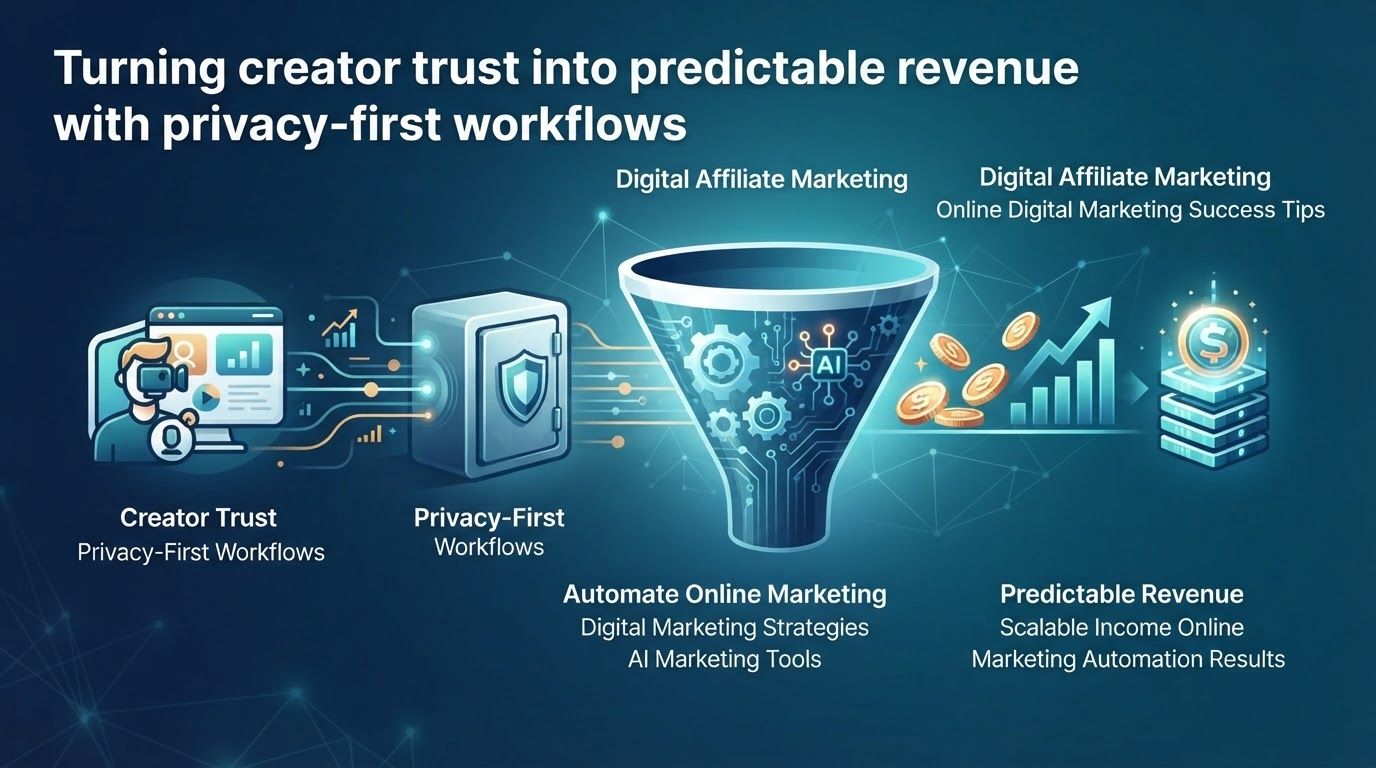
A creator can earn an audience’s confidence and still face months of uneven income. Turning that trust into more predictable revenue takes privacy-first workflows: clear offers, permission-based audience relationships, transparent recommendations, and measurement that does not depend on collecting more personal data than necessary.
For affiliate marketers and home-based entrepreneurs, this is an operating challenge, not a reason to post more often or automate every interaction. The goal is to build a system that helps people make informed buying decisions, gives you a reliable way to learn what works, and respects the limits of the data they choose to share.
Why creator trust does not automatically become predictable revenue
Trust makes a recommendation worth considering, but it does not determine when a buyer is ready, whether an offer fits their needs, or how a creator gets paid. Modash’s 2026 Creator Trust Report surveyed 1,042 U.S. adults and found that, among people who follow creators, 84% had purchased something based on a creator’s recommendation. That shows the commercial potential of trusted recommendations; it does not mean every recommendation produces dependable income.
CreatorIQ’s 2026 study of 5,095 creators across 100 regions illustrates the gap. It found that 67% earned under $10,000 from content creation in the past year, while under 5% earned more than $100,000. Its State of Creator Compensation report also found that the top 10% of creators earned 62% of creator payments in 2025 and described income as episodic and unpredictable, often driven by one-off campaigns.
Meanwhile, brand interest is substantial. IAB projected U.S. creator ad spend of $37 billion in 2025, up 26% year over year, and $44 billion in 2026. A growing market creates opportunities, but it does not distribute them evenly or remove the uncertainty of an individual campaign.
Direct answer: Turn creator trust into more predictable revenue by pairing relevant, clearly disclosed offers with consent-based audience channels, repeatable follow-up, and privacy-conscious measurement. Review performance over time, then improve the offers and workflows that serve your audience without treating personal data as a shortcut.
The useful question is not simply, “How do I get more followers?” It is, “What can a person reliably expect after they decide to trust one of my recommendations?” If the answer changes with every sponsor, link, or platform algorithm, revenue will be difficult to plan around.
Identify the break in the journey
Start by looking at the path from a reader’s problem to a purchase. Is the offer relevant to the problem? Can the reader tell what is sponsored, what you have tested, and what limitations matter? Is there a sensible next step for someone who is interested but not ready to buy today?
These questions separate an audience problem from an operating problem. More reach may help when the right people rarely see your work. But if people engage and still cannot find an appropriate offer, a clear explanation, or a permission-based way to hear from you again, more traffic may only increase the number of missed opportunities.
Build a revenue mix around repeatable audience needs
One-off sponsorships can pay well, but they are hard to forecast when each deal requires a new negotiation and a new approval cycle. A more repeatable model begins with the needs your audience brings back to you: the task they are learning, the tool they are choosing, or the obstacle that appears at the next stage of their business.
For example, a creator teaching beginners how to set up a home-based business might publish a guide to choosing an email platform. A relevant affiliate recommendation could sit alongside a plain-language comparison, setup instructions, and an explanation of who may not need a paid plan yet. The guide remains useful even when no purchase happens immediately.
That approach differs from placing a link wherever it might earn a commission. It gives readers a reason to return and makes the commercial path easier to understand. It also creates an asset you can update as products, prices, and your own experience change.
- Affiliate offers: Useful when a product closely matches a recurring question, but commission terms and merchant conversion paths remain outside your control.
- Sponsorships: Useful for funding substantial content, but campaign timing and brand approvals can make income uneven.
- Your own digital products or services: Give you more control over the offer and customer experience, but require delivery, support, and a clear value proposition.
- Subscriptions or memberships: Can support an ongoing relationship when you can consistently provide a distinct benefit; they also create a continuing obligation to members.
These options are not interchangeable. A beginner does not need to launch all of them. Choose one primary offer type that matches what you can deliver well, then consider a complementary option when audience questions justify it. For an affiliate-focused business, that may mean improving a small set of recommendations before adding a course or a membership.
IAB’s 2025 creator-market reporting notes that some market estimates include affiliate links, subscriptions, tips, and merchandise alongside advertising. The channels differ, but they share a practical requirement: readers need to understand what is being offered and what relationship, if any, influences the recommendation.
Make each recommendation earn its place
Before adding an offer, write down the audience problem, the person the product is for, the person it is not for, and the evidence behind your recommendation. Explain meaningful trade-offs, such as cost, learning curve, support needs, or whether a free alternative is sufficient. If you have not used a product, do not imply hands-on experience.
This review protects the trust that makes future recommendations possible. It also makes income easier to analyze: when each offer serves a defined need, you can compare how people respond without guessing whether a disappointing result came from the content, the product fit, or an unclear buying path.
Use privacy-first workflows to keep audience relationships permission-based
A privacy-first workflow starts before someone enters an email address or clicks an affiliate link. It asks what information is actually needed, why it is collected, how it will be used, who receives it, and what the person should reasonably expect next. The answer should be understandable to the audience, not only to the business owner.
For a small creator business, an email signup is a useful example. If a visitor requests a checklist, explain whether they will receive only that resource, an ongoing newsletter, or promotional emails as well. Keep the signup language consistent with the messages you send, and provide a straightforward way to stop receiving them.
Do not assume that a first-party email list is automatically compliant simply because you collected it yourself. IAB’s 2024 internet ad revenue report describes a broader industry pivot toward privacy-first approaches, including first-party data, contextual advertising, and data clean rooms as reliance on third-party identifiers declines. First-party collection can help you build a direct relationship, but the way you obtain and use that data still matters.
Map the data before adding automation
List the places where audience information enters your business: signup forms, checkout pages, contact forms, analytics, affiliate networks, ad platforms, and customer-support tools. Then note what each tool receives and whether you need that information to deliver the promised experience. This simple inventory is often more useful than adding another dashboard.
- Define the purpose: State what each form or tracking tool is meant to accomplish. Avoid collecting fields merely because the software makes them available.
- Check the permission: Match your notice and consent mechanism to the marketing activity and the markets you serve. Do not treat a general acceptance of site terms as a substitute for every marketing permission.
- Review sharing: Identify when information goes to an email provider, affiliate partner, ad platform, or other third party, and assess whether the permission and disclosures cover that use.
- Limit access: Give collaborators and automation tools only the information needed for their tasks. Remove connections and stored data that no longer serve a clear purpose.
- Test the experience: Sign up as a visitor would, read every notice, follow the messages, and check whether opting out is easy to find and works.
Legal requirements vary by location and by channel. As a concrete example, the UK Information Commissioner’s Office says direct marketing needs a lawful basis and recommends planning campaigns with data protection by design. It also says consent is required for some electronic marketing under PECR. If personal data used for consent-based online advertising is then supplied to third parties, the ICO says the user’s consent must apply across that chain.
That is a reason to inspect the entire workflow, not just the wording beside a signup button. If a tool promises effortless retargeting or audience syncing, ask which parties receive data and whether your permissions support that use. When the answer is unclear, a simpler approach, such as contextual placement or an email sequence sent to people who requested it, may be easier to explain and maintain.
Make affiliate disclosures part of the buying experience
Transparent monetization is a practical service to your reader. If you earn a commission, receive a product, or have another material relationship that could affect how a recommendation is understood, the audience should be able to recognize it without hunting through your profile or a distant policy page.
The U.S. Federal Trade Commission says influencers must disclose material relationships clearly and conspicuously, close to the endorsement. It recommends simple language such as “ad” or “sponsored” and says platform disclosure tools are not sufficient by themselves. A disclosure hidden among hashtags or left only in a description may not give someone the context they need when they see the recommendation.
For an article, put a clear affiliate disclosure near the recommendation or link so a reader encounters it at the relevant moment. For a video or social post, consider where the endorsement appears and where viewers will actually see or hear the disclosure. The format may change, but the principle is consistent: do not make the audience work to discover the commercial relationship.
Separate recommendation quality from commission size
A high payout can make an offer attractive to a creator even when it is a poor fit for the audience. Counter that incentive with an editorial check: Would you still explain this product’s strengths and limitations the same way if the commission changed? If not, reconsider the recommendation or revise the content until the trade-offs are honest.
Suppose you review two automation tools. One pays an affiliate commission and the other has a free plan that is better for someone just starting out. You can still recommend the paid tool to people who need its capabilities, while clearly saying when the free option is enough. That distinction helps a reader act with confidence and makes your future advice more credible.
Disclosure is not a guarantee that everyone will buy. It is a foundation for informed choice. A reader who understands why a link is there can evaluate the recommendation on its merits, while you avoid making the commercial relationship a surprise after the click.
Document your disclosure approach so it survives repurposing. When you turn a blog post into an email, short video, or social caption, check the disclosure in the new context rather than assuming the original article covers it. This small editorial habit is especially important when templates or AI tools help publish the same idea across several channels.
Measure revenue without building a surveillance system
Predictability requires measurement, but not every metric answers a revenue question. IAB’s work on the creator economy’s measurement landscape identifies fragmented metrics, siloed platforms, and proxy-based return-on-investment measures as enterprise risks. A small creator faces a simpler version of the same problem: a platform view, an affiliate click, an email signup, and a sale may appear in different systems and tell different parts of the story.
Begin with decisions rather than dashboards. If you want to know whether an educational guide helps people choose a product, track the guide’s relevant visits, the clicks to the offer, and the commissions reported by the affiliate program. If you want to assess an email series, examine whether subscribers engage with it and whether its recommendations lead to the outcomes you can legitimately observe.
Not every sale can be attributed to a single post. People may compare options on another device, return later, or decide after a conversation you cannot measure. Treat reported conversions as useful evidence, not a complete account of every influence your content had.
Choose a small set of useful signals
- Offer relevance: Which questions or content topics lead people to seek more information about an offer?
- Qualified action: Which pages or emails prompt a click from someone who has received enough context to evaluate the product?
- Reported revenue: What commissions, product sales, or contract payments are recorded by the systems that process them?
- Continuity: Do useful content and permission-based follow-up bring interested people back, or does every campaign start from zero?
- Audience feedback: What objections, requests, refunds, or support questions suggest that an offer or explanation needs work?
Use a consistent review routine. Record the content and offer involved, the measurement source, the period being compared, and any important changes, such as a revised landing page or altered affiliate terms. This makes it easier to distinguish a genuine pattern from a one-time promotion without pretending that the data is perfect.
Privacy-preserving measurement has limits and is still developing. NIST’s 2025 SP 800-226 defines differential privacy as a mathematical framework for quantifying privacy loss and gives guidance for evaluating privacy-preserving software solutions. It is not a feature you can assume exists because a vendor calls its dashboard private; assess the actual method and whether it fits your use case.
Recent academic work on the IAB Global Privacy Platform and a 2026 NIST workshop presentation also indicate that consent measurement and privacy-preserving ad conversion measurement remain active technical challenges. For a beginner, the sensible alternative is rarely to engineer a sophisticated identity system. Start with the data you are entitled to use, compare like with like, and acknowledge what your reports cannot establish.
Use AI and automation to support judgment, not replace it
AI can help a small business carry out repeatable work: organizing audience questions, drafting a content outline, summarizing approved performance reports, or checking whether a publishing checklist was completed. Aspire’s 2026 benchmark report found that 59% of marketers use AI to scale creator discovery, workflows, and analytics. That is evidence of adoption, not proof that automation improves the quality of every recommendation.
The best tasks to automate have clear inputs and review points. For example, you might use a tool to group recurring questions from messages you are permitted to analyze, then decide which deserve a human-written guide. You might generate a first draft of an email, but review the product claims, disclosure, tone, links, and recipient permissions before sending it.
Do not paste personal audience details into an AI system merely because doing so is convenient. Check what the tool needs, what its terms say about data handling, and whether aggregated or de-identified inputs would answer the question. If a task requires sensitive context, decide whether it belongs in that tool at all.
Create one publishing checkpoint
Before a recommendation goes live, ask one person, or use a written checklist if you work alone, to verify five things: the audience problem is clear; product claims are supportable; material relationships are disclosed; links and signup promises match the destination; and any collected information has a defined purpose. The checkpoint can be brief, but it should be consistent.
After publication, let automation handle reminders rather than decisions. A recurring prompt to review an article can help you catch outdated pricing references, changed affiliate terms, broken links, or an offer you no longer stand behind. The human decision is whether the recommendation still serves the reader.
CreatorIQ’s 2025,2026 State of Creator Marketing report describes pressure around creator vetting, compliance, data ownership, privacy, and measurement, with centralized program control becoming essential for organizations. You do not need an enterprise system to apply the lesson. A single record of offers, disclosures, permissions, owners, and review notes can keep a home-based business from losing track as it grows.
Turn the strategy into a manageable operating routine
You can put this model into practice without rebuilding your business at once. Start with one audience problem you understand well and one offer you can evaluate honestly. Build or improve the content that answers the problem, then connect it to a permission-based way for interested readers to continue learning.
- Audit the current journey: Read your most relevant content as a new visitor. Identify where the next step, commercial relationship, or product limitation is unclear.
- Choose the offer: Confirm who it helps, what evidence supports your recommendation, what alternative may fit someone else better, and what you earn if a purchase occurs.
- Clarify permissions: Check the signup promise, marketing messages, tools receiving data, and opt-out process before adding new follow-up.
- Set a measurement baseline: Record the signals available from your site, email provider, affiliate platform, or checkout, along with the gaps between them.
- Review and revise: Use reported results and audience feedback to improve the explanation, offer fit, or follow-up. Keep the content useful even when the reader decides not to buy.
This routine makes trade-offs visible. A sponsorship may be worth taking for the income, but it might interrupt a more coherent sequence of audience education. An elaborate tracking tool may promise better attribution, but it can add cost, data-sharing questions, and maintenance work. A smaller set of offers with clearer explanations may be easier to manage than a large library of links.
Review both revenue and relationship quality. If commissions rise while readers increasingly question your recommendations, the system needs attention. If readers appreciate your work but no offer helps them take a useful next step, consider whether the product, placement, or business model needs to change.
Usercentrics’ 2026 State of Digital Trust report found that 47% of consumers globally had taken at least one action with a direct revenue consequence in the prior six months because of concerns about how brands handle their data in AI. That finding does not predict what your own audience will do, but it reinforces why data handling belongs in the customer experience rather than in a forgotten settings page.
There is no workflow that makes creator income certain. Merchants change terms, audiences change needs, platforms change distribution, and measurement remains incomplete. What you can control is the quality of the recommendation, the clarity of the relationship, the permissions behind your outreach, and the discipline with which you learn from results.
Pick one existing recommendation this week and trace its full path: content, disclosure, link, signup, follow-up, data sharing, and reported outcome. Improve the weakest step before adding another offer. That is a practical way to turn trust into a business process without spending the trust itself.


No comments:
Post a Comment