
Showing posts with label Digital Entrepreneur. Show all posts

Monday, November 16, 2026

Scaling partner commissions with automated workflows and AI insights

Scaling partner commissions with automated workflows and AI insights

Scaling partner commissions gets difficult when every new affiliate, offer, or exception adds another spreadsheet check. Automated workflows can handle the repeatable calculations, while AI insights help you spot unusual results and make better decisions about where to invest.

You do not need an enterprise-sized program to benefit. A home-based business with a handful of partners can start by documenting its commission rules, connecting reliable sales data, and reviewing exceptions before anyone gets paid. The goal is not to remove people from the process; it is to give them a process they can trust as the program grows.

Why partner commissions become harder to manage as you grow

A simple affiliate program may begin with one product and one percentage rate. Soon, you might add recurring subscriptions, limited-time bonuses, different rates for different partners, and refunds that arrive after a commission has been recorded. Each change introduces a question: Which partner gets credit, how much have they earned, and when is that amount payable?

This is more than an accounting inconvenience. Partners need clear earnings information to decide what to promote, and you need a reliable view of commission costs to judge whether a campaign is profitable. If the numbers in your affiliate platform, store, and payment records disagree, a faster payout process will only deliver questionable answers faster.

The wider partner market helps explain why these workflows are receiving attention. Salesforce’s 2026 State of Sales report says 94% of sales teams use partner selling, and 90% of sales professionals who work with partners use dedicated tools to support them. Those figures describe surveyed sales organizations, not a typical small affiliate business, but they illustrate how partner relationships can outgrow informal tracking.

Forrester also reports that 70% of partner ecosystem and channel marketing decision-makers consider orchestrating or optimizing a partner ecosystem very important or absolutely essential. For a smaller operator, the practical lesson is not to buy a large platform immediately. It is to treat the connection between partner activity, sales records, and commissions as a core business process rather than a spreadsheet chore you will fix later.

  • More offers create more rules: A subscription, a one-time product, and a special launch bonus may each need different treatment.
  • More partners create more exceptions: A partner may change links, dispute attribution, or qualify for a negotiated rate.
  • More transactions create more timing issues: Refunds, cancellations, and payment delays can change what is actually owed.

Automation helps most when these situations are defined in advance. AI becomes useful once the underlying records are dependable enough to reveal patterns worth acting on.

Define commission rules before you automate them

Start with a written commission policy that a partner and a bookkeeper could both understand. Specify the event that creates a commission, the rate or flat amount, the attribution method, and the point at which earnings become eligible for payout. If you offer recurring commissions, define how renewals, failed payments, cancellations, and plan changes are handled.

Consider a hypothetical affiliate who promotes two offers: a course with a one-time commission and a subscription with a recurring commission. A workflow cannot safely infer whether an upgrade counts as a new sale, a renewal, or an excluded transaction. You have to decide first, then translate that decision into a rule that can be tested against real orders.

Create a source of truth for every calculation

Each commissionable event should connect to a partner identifier, an order or invoice identifier, the relevant offer, the applicable rule, and the current transaction status. Keep the original sale amount distinct from the amount on which commission is calculated. For example, a program might exclude shipping or taxes from its commissionable base; whether yours does so is a policy decision that should be explicit.

Record rule versions, too. If you change a rate for future sales, the system should preserve which rate applied to earlier transactions. Otherwise, a later recalculation could silently rewrite historical earnings. An adjustment record is usually more transparent than editing an old commission entry without leaving a trace.

  1. List your offers and eligible partners. Note any negotiated rates, temporary promotions, or partner tiers.
  2. Write down credit rules. Decide what counts as a valid referral and how you handle overlapping links, coupon codes, or manual referrals.
  3. Set earning and payout states. Distinguish a tracked sale from a pending commission, an approved commission, and a paid commission.
  4. Define reversals. State what happens when an order is refunded, canceled, duplicated, or determined to be ineligible.
  5. Test the awkward cases. Walk through an upgrade, a partial refund, an expired promotion, and a disputed referral before turning on automatic approvals.

This preparation is not separate from scaling; it is the foundation of it. Salesforce describes AI-powered incentive compensation management as a way to automate calculations, plan administration, earnings reporting, and support. Those capabilities still depend on clear plans and usable deal data. For a small program, a well-maintained rules document can be more valuable than a sophisticated tool configured around vague policies.

Build an automated partner commissions workflow from sale to payout

Direct answer: To scale partner commissions, capture each eligible sale, apply a documented rule, hold the result until it can be verified, route exceptions for review, and reconcile approved earnings before payout. Use AI to investigate patterns and assist reviewers, not to invent rates or approve ambiguous transactions on its own.

Think of your workflow as a series of handoffs rather than one giant automation. The sale source provides transaction facts. Your tracking system connects the sale to a partner. A rules engine calculates potential earnings. A review step resolves exceptions. Finally, approved amounts are exported to a payment process and matched against what was actually sent.

Keep the stages separate

At the capture stage, import order events from your store, checkout, CRM, or affiliate tracking tool. Include stable identifiers so retries do not create duplicate commissions. Preserve the raw event alongside the processed result; if a partner challenges an amount, you will want to see what the source system reported at the time.

At the calculation stage, apply the rule version associated with that event. Calculate an amount, but do not confuse a calculated amount with an approved obligation. Hold entries that need a refund window to pass, a payment to settle, or an attribution question to be answered. The appropriate timing depends on your offer and published partner terms.

At the approval stage, let straightforward entries follow a defined path and send unusual entries to a human queue. An unusually large order, a missing partner identifier, or a rate that does not match the current plan deserves inspection. When a reviewer changes an amount, record who made the change and why.

At the payout stage, group only approved entries for the relevant period. Reconcile the payout file or payment records with the approved ledger, then mark entries as paid only when payment is confirmed. This distinction prevents a failed transfer from appearing as a completed commission.

  • Trigger: A new or updated transaction arrives from a trusted sales source.
  • Decision: The workflow checks eligibility, attribution, rate, and transaction status.
  • Exception: Missing or conflicting information creates a review task instead of a guessed answer.
  • Outcome: Approved earnings enter a payout batch, with a record linking payment back to the originating transaction.

If you use a no-code automation tool, build these as small, observable steps. Give each step a clear input and output, and arrange an alert for failed imports or unusually large exception queues. A quiet automation is not necessarily a healthy one; it may simply have stopped receiving data.

OpenAI’s June 2026 Partner Network announcement argues that getting value from AI depends on choosing use cases, redesigning workflows, connecting existing systems, and driving adoption. That is a useful lens here: importing a spreadsheet into an AI tool is not the same as designing a dependable commission process.

Use AI insights to find commission issues and growth opportunities

Once a trustworthy workflow is producing consistent records, AI can help you ask better questions of them. It might summarize why commissions increased this month, group similar partner questions, or flag transactions that look different from a partner’s usual activity. These are prompts for investigation, not proof that a partner has made a mistake or that a campaign is working.

Begin with a narrow use case and a clear review question. For instance, ask an AI assistant to identify approved commissions with no matching payment confirmation, then verify the results against your ledger. Or have it draft a plain-language explanation of a partner’s earnings from the underlying transaction records. In both cases, the records supply the facts and a person checks the output before taking action.

Questions worth asking your data

  • Where are reviews getting stuck? Group exceptions by cause, such as missing attribution, conflicting rates, or unsettled payments, so you can improve the underlying workflow.
  • Which partners need clearer information? Look for repeated questions about the same offer or rule, then improve your partner-facing guidance.
  • Which promotions deserve a closer look? Compare eligible sales, approved commissions, reversals, and the cost of partner incentives before increasing an offer.
  • What changed unexpectedly? Flag sudden shifts in refund patterns or commission amounts for manual review, using context rather than an automatic fraud label.

AI can also support partner engagement. Gartner’s July 2026 research recommends data-driven, AI-enhanced incentive programs aligned with business goals and partner needs. For a small business, that could mean reviewing which offers a partner’s audience responds to before suggesting a relevant promotion. It does not mean generating a different opaque commission rate for every person.

Gartner reported in May 2026 that sales organizations providing AI-enabled next best actions were 2.6 times more likely to achieve commercial growth. That finding is about an association in sales organizations, not a guaranteed outcome for your affiliate program. A practical next-best-action workflow might suggest that you send a partner an updated product brief after their audience shows interest in a particular offer. You would still judge whether the suggestion fits the relationship and your budget.

Keep analysis proportional to the quality and volume of your data. If you have only a few monthly sales, a short manual review may tell you more than a predictive model. AI is often most helpful as a research and drafting assistant at that stage: it can organize questions, summarize records, and prepare a reviewer to make a decision without pretending that limited data supports precise forecasts.

Protect partner trust with visibility, review, and privacy controls

A partner who cannot understand an earnings statement may not trust a perfectly calculated payout. Give partners a view, or a clear report, that separates tracked activity from pending, approved, reversed, and paid commissions. Include enough detail to explain the result without exposing customer information they do not need.

Publish the rules partners rely on: attribution, qualification, reversal, and payout timing. When a rule changes, communicate what changed and which transactions it affects. If you introduce an AI-generated explanation of earnings, label it as an explanation of recorded entries and make the underlying statement available for checking.

Decide what AI may do without approval

A sensible boundary is to let AI classify support questions, summarize exception histories, and draft responses for a person to approve. Do not let a generated answer quietly change a contractual rate, override a dispute, or trigger payment. For sensitive decisions, require a reviewer to examine the source transaction and the applicable rule.

Salesforce says organizations deploying AI agents resolve customer, employee, or partner issues 31% faster. That is an encouraging signal for support workflows, but it does not establish that an AI agent should settle a commission dispute unaided. Speed matters only if the answer remains correct, traceable, and fair to the partner.

Limit access according to the task. A support assistant may need the partner’s program terms and their own commission history; it may not need every customer record or every other partner’s earnings. Check the permissions and data-handling settings of any connected tool before sharing sales or payment information with it.

Make disputes easy to raise and straightforward to investigate. Ask for the order or referral details, compare them with the stored event and rule version, and record the resolution. If your system was wrong, correct it with a visible adjustment. If a claim is ineligible, explain the specific rule rather than returning a generic rejection. These habits make automation feel accountable instead of impersonal.

There is a business reason to get this right. Salesforce’s 2026 State of Sales report says 40% of sales teams give partners full access to company AI tools, 55% give partial access, and 5% give none. Those figures do not prescribe how much access you should grant. They do show why partner-facing AI and clear permission boundaries belong in the same conversation.

Choose tools that match your partner program, not its ambitions

You can build a useful system with several different combinations of tools. A small affiliate program might use its existing tracking platform, a store or payment export, a spreadsheet ledger, and a no-code workflow for notifications and reviews. A larger program with complex plans may need dedicated partner management and incentive compensation software. The right choice depends on rule complexity, transaction volume, integration needs, and the people available to operate it.

Start by listing the jobs your current tools must perform. Can they reliably identify partners and transactions? Can they store rates and effective rule changes? Can you export pending and approved earnings separately? Can a reviewer trace a payout back to the original sale? If not, address those gaps before buying an AI add-on.

Compare three practical approaches

  • Manual ledger with lightweight automation: Often workable when you have few offers and transactions. It keeps costs and complexity down, but relies on careful ownership and regular reconciliation.
  • Affiliate platform plus connected workflows: Useful when tracking and standard commission rules are already handled, but you need better exception routing, reporting, or partner communications. Check how well the platform exports underlying records.
  • Dedicated partner or compensation platform: Better suited to many plans, teams, or approval layers. Expect more configuration work and make sure the platform fits the maturity of your program.

Gartner’s 2026 Market Guide for Partner Ecosystem Relationship Management Applications highlights AI-enabled platforms and recommends aligning technology choices with partner and channel maturity. That supports a simple buying principle: do not pay for sophisticated orchestration before you have a process to orchestrate.

Investment trends can inform your planning without dictating your budget. In Forrester’s 2026 survey, 75% of partner ecosystem marketing decision-makers expected overall technology investment to rise in the next 12 months; among organizations already investing in a partner marketing automation platform, 65% planned to increase that investment. Those are decisions by surveyed organizations, not evidence that every small business needs another subscription.

When evaluating a tool, ask for a demonstration using your messiest realistic scenario: a partner-specific promotion followed by a partial refund and a disputed referral. Request to see the original event, rule applied, resulting adjustment, reviewer action, and final statement. An attractive dashboard matters less than a clear answer to how the tool reaches and corrects a commission amount.

Roll out automation in stages without disrupting payouts

Switching an entire commission program at once makes errors harder to isolate. Instead, choose one offer and one group of transactions for a pilot. Keep your existing review process running alongside the new workflow until you can explain any differences between the two sets of results.

  1. Baseline the current process. Record where transaction data comes from, who calculates earnings, how exceptions are resolved, and how payouts are confirmed.
  2. Clean partner and offer records. Remove duplicate identifiers, retire outdated rates, and confirm which terms apply to active partners.
  3. Automate capture and calculation first. Generate proposed commissions without automatically releasing them for payment.
  4. Review differences. Compare proposed results with your existing records, then fix rules or data mappings rather than hiding mismatches with manual edits.
  5. Add exception routing and reporting. Give a named person responsibility for unresolved items and provide partners with clearer status information.
  6. Expand carefully. Add other offers or partner groups once the first workflow is understandable and stable.

During the pilot, document what happens if an integration fails. You need a way to identify missed events, rerun a job without creating duplicates, and pause payout approval when the data is incomplete. An automation that works on a perfect day but cannot recover from a failed import is not ready to run your commissions unattended.

Teach the people involved how to use the system, not just where to click. A reviewer should know which fields come from the sale source, which are calculated, and which require judgment. A partner support contact should be able to explain what pending means without promising a payout date that your terms do not support.

AI can make this training and support easier. OpenAI’s note on its HP partnership describes agents that can provide always-on guidance for partner program navigation, business information, and partner operations. For your program, an assistant grounded in your current partner guide could answer routine questions or prepare a response for review. Keep an obvious path to a human when the question involves an exception or a disputed amount.

Measure whether the workflow is actually helping

The most important measure is not how many steps you automated. It is whether you can pay the right amount, explain it, and improve the program without creating more hidden work. Review both operational signals and partner experience after each rollout stage.

  • Reconciliation: Can every paid amount be matched to approved commission entries and a payment confirmation?
  • Exception volume and causes: Are the same attribution or data problems appearing repeatedly?
  • Time spent reviewing: Has automation reduced routine checking, or merely moved it into a new dashboard?
  • Correction patterns: What kinds of errors require adjustments after approval or payout?
  • Partner clarity: Can partners understand their statements and get a useful answer when they question an entry?
  • Offer economics: After commissions and reversals, does an incentive still support the business goal it was designed for?

Look at these measures together. A drop in review time is not a success if corrections rise. A surge in tracked partner sales may be less encouraging if many transactions later reverse. Conversely, an initial increase in reported exceptions can be healthy if the new workflow is revealing issues your old process missed.

For AI features, evaluate the specific task. If an assistant summarizes exceptions, check whether its summaries accurately reflect the records and help a reviewer reach a decision. If it suggests partner outreach, ask whether the suggestion is relevant and whether anyone can explain why it was made. Turn off or redesign features that add noise, even if they sound impressive in a product demo.

Salesforce describes deal data flowing into AI-assisted commission calculations and seller support, while OpenAI points to workflow redesign and system integration as the work needed to realize AI value. Together, those ideas offer a practical standard for a small business: connected data should make the process easier to verify, and AI should make the next useful action clearer. Neither is a substitute for sound commission rules.

Scaling partner commissions starts with a decision you can make today: choose one offer and write down exactly how a sale becomes an approved, paid commission. Once that path is clear, automate the repeatable handoffs and keep a human review point for the cases your rules do not settle.

Then add AI insights where they solve a specific problem, such as organizing exceptions, explaining statements, or identifying a relevant partner follow-up. Build for accuracy and partner trust first. Speed and growth are far more useful when everyone can see how the numbers were reached.

Friday, November 13, 2026

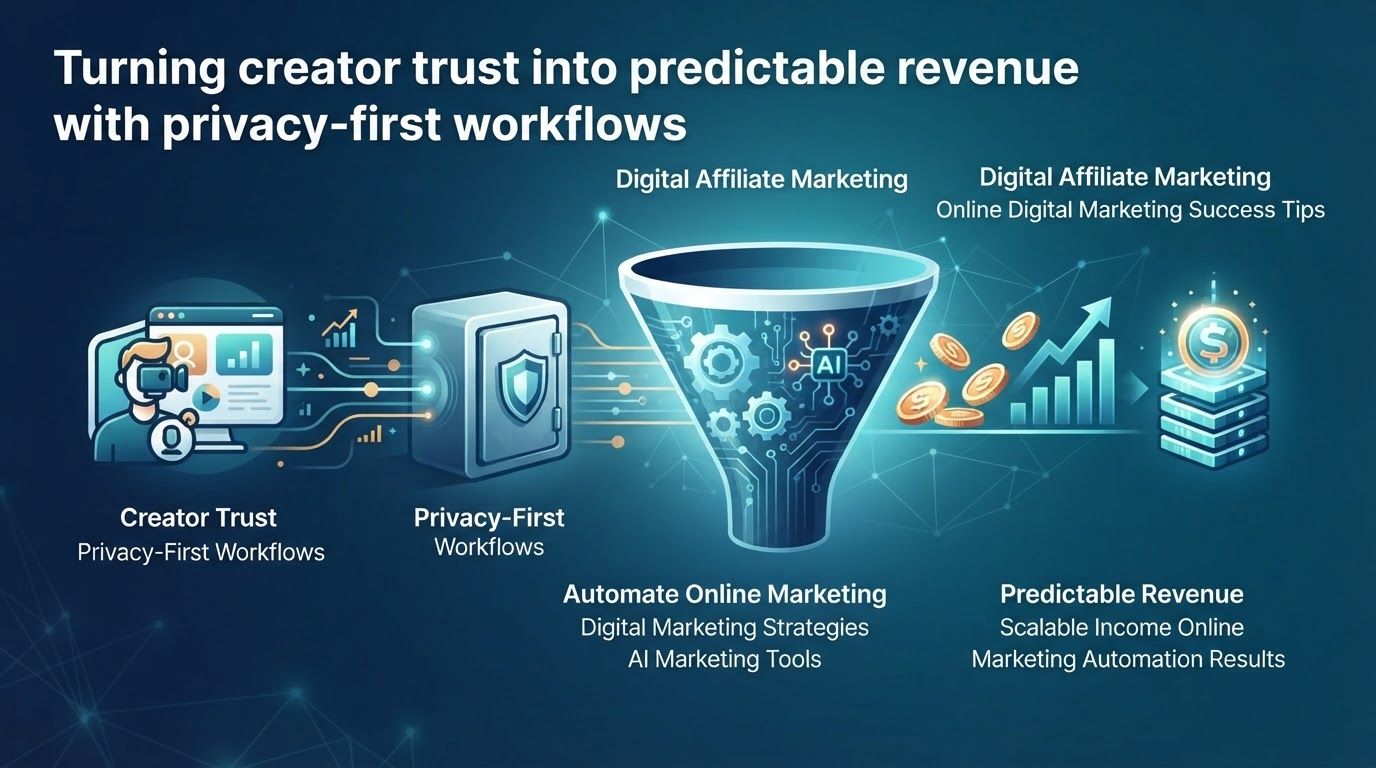
Turning creator trust into predictable revenue with privacy-first workflows

Turning creator trust into predictable revenue with privacy-first workflows

A creator can earn an audience’s confidence and still face months of uneven income. Turning that trust into more predictable revenue takes privacy-first workflows: clear offers, permission-based audience relationships, transparent recommendations, and measurement that does not depend on collecting more personal data than necessary.

For affiliate marketers and home-based entrepreneurs, this is an operating challenge, not a reason to post more often or automate every interaction. The goal is to build a system that helps people make informed buying decisions, gives you a reliable way to learn what works, and respects the limits of the data they choose to share.

Why creator trust does not automatically become predictable revenue

Trust makes a recommendation worth considering, but it does not determine when a buyer is ready, whether an offer fits their needs, or how a creator gets paid. Modash’s 2026 Creator Trust Report surveyed 1,042 U.S. adults and found that, among people who follow creators, 84% had purchased something based on a creator’s recommendation. That shows the commercial potential of trusted recommendations; it does not mean every recommendation produces dependable income.

CreatorIQ’s 2026 study of 5,095 creators across 100 regions illustrates the gap. It found that 67% earned under $10,000 from content creation in the past year, while under 5% earned more than $100,000. Its State of Creator Compensation report also found that the top 10% of creators earned 62% of creator payments in 2025 and described income as episodic and unpredictable, often driven by one-off campaigns.

Meanwhile, brand interest is substantial. IAB projected U.S. creator ad spend of $37 billion in 2025, up 26% year over year, and $44 billion in 2026. A growing market creates opportunities, but it does not distribute them evenly or remove the uncertainty of an individual campaign.

Direct answer: Turn creator trust into more predictable revenue by pairing relevant, clearly disclosed offers with consent-based audience channels, repeatable follow-up, and privacy-conscious measurement. Review performance over time, then improve the offers and workflows that serve your audience without treating personal data as a shortcut.

The useful question is not simply, “How do I get more followers?” It is, “What can a person reliably expect after they decide to trust one of my recommendations?” If the answer changes with every sponsor, link, or platform algorithm, revenue will be difficult to plan around.

Identify the break in the journey

Start by looking at the path from a reader’s problem to a purchase. Is the offer relevant to the problem? Can the reader tell what is sponsored, what you have tested, and what limitations matter? Is there a sensible next step for someone who is interested but not ready to buy today?

These questions separate an audience problem from an operating problem. More reach may help when the right people rarely see your work. But if people engage and still cannot find an appropriate offer, a clear explanation, or a permission-based way to hear from you again, more traffic may only increase the number of missed opportunities.

Build a revenue mix around repeatable audience needs

One-off sponsorships can pay well, but they are hard to forecast when each deal requires a new negotiation and a new approval cycle. A more repeatable model begins with the needs your audience brings back to you: the task they are learning, the tool they are choosing, or the obstacle that appears at the next stage of their business.

For example, a creator teaching beginners how to set up a home-based business might publish a guide to choosing an email platform. A relevant affiliate recommendation could sit alongside a plain-language comparison, setup instructions, and an explanation of who may not need a paid plan yet. The guide remains useful even when no purchase happens immediately.

That approach differs from placing a link wherever it might earn a commission. It gives readers a reason to return and makes the commercial path easier to understand. It also creates an asset you can update as products, prices, and your own experience change.

  • Affiliate offers: Useful when a product closely matches a recurring question, but commission terms and merchant conversion paths remain outside your control.
  • Sponsorships: Useful for funding substantial content, but campaign timing and brand approvals can make income uneven.
  • Your own digital products or services: Give you more control over the offer and customer experience, but require delivery, support, and a clear value proposition.
  • Subscriptions or memberships: Can support an ongoing relationship when you can consistently provide a distinct benefit; they also create a continuing obligation to members.

These options are not interchangeable. A beginner does not need to launch all of them. Choose one primary offer type that matches what you can deliver well, then consider a complementary option when audience questions justify it. For an affiliate-focused business, that may mean improving a small set of recommendations before adding a course or a membership.

IAB’s 2025 creator-market reporting notes that some market estimates include affiliate links, subscriptions, tips, and merchandise alongside advertising. The channels differ, but they share a practical requirement: readers need to understand what is being offered and what relationship, if any, influences the recommendation.

Make each recommendation earn its place

Before adding an offer, write down the audience problem, the person the product is for, the person it is not for, and the evidence behind your recommendation. Explain meaningful trade-offs, such as cost, learning curve, support needs, or whether a free alternative is sufficient. If you have not used a product, do not imply hands-on experience.

This review protects the trust that makes future recommendations possible. It also makes income easier to analyze: when each offer serves a defined need, you can compare how people respond without guessing whether a disappointing result came from the content, the product fit, or an unclear buying path.

Use privacy-first workflows to keep audience relationships permission-based

A privacy-first workflow starts before someone enters an email address or clicks an affiliate link. It asks what information is actually needed, why it is collected, how it will be used, who receives it, and what the person should reasonably expect next. The answer should be understandable to the audience, not only to the business owner.

For a small creator business, an email signup is a useful example. If a visitor requests a checklist, explain whether they will receive only that resource, an ongoing newsletter, or promotional emails as well. Keep the signup language consistent with the messages you send, and provide a straightforward way to stop receiving them.

Do not assume that a first-party email list is automatically compliant simply because you collected it yourself. IAB’s 2024 internet ad revenue report describes a broader industry pivot toward privacy-first approaches, including first-party data, contextual advertising, and data clean rooms as reliance on third-party identifiers declines. First-party collection can help you build a direct relationship, but the way you obtain and use that data still matters.

Map the data before adding automation

List the places where audience information enters your business: signup forms, checkout pages, contact forms, analytics, affiliate networks, ad platforms, and customer-support tools. Then note what each tool receives and whether you need that information to deliver the promised experience. This simple inventory is often more useful than adding another dashboard.

  1. Define the purpose: State what each form or tracking tool is meant to accomplish. Avoid collecting fields merely because the software makes them available.
  2. Check the permission: Match your notice and consent mechanism to the marketing activity and the markets you serve. Do not treat a general acceptance of site terms as a substitute for every marketing permission.
  3. Review sharing: Identify when information goes to an email provider, affiliate partner, ad platform, or other third party, and assess whether the permission and disclosures cover that use.
  4. Limit access: Give collaborators and automation tools only the information needed for their tasks. Remove connections and stored data that no longer serve a clear purpose.
  5. Test the experience: Sign up as a visitor would, read every notice, follow the messages, and check whether opting out is easy to find and works.

Legal requirements vary by location and by channel. As a concrete example, the UK Information Commissioner’s Office says direct marketing needs a lawful basis and recommends planning campaigns with data protection by design. It also says consent is required for some electronic marketing under PECR. If personal data used for consent-based online advertising is then supplied to third parties, the ICO says the user’s consent must apply across that chain.

That is a reason to inspect the entire workflow, not just the wording beside a signup button. If a tool promises effortless retargeting or audience syncing, ask which parties receive data and whether your permissions support that use. When the answer is unclear, a simpler approach, such as contextual placement or an email sequence sent to people who requested it, may be easier to explain and maintain.

Make affiliate disclosures part of the buying experience

Transparent monetization is a practical service to your reader. If you earn a commission, receive a product, or have another material relationship that could affect how a recommendation is understood, the audience should be able to recognize it without hunting through your profile or a distant policy page.

The U.S. Federal Trade Commission says influencers must disclose material relationships clearly and conspicuously, close to the endorsement. It recommends simple language such as “ad” or “sponsored” and says platform disclosure tools are not sufficient by themselves. A disclosure hidden among hashtags or left only in a description may not give someone the context they need when they see the recommendation.

For an article, put a clear affiliate disclosure near the recommendation or link so a reader encounters it at the relevant moment. For a video or social post, consider where the endorsement appears and where viewers will actually see or hear the disclosure. The format may change, but the principle is consistent: do not make the audience work to discover the commercial relationship.

Separate recommendation quality from commission size

A high payout can make an offer attractive to a creator even when it is a poor fit for the audience. Counter that incentive with an editorial check: Would you still explain this product’s strengths and limitations the same way if the commission changed? If not, reconsider the recommendation or revise the content until the trade-offs are honest.

Suppose you review two automation tools. One pays an affiliate commission and the other has a free plan that is better for someone just starting out. You can still recommend the paid tool to people who need its capabilities, while clearly saying when the free option is enough. That distinction helps a reader act with confidence and makes your future advice more credible.

Disclosure is not a guarantee that everyone will buy. It is a foundation for informed choice. A reader who understands why a link is there can evaluate the recommendation on its merits, while you avoid making the commercial relationship a surprise after the click.

Document your disclosure approach so it survives repurposing. When you turn a blog post into an email, short video, or social caption, check the disclosure in the new context rather than assuming the original article covers it. This small editorial habit is especially important when templates or AI tools help publish the same idea across several channels.

Measure revenue without building a surveillance system

Predictability requires measurement, but not every metric answers a revenue question. IAB’s work on the creator economy’s measurement landscape identifies fragmented metrics, siloed platforms, and proxy-based return-on-investment measures as enterprise risks. A small creator faces a simpler version of the same problem: a platform view, an affiliate click, an email signup, and a sale may appear in different systems and tell different parts of the story.

Begin with decisions rather than dashboards. If you want to know whether an educational guide helps people choose a product, track the guide’s relevant visits, the clicks to the offer, and the commissions reported by the affiliate program. If you want to assess an email series, examine whether subscribers engage with it and whether its recommendations lead to the outcomes you can legitimately observe.

Not every sale can be attributed to a single post. People may compare options on another device, return later, or decide after a conversation you cannot measure. Treat reported conversions as useful evidence, not a complete account of every influence your content had.

Choose a small set of useful signals

  • Offer relevance: Which questions or content topics lead people to seek more information about an offer?
  • Qualified action: Which pages or emails prompt a click from someone who has received enough context to evaluate the product?
  • Reported revenue: What commissions, product sales, or contract payments are recorded by the systems that process them?
  • Continuity: Do useful content and permission-based follow-up bring interested people back, or does every campaign start from zero?
  • Audience feedback: What objections, requests, refunds, or support questions suggest that an offer or explanation needs work?

Use a consistent review routine. Record the content and offer involved, the measurement source, the period being compared, and any important changes, such as a revised landing page or altered affiliate terms. This makes it easier to distinguish a genuine pattern from a one-time promotion without pretending that the data is perfect.

Privacy-preserving measurement has limits and is still developing. NIST’s 2025 SP 800-226 defines differential privacy as a mathematical framework for quantifying privacy loss and gives guidance for evaluating privacy-preserving software solutions. It is not a feature you can assume exists because a vendor calls its dashboard private; assess the actual method and whether it fits your use case.

Recent academic work on the IAB Global Privacy Platform and a 2026 NIST workshop presentation also indicate that consent measurement and privacy-preserving ad conversion measurement remain active technical challenges. For a beginner, the sensible alternative is rarely to engineer a sophisticated identity system. Start with the data you are entitled to use, compare like with like, and acknowledge what your reports cannot establish.

Use AI and automation to support judgment, not replace it

AI can help a small business carry out repeatable work: organizing audience questions, drafting a content outline, summarizing approved performance reports, or checking whether a publishing checklist was completed. Aspire’s 2026 benchmark report found that 59% of marketers use AI to scale creator discovery, workflows, and analytics. That is evidence of adoption, not proof that automation improves the quality of every recommendation.

The best tasks to automate have clear inputs and review points. For example, you might use a tool to group recurring questions from messages you are permitted to analyze, then decide which deserve a human-written guide. You might generate a first draft of an email, but review the product claims, disclosure, tone, links, and recipient permissions before sending it.

Do not paste personal audience details into an AI system merely because doing so is convenient. Check what the tool needs, what its terms say about data handling, and whether aggregated or de-identified inputs would answer the question. If a task requires sensitive context, decide whether it belongs in that tool at all.

Create one publishing checkpoint

Before a recommendation goes live, ask one person, or use a written checklist if you work alone, to verify five things: the audience problem is clear; product claims are supportable; material relationships are disclosed; links and signup promises match the destination; and any collected information has a defined purpose. The checkpoint can be brief, but it should be consistent.

After publication, let automation handle reminders rather than decisions. A recurring prompt to review an article can help you catch outdated pricing references, changed affiliate terms, broken links, or an offer you no longer stand behind. The human decision is whether the recommendation still serves the reader.

CreatorIQ’s 2025,2026 State of Creator Marketing report describes pressure around creator vetting, compliance, data ownership, privacy, and measurement, with centralized program control becoming essential for organizations. You do not need an enterprise system to apply the lesson. A single record of offers, disclosures, permissions, owners, and review notes can keep a home-based business from losing track as it grows.

Turn the strategy into a manageable operating routine

You can put this model into practice without rebuilding your business at once. Start with one audience problem you understand well and one offer you can evaluate honestly. Build or improve the content that answers the problem, then connect it to a permission-based way for interested readers to continue learning.

  1. Audit the current journey: Read your most relevant content as a new visitor. Identify where the next step, commercial relationship, or product limitation is unclear.
  2. Choose the offer: Confirm who it helps, what evidence supports your recommendation, what alternative may fit someone else better, and what you earn if a purchase occurs.
  3. Clarify permissions: Check the signup promise, marketing messages, tools receiving data, and opt-out process before adding new follow-up.
  4. Set a measurement baseline: Record the signals available from your site, email provider, affiliate platform, or checkout, along with the gaps between them.
  5. Review and revise: Use reported results and audience feedback to improve the explanation, offer fit, or follow-up. Keep the content useful even when the reader decides not to buy.

This routine makes trade-offs visible. A sponsorship may be worth taking for the income, but it might interrupt a more coherent sequence of audience education. An elaborate tracking tool may promise better attribution, but it can add cost, data-sharing questions, and maintenance work. A smaller set of offers with clearer explanations may be easier to manage than a large library of links.

Review both revenue and relationship quality. If commissions rise while readers increasingly question your recommendations, the system needs attention. If readers appreciate your work but no offer helps them take a useful next step, consider whether the product, placement, or business model needs to change.

Usercentrics’ 2026 State of Digital Trust report found that 47% of consumers globally had taken at least one action with a direct revenue consequence in the prior six months because of concerns about how brands handle their data in AI. That finding does not predict what your own audience will do, but it reinforces why data handling belongs in the customer experience rather than in a forgotten settings page.

There is no workflow that makes creator income certain. Merchants change terms, audiences change needs, platforms change distribution, and measurement remains incomplete. What you can control is the quality of the recommendation, the clarity of the relationship, the permissions behind your outreach, and the discipline with which you learn from results.

Pick one existing recommendation this week and trace its full path: content, disclosure, link, signup, follow-up, data sharing, and reported outcome. Improve the weakest step before adding another offer. That is a practical way to turn trust into a business process without spending the trust itself.

Wednesday, November 11, 2026

How smart workflows and creator partnerships drive steady revenue without a heavy lift

Steady revenue is hard to build when every sale depends on publishing another post, finding another creator, or rebuilding a campaign from scratch. Smart workflows and creator partnerships can reduce that repeated work by turning audience trust, relevant offers, and reliable follow-up into a process you can run and improve over time.

For a home-based entrepreneur, that does not mean putting marketing on autopilot or assuming a creator will make an offer profitable. It means choosing partners whose audiences match your offer, making each promotion easy to execute, tracking what happens after a click, and using simple automation to keep the relationship moving without constant manual coordination.

How creator partnerships and smart workflows work together

A creator partnership connects an offer to an audience that already pays attention to a particular voice. A smart workflow handles the repeatable work around that connection: collecting partner details, sharing approved offer information, generating tracking links, scheduling check-ins, recording results, and preparing the next collaboration. One part earns attention; the other keeps the operation from becoming a second full-time job.

Direct answer: To build steadier revenue without a heavy lift, partner with niche-relevant creators on offers that fit their audiences, give them clear briefs and tracked links, automate routine coordination, and use results from each promotion to improve the next one. Aim for repeatable collaborations rather than assuming a single post will create dependable income.

This approach makes particular sense for affiliate marketers. A creator can introduce a product through a tutorial, review, comparison, or personal use case, while an affiliate link or code helps connect the resulting action to that recommendation. If you operate a brand, you can use the same structure to recruit creators. If you are an affiliate yourself, you may instead collaborate on content, referrals, or audience introductions, subject to the merchant program's rules.

The reason to think beyond individual campaigns is audience behavior. Deloitte reports that 65% of US consumers engage with creator content, about 60% do so daily, and 70% regularly return to creators they already follow. Those figures do not guarantee a sale from any particular partnership. They do explain why a creator who remains useful to the same audience may have more opportunities to introduce a relevant offer than a one-off placement allows.

Research also points toward sustained relationships as a business decision, not just a branding preference. Deloitte argues that brands should evaluate creator relationships over time rather than judging them solely by a single campaign's return. Coverage of The Influencer Marketing Factory's 2026 Brand Deals analysis by Tubefilter says 63% of brand-creator relationships are one-off deals, while repeat collaborations can build trust and stronger commercial signals.

For a small business, the practical takeaway is not to sign a long contract immediately. Start with a manageable test, learn whether the audience and offer fit, and make a second collaboration easy if the first one shows promise. A workflow gives that learning somewhere to live instead of leaving it scattered across inboxes, spreadsheets, and memory.

Choose creators for audience fit, not impressive follower counts

The biggest partnership decision comes before any automation: who should speak about the offer? A large audience is not necessarily an interested audience. Sprout Social's 2026 Influencer Marketing Report says reach is no longer tied to follower count and points to niche and platform fit as important factors for brands seeking returns. Sprout Social also warns that follower-first sourcing and poorly aligned partnerships can waste creator budgets.

Begin with the buyer's problem. If you promote an AI scheduling tool for solo service providers, a creator who regularly demonstrates client-booking workflows may be more relevant than a broader technology account with a larger audience. If your offer is a beginner-friendly affiliate course, look for someone whose audience is asking foundational questions, not someone who mainly speaks to experienced media buyers.

Use a short partner-fit checklist

  • Audience match: Do their followers appear to face the problem your offer solves? Look at recurring questions and discussion topics, not just the creator's bio.
  • Content context: Can the creator demonstrate the offer naturally in the format their audience expects, such as a walkthrough, newsletter recommendation, or short video?
  • Credibility: Do they explain trade-offs and show real familiarity with the products they mention, or does every recommendation sound interchangeable?
  • Commercial compatibility: Are the proposed fees, commissions, deliverables, and usage rights realistic for your budget and margin?
  • Working style: Do they respond clearly, respect deadlines, and ask useful questions about the audience and offer?

A simple scoring note can make selection more consistent. Record what you observed for each criterion, along with a link to a relevant piece of content. The point is not to turn a human decision into a mechanical score; it is to prevent a flashy profile from overshadowing obvious mismatches.

Look for evidence in the content itself. A creator's comments may show whether people ask for practical advice, while a newsletter archive may reveal whether product mentions are occasional and thoughtful or constant and disconnected. Where possible, ask the creator what their audience is trying to accomplish and how they would introduce the offer. Their answer can reveal more about fit than a media kit alone.

Creator fit also includes the creator's interests. HubSpot's 2026 creator partnership report says creators value a natural match, a clear brief, and opportunities that extend beyond a single payment, including introductions to brands, industry contacts, or business opportunities. For a home-based operator with a modest budget, being organized, responsive, and genuinely helpful is part of the value you can offer.

Build a shortlist before sending a pitch. A few carefully chosen contacts are easier to research and support than a broad automated outreach blast. Personalize the reason for each invitation: name the audience problem you noticed, explain why the offer may help, and leave room for the creator to say that it is not a fit. An honest no is cheaper than a forced promotion to the wrong people.

Build an offer and compensation model that both sides can sustain

A good match can still fail if the economics are unclear. Before asking a creator to promote anything, decide what action matters: a qualified lead, a trial signup, a first purchase, or a repeat purchase. Then work backward from the value of that action to determine what you can afford to pay while leaving room for fulfillment, refunds, support, and profit.

Performance-based affiliate arrangements can reduce upfront exposure because payment is tied to an agreed result. In impact.com's 2025 global affiliate report, 71% of respondents said affiliate marketing was more cost-effective than other channels, and 66% reported stronger return on ad spend. Those are respondent reports, not a promise that every affiliate offer will outperform other marketing. The underlying offer and partner fit still matter.

One example of the mechanics comes from impact.com's Ellos case study. The brand shifted toward a performance-based partnership model, used unique tracking links and promo codes, and achieved higher revenue without a heavy upfront investment. That result is specific to Ellos; the reusable lesson is to make partner activity attributable before trying to scale it.

Pick the arrangement that fits the risk

  • Commission only: Useful when cash is tight and the creator is comfortable earning on tracked outcomes. It places more risk on the creator, so it may be a poor fit when the promotion requires substantial production work.
  • Flat fee: Gives the creator predictable payment for defined work. It can suit awareness or content-creation goals, but you carry more risk if sales do not follow.
  • Hybrid compensation: Combines a guaranteed base fee with a performance bonus. Sprout Social identifies this model as a way to align creator earnings with brand revenue outcomes while paying for the work involved.
  • Longer-term agreement: Can make planning easier after both sides have evidence that the collaboration works. Define review points so neither party is locked into an arrangement that has stopped making sense.

Creators have their own need for predictability. Deloitte found that creators with brand partnerships receive, on average, 55% of their income from those partnerships, and nearly one-third receive more than 70% of their income from brands. Deloitte also reports growing interest in longer-term annual contracts for steadier revenue; in one lifecycle study, one in six creators in the 500,000-plus range wanted partnerships lasting more than a year. These figures describe creator-side incentives, not what a new business should automatically commit to paying.

If you are a small brand, start with terms you can honor. State the deliverables, payment timing, commission eligibility, attribution window if applicable, content approval process, and what happens when a customer refunds or a tracked link fails. If you are an affiliate seeking collaborators, check whether the merchant permits the proposed promotion and how commissions are assigned. Do not promise a creator a share of revenue you cannot reliably verify or pay.

A bigger commission is not always the best fix for a weak offer. If visitors click but do not buy, revisit the landing page, product relevance, price explanation, and customer questions before raising payouts. Conversely, if a creator's content produces qualified customers, better terms or a repeat commitment may be more valuable than recruiting an endless stream of new partners.

Set up a lightweight creator workflow before scaling outreach

Automation is most useful after you know which steps repeat. Do one partnership manually first and write down each handoff: discovery, outreach, agreement, brief, link setup, content review, publication, reporting, payment, and follow-up. That sequence becomes your workflow. You do not need an elaborate software stack to make it reliable.

  1. Keep one partner record. Store contact details, audience notes, agreed terms, content links, permissions, and next action in a shared document or simple database. Make it easy to see the current status without searching an inbox.
  2. Prepare a reusable brief. Include the offer's audience, core benefit, product facts, restrictions, landing page, tracking details, disclosure expectations, deadline, and contact person. Leave space for the creator's own concept and voice.
  3. Create unique tracking assets. Give each partner a distinct link or code when your platform supports it. Test the destination and tracking before publication, including on a phone.
  4. Automate reminders, not relationships. Schedule prompts for approvals, launch checks, payment dates, and performance reviews. Keep the actual feedback specific to the creator and their content.
  5. Capture results in one place. Record what went live, where it appeared, what it cost, what actions it produced, and what the creator learned from the audience response.
  6. Schedule a decision point. After the agreed review period, choose whether to repeat, adjust, pause, or end the collaboration. Record the reason so your next decision is better informed.

AI can lighten parts of this process without taking over judgment. It can turn your product notes into a first draft of a brief, summarize recurring questions from approved feedback, suggest follow-up topics, or help organize performance notes. Deloitte describes generative AI as a way to simplify creator workflows and support creative output, while its platform research highlights the value of KPI monitoring, audience insights, and AI-enabled support.

Keep a person responsible for checking facts, offer terms, and the creator's final message. An AI-written pitch that invents familiarity with someone's work can damage trust before the relationship starts. A generic brief can also flatten the voice that made the creator worth partnering with. Use automation to remove copying, chasing, and reformatting; do not use it to fake attention or dictate a personal endorsement.

For a solo operator, a practical stack might be a contact tracker, a document template, an affiliate platform or link manager, calendar reminders, and a shared place for reports. Add integrations only when the manual task is both frequent and error-prone. A complex system that no updates creates more work than a basic checklist that gets used every time.

Give creators room to make content their audience will trust

A clear brief should reduce confusion, not turn every creator into the same ad. Tell partners what is factual and non-negotiable: product capabilities, eligibility, price or offer terms, required disclosures, and claims they must not make. Then invite them to explain the offer in the format and language that suits their audience.

For example, an affiliate promoting a workflow tool might ask a creator to demonstrate how they plan a week of content, then show where the tool helps. That is more useful than handing over a script that says the tool will make every business effortless. The creator can show what they actually use, who it may suit, and where a manual alternative could be enough.

Match the content to the buyer's next question

  • Early interest: A practical lesson or problem-solving post can introduce the category without forcing an immediate purchase.
  • Active comparison: A walkthrough or honest comparison can explain features, setup effort, and who should choose another option.
  • Ready to act: A clear recommendation with the relevant link, offer terms, and next step can help someone who has already decided the product fits.
  • After purchase: A follow-up tutorial can help buyers get value from what they chose, potentially reducing confusion and creating a better customer experience.

Think about a series rather than a pile of repeated endorsements. The first collaboration might address a common problem, the second might answer objections that appeared in comments, and a later piece might show a more advanced use case. This gives the audience new information each time and gives you a reason to review performance between posts.

Trust depends on honesty. Ask for appropriate disclosure of paid or affiliate relationships under the rules that apply to the creator and platform, and make sure the creator can express a genuine view. Do not require unsupported results claims, hide conditions behind a code, or ask someone to say they use a product if they do not. Short-term clicks are not a useful win if customers feel misled.

It is also worth discussing rights before content goes live. May you repost the video, quote a review, edit a clip, or use the creator's content in an ad? For how long, and where? A creator may be happy to publish to their own audience but charge separately for advertising usage. Agreeing on those boundaries early protects the relationship and helps you budget accurately.

Measure revenue without judging a partnership by one post

Tracking should answer a business question, not just produce a dashboard. At minimum, distinguish exposure from action. Views and likes can show whether content reached people; clicks, signups, purchases, and qualified inquiries reveal what people did next. Revenue, commission, fees, refunds, and support costs help show whether the arrangement is commercially worthwhile.

Use a simple review record for each collaboration. Note the content format, creator, offer, publication channel, tracking link or code, agreed cost, observed actions, and any limitations in the data. If you cannot see conversions because another company controls the checkout, be clear about what your affiliate dashboard does and does not report. Do not treat an untracked mention as proof of no impact, or an attributed purchase as proof that the creator alone caused it.

When a result disappoints, diagnose the stage that broke. Strong views but few clicks may suggest the content entertained the audience without giving them a clear next step. Clicks without qualified leads can indicate a mismatch between the recommendation and the landing page. Leads without sales may call for a closer look at offer fit, pricing, follow-up, or the definition of a qualified lead.

Repeat collaborations create more opportunities to learn. Compare whether the same creator can communicate the offer effectively in different formats, whether questions from earlier posts get resolved, and whether a later audience response improves. Tubefilter's summary of The Influencer Marketing Factory analysis connects repeat collaborations with greater audience trust and stronger results than one-off deals. That is a reason to test continuity, not to keep paying for activity that never moves a relevant business outcome.

Look at the economics over the agreed review period, especially if you are paying a base fee. A simple contribution view starts with attributable revenue, subtracts the costs you can identify, and considers whether the remaining amount supports your business. If purchases tend to happen later or through more than one touchpoint, avoid declaring victory or failure from the first day's dashboard. Set a review window that reflects the way customers actually decide.

Research can help frame the opportunity but cannot replace your own numbers. Deloitte reports that high-ROI brands allocate 42% of their social media budgets to creator partnerships, nearly twice the share of low-ROI brands, and that three out of five consumers are likely to engage positively when the right creator recommends a brand. That does not establish that increasing your creator budget will cause higher ROI. Start with evidence from your own audience, offer, and margins before increasing spend.

Turn a promising test into a repeatable revenue system

Once a collaboration produces useful signals, the next step is not simply to ask for the same post again. Review what the creator heard from their audience, which questions remained unanswered, and which part of the customer journey needs help. Then propose a follow-up with a new purpose. A steady system is a learning loop, not a scheduled stream of identical promotions.

Make the second collaboration easier than the first

Save approved facts, working links, creative preferences, and lessons from the initial promotion. Confirm whether the offer or terms have changed before reusing anything. Give the creator a concise recap of what worked and ask what they would change; they may have noticed audience reactions that your analytics missed.

If both sides want to continue, agree on a practical rhythm. This might be a recurring educational series, periodic inclusion in a newsletter, or content tied to real product updates. The right cadence depends on how often the creator has something useful to say. Publishing more often is not progress if the audience starts ignoring the recommendation.

Consider expanding value in ways that do not rely only on a higher fee. A small brand might offer early access to a feature, introduce a creator to another relevant business, or invite them to shape a tutorial based on customer questions. HubSpot's creator partnership findings suggest that natural fit, clear direction, and opportunities beyond a single campaign matter to creators. Offer these only when they are real and welcome, rather than using vague future exposure in place of fair compensation.

Established brands provide a useful signal about the channel's scale, but not a ready-made budget for a home business. impact.com's 2026 consumer spending report says average affiliate commission rates rose 2% year over year and non-action-based payments rose 3% year over year. In its Singapore snapshot, 48% of brands reported that affiliate marketing contributed 21% to 30% of total revenue. Those figures describe particular reported markets and measures; your goal is to build a profitable, manageable contribution to your own revenue mix.

Do not make one creator your entire acquisition plan. Even a well-matched partnership can slow if the creator changes focus, the platform changes, or the offer stops fitting the audience. Retain permission-based ways to communicate with interested customers, maintain your own useful content, and test a small number of other relevant partners. Diversification makes steadiness more plausible without turning your calendar into nonstop outreach.

Know when automation or a long-term deal is the wrong move

Not every business needs a creator program yet. If your product page cannot explain the offer, your checkout is unreliable, or you cannot answer basic customer questions, more partner traffic may only expose those problems faster. Fix the customer path first. A strong creator cannot compensate indefinitely for a confusing offer.

Likewise, automation is not a shortcut around a decision you have not made. If you do not know which customers you serve, what counts as a qualified conversion, or who approves claims, an automated outreach or reporting sequence can multiply mistakes. Handle a small test by hand, document what works, and automate the stable steps afterward.

A long-term agreement also has a trade-off. It can make planning and income more predictable for both sides, but it can tie up budget and attention before you know whether the partnership fits. A short pilot with clear deliverables and a review point is often a more sensible starting point for a beginner. Longer commitments become easier to justify when communication is smooth, the content remains authentic, and the economics hold up over multiple collaborations.

There are alternatives if direct creator deals are not practical. You might improve your own email follow-up, collaborate with another small business on an educational resource, or use an established affiliate program that already handles tracking and payouts. Each option has its own work and constraints. Choose the smallest arrangement you can run responsibly rather than copying a large brand's partnership program.

Finally, treat steady revenue as a direction, not a guaranteed monthly result. Creator content, affiliate programs, and AI-assisted workflows can make execution more consistent, but customer demand, platform behavior, offer quality, and measurement limits still affect outcomes. The advantage of a system is that you can see where it fails, make a focused change, and try again without rebuilding everything.

Start with one relevant offer and a short list of creators whose audiences have a real reason to care. Put the terms, brief, tracking, review date, and next action in one simple workflow; run a small collaboration; then decide from the results whether to adjust, repeat, or stop.

If the fit is good, keep giving the audience something useful and the creator a partnership worth continuing. That is how smart workflows and creator partnerships can turn isolated promotions into a more manageable source of revenue, without pretending the work or the judgment disappears.

Monday, June 29, 2026

Future-Proof Your Income: How AI and Automation Are Rewriting the Rules of Online Wealth in 2026

In 2026, relying on traditional jobs or outdated online methods is risky. Artificial intelligence and automation are fundamentally transforming how wealth is created online. Smart entrepreneurs who embrace these tools are building scalable, resilient income streams, while others risk being left behind.

The good news? 
You don’t need a technical background or massive budget to benefit. This guide reveals how AI and automation are changing the game and provides actionable tips to future-proof your income.Why 2026 Is the Tipping Point for AI-Driven WealthWe are no longer in the “AI is coming” phase we are in the “AI is here and winning” phase. Tools that once cost thousands of dollars or required coding skills are now accessible to everyday entrepreneurs.
Trending reality: Content creators using AI assistants are producing 5-10x more material with higher engagement. E-commerce store owners automating customer service and marketing are seeing profit margins jump 30-50%. Solopreneurs are replacing entire teams with smart automation stacks.
The rules have changed. Success now favors those who leverage technology to multiply their efforts rather than those who simply work harder.

TheHomeBizInsider.com - Future Proof Your Income - How AI and Automation Are Rewriting the Rules of Online Wealth


The New Wealth Formula: Human Creativity + AI EfficiencyThe most successful online earners in 2026 combine human strengths (creativity, empathy, vision) with AI strengths (speed, scale, data analysis).Here’s how top performers are doing it:
1. AI-Powered Content Empire Building
Gone are the days of staring at a blank screen for hours. Modern creators use AI to brainstorm ideas, draft outlines, generate SEO-optimized articles, and even create video scripts or social media carousels in minutes.

Tip: Use AI tools for research and first drafts, then inject your unique voice and personal stories. This authenticity combined with speed creates a massive competitive advantage.Trick: Set up automated content calendars that post across platforms while you focus on high-level strategy or product creation.
2. Automated Sales Funnels That Work 24/7
AI chatbots now qualify leads, answer objections, and even close sales with sophisticated conversation flows. Automation tools handle email sequences, retargeting ads, and abandoned cart recovery at scale.

Trending Trick: Combine AI personalization with automation. Tools can analyze user behavior and dynamically adjust offers or messaging in real time, dramatically boosting conversion rates.
3. Passive Income Through Automated Digital Products
Create once, sell forever has never been easier. AI helps generate eBooks, courses, pintables, and membership content faster than ever.

Pro Tip: Use AI to analyze trending topics in your niche, then build evergreen products around them. Automate delivery, customer onboarding, and upsells for truly hands-off income.Essential AI & Automation Tools for 2026
  • Content Creation: Advanced models for writing, graphics, and video
  • Marketing Automation: Email sequences, social posting, and ad optimization
  • Customer Service: Intelligent chatbots that handle 80%+ of inquiries
  • Data & Analytics: Tools that predict trends and optimize your business decisions
  • Workflow Automation: Connect apps so tasks flow automatically between platforms

Actionable Stack for Beginners: Start simple one AI writing tool, one automation platform (like Zapier or Make), and one chatbot builder. Master these before expanding.Risk Mitigation: Don’t Put All Your Eggs in One AI BasketWhile AI is powerful, smart entrepreneurs diversify:
  • Build your own email list (still the most future-proof asset)
  • Develop personal branding and authority that AI can’t replicate
  • Create hybrid offers combining digital products with high-ticket coaching or services
  • Stay updated on AI developments but avoid chasing every new tool
Real-World Success Patterns in 2026Entrepreneurs building $10K–$100K+/month businesses share common traits:
  • They treat AI as an employee, not a replacement for their vision
  • They focus on solving real human problems with technology-enhanced solutions
  • They automate the repetitive while doubling down on relationships and creativity
  • They continuously test and optimize rather than seeking perfect systems
Your 30-Day Future-Proof Income Action PlanWeek 1: Audit your current income streams and identify repetitive tasks that AI/automation can handle.
Week 2: Implement one AI tool for content or customer service.

Week 3: Set up your first automated workflow (email sequence, social posting, or lead follow-up).

Week 4: Create and launch one new AI-assisted digital product or offer.
Track results weekly. Small consistent improvements compound dramatically with these technologies.

TheHomeBizInsider.com - Future Proof Your Income - How AI and Automation Are Rewriting the Rules of Online Wealth


The Mindset Shift You NeedThe entrepreneurs winning with AI in 2026 view technology as a multiplier, not a crutch. They focus on becoming irreplaceable through creativity, strategy, and audience connection while using tools to scale execution.
This abundance mindset believing there are unlimited opportunities when you leverage modern AI tools separates the thriving from the struggling.Final ThoughtsThe future of online wealth belongs to those who adapt quickly. AI and automation aren’t just nice-to-have tools anymore they are the new foundation of successful online businesses.Start small, stay consistent, and focus on adding massive value. The entrepreneurs taking action today will be the success stories others read about tomorrow.
The rules of wealth are being rewritten right now. Will you be the one writing them or watching from the sidelines?
#FutureProofIncome #AIWealth #AutomationSuccess #thehomebizinsider #1


Check Out The Latest Featured Post That You Might Like!

Scaling revenue with machine intelligence copilots and real-time data for lean teams

Lean teams often have plenty of potential revenue work and too little time to follow through: leads wait for replies, useful customer signal...