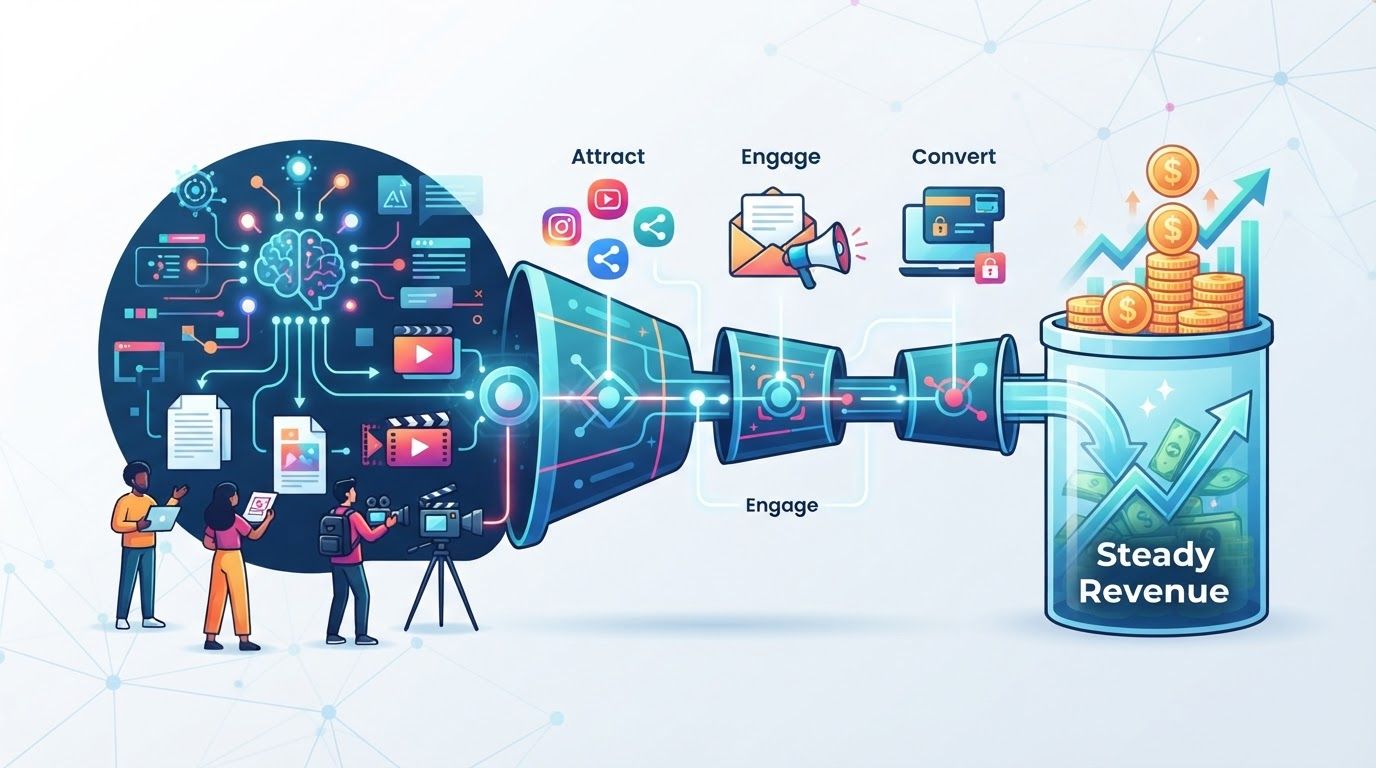
Posting more AI-generated content does not automatically create dependable income. Creators build steadier revenue with low-touch funnels when generative models help them attract the right people, deliver a useful offer, and follow up without requiring a personal conversation for every sale.
The opportunity is real, but so is the gap between attention and income. Menlo Ventures reports that 48% of AI users said they had earned money with AI, most commonly through content creation and freelancing. For a home-based entrepreneur, the more useful question is not simply how to produce more with AI. It is how to turn that production capacity into a repeatable path from a specific customer problem to a purchase and, where appropriate, a lasting relationship.
What low-touch funnels actually do for creators
A low-touch funnel is a customer journey that can work without the creator manually guiding every visitor. Someone discovers a helpful piece of content, takes a relevant next step, evaluates an offer, and receives the information needed to decide. Automation handles predictable tasks; the creator still owns the offer, the claims, and the relationship.
To turn generative models into steadier revenue, use AI to make and adapt useful content, connect each piece to one clear offer, automate relevant follow-up, and improve the journey using actual customer behavior. Keep human review and support where trust or judgment matters.
That answer sounds simple, but each link has a job. Content brings in people with a particular need. A landing page or product page explains the outcome and the offer. Email or another permission-based channel helps interested people continue when they are ready. Fulfillment delivers what was promised, while feedback shows where the journey breaks.
Consider a creator teaching beginners how to organize a home office. A practical article about choosing a workspace layout could lead to a free planning checklist. That checklist might introduce a paid template pack, a relevant affiliate recommendation, or a small membership with ongoing workspace advice. The model can help draft variations, organize the checklist, and prepare follow-up messages, but the creator must check that the advice and recommendations fit real home offices.
Low-touch is not the same as hands-off. A customer may need help using a product, an affiliate link may stop working, or an automated message may become inaccurate. Set aside time to review the path as a customer would. The aim is to reduce repetitive work while preserving the moments when a person needs a trustworthy answer.
Choose an offer that matches the problem your audience already has
Start with the buyer’s decision, not the model’s ability to generate material. If your audience needs a quick answer, a clear affiliate recommendation or small digital product may fit. If they need repeated help, an ongoing membership or subscription may be more natural. If the problem requires personal diagnosis, a service can be valuable, but it will be less low-touch unless its scope and delivery are tightly defined.
Match the revenue model to the work required
- Affiliate offers: Recommend a relevant third-party product and earn under its affiliate terms. You do not fulfill the product, but you depend on its quality, availability, pricing, and program rules.
- Digital products: Sell a template, guide, workshop recording, or other defined asset. You control the customer experience, but you must create something useful and keep it accurate.
- Memberships and subscriptions: Offer continuing value such as fresh resources, community access, or ongoing guidance. Recurring billing is not recurring value; people need a reason to stay.
- Productized services: Sell a clearly scoped outcome, such as a content audit or campaign setup. Templates and AI can reduce preparation time, while client review and delivery still take attention.
Circle’s 2026 creator economy statistics describe a growing emphasis on owned, recurring revenue rather than platform-dependent income. That is a useful direction to consider, not a reason to force every audience into a subscription. A one-time product can be a better starting point when the customer has a one-time problem.
Use a narrow offer statement before building assets: “I help this type of person solve this problem with this deliverable.” Then test it against the questions people already ask you, the objections they raise, and the outcome you can responsibly provide. A beginner affiliate marketer might sell a campaign-planning template rather than a broad “AI business system.” The narrow version is easier to explain, demonstrate, and support.
Do not mistake more offers for more revenue. Multiple disconnected products can leave visitors unsure what to do next and create more maintenance for you. Give each audience segment one obvious starting point, then add alternatives when customer behavior shows a genuine need for them.
Use generative models to build a content system, not a content flood
Generative models are most useful when they take repeatable production tasks off your plate. They can turn your notes into an outline, suggest examples for different skill levels, adapt a long lesson into shorter formats, and help prepare an email that points back to the original resource. Your experience should determine what goes in; the model can help shape how it is presented.
OpenAI’s January 2026 Higgsfield story describes GPT-4.1 and GPT-5 supporting content planning while Sora 2 helps create media, giving solo creators production capacity that previously required more people. That illustrates the workflow opportunity, not a guarantee that every AI-assisted post will perform. A 2026 Creator Landscape report similarly describes AI as a productivity accelerator that can help creators scale while retaining a human touch.
Build one useful source asset first
- Choose one specific question tied to your offer, such as how to compare two tools before paying for either.
- Collect your own examples, product details, customer language, and any claims you can verify. Mark gaps that need research rather than asking a model to fill them with plausible guesses.
- Use the model to organize a thorough answer. Review it for accuracy, originality, tone, and the next step a reader would reasonably want.
- Adapt the approved source into formats suited to different discovery channels. Preserve the same core advice, but make each version useful on its own.
- Connect the asset to a relevant landing page, product, or email signup, then review whether visitors actually take that next step.
This system reduces the temptation to publish many near-identical posts. One well-researched tutorial can become a short demonstration, an email explanation, and a set of focused social posts. The versions should serve distinct reading situations, not just repeat keywords.
OpenAI’s research on ChatGPT usage describes people producing writing, code, spreadsheets, and other digital products, alongside image-related work. Those capabilities can also help with behind-the-scenes funnel tasks: drafting onboarding instructions, organizing customer questions, or preparing a first version of a worksheet. Check outputs before publication, especially product specifications, prices, legal language, and any claim that affects a buying decision.
Put your funnel where buying decisions are already happening
Not all attention is equally useful. A broad post may reach many curious people, while a focused answer to a comparison or setup question may reach fewer people who are closer to deciding. For a low-touch funnel, the second visitor can be more valuable because the next step is easier to understand.
OpenAI said in its August 2026 advertising announcement that people come to ChatGPT with goals such as choosing software, planning a renovation, and exploring a hobby. Its November 2026 launch of Businesses in ChatGPT added ways for businesses to claim listings, manage information, view engagement insights, and use Business Agents as people explore options. These developments show why clear, accurate business information matters beyond traditional search results. They do not mean a creator can rely on any one AI interface to send dependable traffic.
OpenAI also said its ad business reached a $1 billion annualized revenue run rate by August 31, 2026. That is evidence that a major platform can monetize attention and intent at scale; it is not evidence that an individual creator will earn comparable returns or that ads are the right starting point for a small business.
Choose channels by intent and control
Search-friendly tutorials can meet people who are trying to solve a named problem. Social posts can demonstrate your perspective and introduce an idea to people who were not actively looking. Marketplaces and retail platforms may put an offer near a transaction, while an email list gives subscribers a direct way to hear from you after the initial visit. Each channel has different rules and levels of creator control.
For example, a creator selling an AI-assisted meal-planning worksheet might publish a tutorial explaining how to adapt a plan to a household’s routine. A short video can show the worksheet in use; the landing page can explain what is included. The creator should make the next step match the lesson instead of sending every visitor to a generic storefront.
Pick a small number of channels you can maintain well. Document which audience question each asset answers, which offer it supports, and what happens after someone clicks. If a channel brings views but few qualified visitors, revisit the topic and promise before accelerating production.
Design the signup and follow-up so they feel helpful
A lead magnet is useful only if it helps the visitor make progress. A checklist, short lesson, or calculator can work when it solves a small part of the same problem as your paid offer. A generic bundle of AI-generated tips may attract signups who have no interest in buying anything you provide.
Keep the landing page focused. Explain who the resource is for, what it helps them do, what they receive, and what happens after they sign up. Show a sample or specific outcome where possible. If you will send marketing emails, ask for permission in a clear way and honor the expectations you set.
Write a short sequence around real decisions
- Deliver the resource: Make it easy to access and explain the first useful action to take.
- Help the reader apply it: Share a concrete example, a common mistake, or a decision they may face next.
- Explain the offer: Show how the paid product, service, or affiliate recommendation addresses a related need that the free resource does not fully solve.
- Answer a genuine objection: Clarify fit, prerequisites, limits, or support without inventing urgency.
A model can draft the first pass of these messages and suggest versions for different interests. The automation should follow behavior that has a clear meaning: someone downloaded a checklist, visited a product page, or bought a starter product. Avoid treating every click as permission to send an aggressive sales sequence.
Keep the sequence manageable. A new subscriber may need only a welcome and a few useful follow-ups before moving to your regular newsletter. After purchase, replace promotional reminders with onboarding and help. These simple rules prevent the awkward experience of being sold a product you just bought.
Test the full journey yourself on a phone and a computer. Confirm that forms work, delivery emails arrive, links point to the correct pages, and a customer can find support. Generative models save drafting time, but a broken signup or confusing checkout can still stop the funnel before its value is clear.
Use affiliate and commerce partnerships without sacrificing trust
Affiliate marketing fits many creator funnels because a useful explanation can help a buyer choose a product they already need. It becomes less useful when every tutorial is shaped around the highest-paying link. Begin with the decision your reader is making, then decide whether a third-party product genuinely belongs in the answer.
EMARKETER forecasts that social media creator revenue will increase 16.2% in 2026 to $20.6 billion and points to the growing importance of lower-funnel partnerships on retail media platforms such as Amazon. The IAB/PwC 2025 internet ad revenue report likewise describes creator value becoming more connected to transactions, purchase data, and the broader customer journey. Those industry trends make commerce opportunities worth examining, but they do not remove the need to evaluate an offer for your particular audience.
Make the recommendation do real work
A comparison should state the criteria a buyer cares about: who a product suits, what it does not do, what effort setup requires, and which alternative makes sense for a different situation. If you have used the product, explain the relevant experience accurately. If you have not, do not imply that you have. Clearly disclose affiliate relationships where applicable and follow the rules of the programs and channels you use.
Suppose your audience asks how to set up a simple creator website. A tutorial might explain the decisions involved, then link to a suitable hosting provider or site builder. A checklist of setup steps could accompany it. The affiliate link serves the lesson because the reader understands the recommendation and can also decide that it is not the right choice.
Commerce partnerships have limits. Program terms can change, a merchant can alter its product, and a platform can change how content is shown. Retain a way to reach interested readers directly, keep your comparisons current, and consider an owned product where you can offer distinct value. The strongest funnel is not the one with the most links; it is the one where the reader can make a better decision after visiting.
Build recurring revenue by improving what happens after the sale
Subscriptions and memberships can make revenue less dependent on a constant stream of first-time buyers. They also create an ongoing promise. Menlo Ventures’ 2026 consumer AI report says consumer AI companies have largely settled on subscriptions, while RevenueCat’s 2026 subscription-app data found AI-powered apps generate 41% more revenue per user than non-AI peers but churn 36% faster. Those are app-market findings, not a forecast for a creator membership. They do highlight a practical problem: a compelling AI-powered first impression does not automatically make people stay.
Before offering recurring billing, define what improves or continues for a member. Will they get updated workflows, timely examples, a curated resource library, or access to a community? If the main value is a single template, selling it once may be more honest and simpler to manage.
Automate delivery, not the relationship
Low-touch retention can begin with clear onboarding. Tell a new customer where to start, what result to aim for first, and how to ask for help. An automated email can point someone who bought a template to a walkthrough; a later check-in can ask whether they managed to use it. Customer replies can reveal unclear instructions and future product ideas.
Generative models can help summarize common questions, draft updated instructions, and turn one helpful answer into an improved lesson. Review those drafts before they reach paying members. In a community, an automated welcome can show people where to introduce themselves, but it cannot replace moderation or thoughtful responses when a member has a specific issue.
OpenAI’s November 2026 Gondola case study says that creator platform doubled revenue year over year without adding payroll costs or significant over, while helping brands hire 2.5 times as many creators. It is an example of a company using scalable systems, not a typical creator outcome. For your own business, the grounded target is simpler: make each new sale deliverable without adding the same amount of manual work, then confirm that customers still get the value they expected.
Protect the human voice that makes an AI-assisted funnel convert
When generative tools make publishing easier, distinctive judgment matters more. The IAB/PwC report notes that these tools can lower production costs while increasing the value of authentic human creators. A 2026 Creator Landscape report makes a similar point about preserving a creator’s unique human touch. Use the model to speed up production, not to manufacture experiences you have not had.
A 2026 creator economy research paper reports that 74% of creators wanted guidelines for responsibly posting generative-AI content. It also identifies engagement as a key performance metric because engagement supports visibility, monetization, and long-term viability. Faster publishing is useful when it helps you reach and serve people; it is not useful merely because the output count rises.
Set a review standard before you automate
- Check factual and product claims against reliable, current information before publication.
- Keep examples and opinions anchored in your own work or clearly identify them as illustrations.
- Disclose realistic synthetic content when appropriate, and avoid implying that AI-generated media documents a real event.
- Make affiliate relationships and promotional intent clear instead of hiding them inside educational content.
- Give readers an easy way to contact a person when an automated answer is not enough.
The same research paper quotes YouTube CEO Neal Mohan on transparency building trust when creators disclose realistic synthetic content. The broader lesson applies across formats: tell people what they need to know to understand what they are seeing and what you are recommending.
You do not have to publish every prompt or describe every editing step. You do need to stand behind the finished work. If a model drafts a software comparison, verify the features and explain your criteria. If it helps make a visual demonstration, ensure the visual does not promise a result the product cannot deliver. Trust reduces the uncertainty that keeps a buyer from taking the next step.
Measure the journey, then improve one bottleneck at a time
A low-touch funnel becomes more dependable through observation, not through adding automation everywhere. Begin with a small set of signals: whether relevant people reach the content, whether they take the next step, whether buyers understand the offer, and whether customers receive enough value to stay or recommend it.
Look at the journey in order. If a tutorial gets little qualified attention, improve the topic, distribution, or line. If readers engage but do not click, the next step may be unclear or unrelated. If visitors reach the offer page but do not buy, examine fit, pricing explanation, proof, and checkout clarity. If buyers request the same help repeatedly, improve onboarding or the product itself.
Keep a simple improvement log
- Write down the funnel’s intended audience, offer, and next step so you have a stable reference point.
- Note the question or friction you observe, using customer messages and behavior rather than guesses alone.
- Change one meaningful element, such as a landing-page explanation, welcome email, or product instruction.
- Allow enough real visits and responses to judge whether the change helped; avoid treating a few clicks as a verdict.
- Record what you learned and repeat with the next bottleneck.
AI can help sort open-ended feedback or generate alternative wording, but it should not turn ambiguous numbers into confident conclusions. Segment results when it matters: a visitor reading a beginner tutorial may need a different next step from someone comparing products. Evaluate revenue alongside support workload, refunds, cancellations, and customer feedback. A funnel that sells quickly but creates disappointed customers is not steady.
OpenAI’s November 2026 Upwork analysis found that the share of postings involving creating and managing social media campaigns rose from 3.23% to 4.92%. It also observed that AI-related work increasingly combines tasks clients previously requested separately. For creator-operators, that points to a useful skill: understanding content, conversion, and customer experience as one connected system rather than treating an AI draft as the finished business.
Start small enough to maintain quality. One audience, one strong offer, one primary discovery channel, and a helpful follow-up path provide plenty to learn from. Add more content or automation only when you can identify the work it will remove or the customer problem it will solve.
Generative models can make a solo creator faster at researching a workflow, drafting useful material, adapting formats, and maintaining a clear customer journey. Steadier revenue comes from connecting those capabilities to a real offer, a trustworthy buying decision, and delivery that remains valuable after the first click.
Choose one problem your audience already brings to you and map the next step you want a reader to take. Build that path, test it yourself, and use customer behavior to decide what to improve before you scale it.