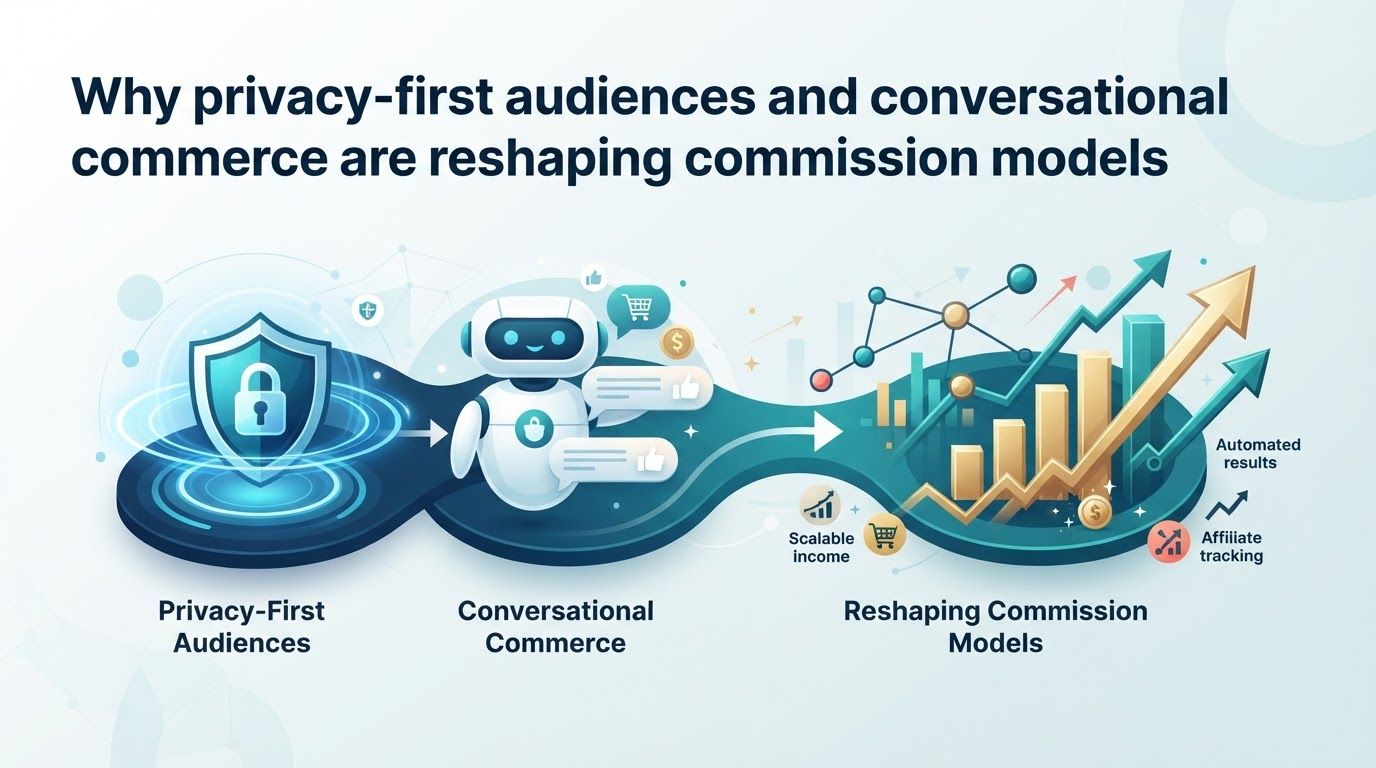
If your affiliate commissions depend on a visible click immediately before a sale, you may be missing part of the value you create. Privacy-first audiences limit the data available for tracking, while conversational commerce lets shoppers research, compare, and sometimes buy without following a familiar link-by-link path.
That does not mean performance commissions are finished. It means affiliates and brands need clearer ways to recognize helpful recommendations, consented customer relationships, and assisted sales without treating every conversation as an opportunity to collect more personal data. Here is how the shift works,and how a smaller publisher can respond without building a complicated tracking system.
Why privacy-first audiences change the economics of affiliate marketing
Privacy is no longer just a policy page issue. In Valtech’s 2026 consumer study, 43.9% of consumers cited privacy and data use as a reason they hesitate to buy, while 52.4% cited payment security concerns. Those figures describe reasons for hesitation, not a guarantee that a particular privacy change will increase your sales, but they make the commercial stakes clear.
A shopper may welcome a useful recommendation and still resist being followed across sites. If an affiliate’s content makes a product easier to understand but the shopper does not accept certain tracking, the publisher may have created value that a conventional attribution report cannot fully show. That is a business measurement problem as well as a customer-experience problem.
Privacy-first marketing does not mean knowing nothing about your audience. It means earning permission for useful data, explaining its purpose, and not making intrusive tracking the price of getting help.
IAB/PwC describes reduced access to user-level identifiers as a reason advertisers are rethinking measurement and attribution. Its reported responses include first-party data, contextual advertising, and data clean rooms. These approaches do different jobs: first-party data comes from a direct relationship, contextual advertising uses the content or setting rather than a detailed personal profile, and a data clean room can support limited analysis between parties under agreed controls.
For a home-based affiliate business, the practical opportunity is to build an audience that chooses to return. A helpful email newsletter, a clearly explained product comparison, or a buyer’s guide tied to a specific use case can build trust without requiring you to identify the reader everywhere they go. If you invite a visitor to subscribe, make the benefit and the data request understandable rather than hiding either behind a vague promise of personalization.
Usercentrics’ 2026 report frames consent as the beginning of an ongoing relationship and points to opt-in rates, data quality, and downstream model performance as ways to evaluate privacy-led design. That suggests a more useful question than “How many people can we track?” Ask whether people understand the choice, whether the information they willingly provide is useful, and whether the resulting experience helps them make a decision.
How conversational commerce compresses the path from question to purchase
A traditional affiliate journey is relatively easy to picture: someone reads a review, clicks a link, visits a merchant, and buys. Conversational commerce can rearrange those steps. A shopper might ask an AI assistant for options, refine the requirements in chat, compare recommendations, and move toward a purchase within the same interaction.
APMA’s 2026 AI search report describes agentic commerce as combining research, comparison, and purchase in one interaction. The important consequence for affiliates is not that every sale will happen inside a chatbot. It is that fewer visible handoffs may remain between the moment your content shapes a decision and the moment a merchant records a transaction.
Gorgias’ 2026 State of Conversational Commerce similarly describes ecommerce moving from a page-based experience toward one in which chat, AI agents, messaging apps, and voice assistants can act as the storefront. Google said in May 2026 that retailers could use conversational attributes to improve product descriptions and that people would be able to book hotels or order food directly from conversations in Search and Maps. These developments show why product information designed only for a conventional landing page may not cover every place a customer asks for help.
What changes for a publisher who answers buying questions?
Imagine you publish a guide to choosing a home-office microphone. A reader might use your explanation of background-noise handling, connection types, and setup effort to form better questions for an assistant. If the final recommendation or purchase takes place elsewhere, the familiar “clicked my button, then bought” sequence may never appear,even though your guide helped the shopper evaluate the options.
The useful response is not to stuff every paragraph with product names. Make your content easy to understand and verify: explain which product fits which situation, identify meaningful drawbacks, and keep specifications accurate. A buyer who encounters your advice through search, a newsletter, or an AI-mediated journey needs the same clarity as someone reading your page directly.
Expectations are rising faster than consistently excellent experiences. Valtech reports that more than 50% of consumers want brand websites or apps to be guided or fully conversational by 2026, while only 5% experience what it calls “state-of-the-art AI assistants” today. For smaller publishers, that gap is a reason to prioritize genuinely useful answers over building a flashy chatbot that cannot handle basic follow-up questions.
There is a trust dimension, too. Attentive’s 2026 retail AI report says 93% of surveyed shoppers sought outside information or proof before buying, and 64% used a seller’s website, app, or physical store for that information. The figures suggest that a conversation does not eliminate verification. Good affiliate content can help someone check a claim, understand an exception, or prepare the right questions to ask a seller.
Why last-click attribution is losing some of its explanatory power
Last-click attribution answers a narrow question: which recognized touchpoint appeared closest to the purchase? It can be useful for paying on clearly tracked transactions, but it does not, by itself, explain every reason a shopper chose a product. Privacy restrictions and conversational journeys make that difference more consequential.
APMA’s 2026 privacy-focused article warns that weakened tracking can leave publishers without commission for sales they generated and give advertisers and networks an incomplete picture of performance. Its AI search reporting also argues that AI-driven discovery is making legacy last-click models less reliable. Those are not claims that every missing click represents a stolen commission; they are reasons to stop treating the recorded last click as a complete account of influence.
Consider three distinct situations:
- A reader follows your tracked link and buys during the recognized attribution window. A conventional sale commission may work well here.
- A reader uses your comparison to shortlist products, then returns to the merchant directly after further research. Your influence may be real, but the usual report may not connect it to the order.
- An AI-mediated shopping experience incorporates useful information from several sources before a shopper buys. Assigning one publisher all the credit would be as questionable as assigning no publisher any credit.
The third case is why “prove the influence” is a better direction than “claim every sale.” APMA explicitly argues for rewards tied to measurable influence, not only direct last-click attribution. Measurement should be specific enough for a brand to evaluate, yet modest enough to avoid pretending that one metric captures every contribution.
For example, a merchant and publisher could agree to assess qualified visitors from a buying guide alongside tracked purchases, or review an opt-in lead program alongside sales. Neither a visitor nor a lead is automatically worth a commission: the agreed definition, quality checks, and terms matter. But combining signals can help both parties see work that a single last-click number obscures.
Be careful with a tempting alternative: replacing lost third-party tracking with aggressive data collection of your own. It may add friction precisely where a cautious shopper needs reassurance. NRF’s 2026 consumer research says 83% of consumers share multiple overlapping concerns involving privacy, misuse, and unwanted marketing. A measurement plan that disregards those concerns may undermine the trust your content was meant to earn.
Which commission models fit a privacy-first, conversational journey?
There is no single replacement for an affiliate commission. The better question is what work the partner performs, what evidence the brand can reasonably check, and who carries the risk when attribution is incomplete. APMA suggests that structures based only on clicks and sales may need supplements such as fixed fees, licensing, and rewards for measurable influence.
Keep sale-based commissions where sales are observable
A tracked percentage or flat amount per sale remains straightforward when the buying journey produces a reliable, eligible referral. It aligns payment with completed transactions and can be comfortable for a merchant testing a new partner. Its limitation is equally clear: if tracking misses meaningful upstream work, a sale-only deal can leave the publisher doing valuable education without corresponding pay.
Use fixed fees for defined work, not vague exposure
A fixed fee can cover a specified deliverable, such as an independently written buying guide, a newsletter placement, or a set of clearly scoped product explainers. It gives a small publisher a more predictable return for research and production time. The merchant, in turn, should know what will be delivered, what disclosure applies, and whether the content must meet any agreed accuracy standards.
A fixed fee should not purchase a favorable opinion. If a product has a drawback that matters to your audience, saying so protects the usefulness of the content. For beginners, that boundary is worth writing into a proposal: the brand pays for the work and placement, while you retain the ability to make honest assessments.
Consider licensing when the brand needs your expertise in another setting
If a merchant wants to reuse an original guide, decision checklist, or other publisher-created material in its own shopping experience, licensing may be more suitable than a link commission alone. A license should identify what material can be used, where it can appear, how long permission lasts, and whether updates are included. These are negotiation points, not an implication that every mention of a product creates a licensing claim.
Conversational storefronts make this distinction particularly useful. Writing an explanation for your own readers is one job; authorizing a brand to repurpose that explanation inside its commerce experience is another. If the brand wants both, separate the deliverables so neither side has to guess what it paid for.
Blend payment types when no single metric tells the whole story
A blended arrangement might pair a modest production fee with a commission on eligible tracked sales. Another could combine a licensed content asset with performance pay for a defined referral program. A qualified-lead payment may suit a longer consideration process, provided the lead definition and permission to contact the person are clear.
Each option has a trade-off. Sale-based pay puts more attribution risk on the publisher; a fixed fee puts more short-term outcome risk on the brand; lead payments require careful quality and consent rules; licensing requires clear usage boundaries. Impact.com’s H1 2026 analysis describes brands monitoring clicks, transactions, conversion rates, average order value, and commission payouts as shoppers become more selective. A proposal that acknowledges those operating concerns will be more credible than one asking for a new fee without explaining the work or the evidence behind it.
How to measure influence without pretending every touchpoint is a sale
Start by separating activity, helpfulness, and commercial outcomes. An article view shows that content was accessed; an engaged question or voluntary signup may show more specific interest; a qualifying order shows a transaction. None of these should be silently substituted for another when discussing compensation.
A small, usable scorecard can organize the conversation with a brand:
- Content delivery: Was the agreed guide, comparison, email, or licensed asset completed and kept accurate under the agreement?
- Audience response: Did readers visit relevant pages, ask useful follow-up questions, or choose to receive more information? Define each measure before using it as evidence.
- Referral activity: What eligible visits, leads, or sales did the agreed tracking actually record, and where might it have limited visibility?
- Customer quality: Where the merchant can share appropriate aggregate results, did referred customers complete purchases, choose suitable products, or produce outcomes the partnership was designed to support?
Aggregate reporting can support decisions without handing a publisher an unnecessary list of customer identities. For instance, a brand might share totals for qualifying orders from a designated campaign or an agreed summary of lead quality. The exact arrangement depends on the tools, permission, and reporting available to both parties; do not promise a level of attribution your program cannot deliver.
Set definitions before a campaign starts. Specify what counts as an eligible sale or lead, which assets are included, what reporting each side will share, how corrections are handled, and when a review happens. If you later disagree about a result, written definitions are more useful than an impressive-looking dashboard with unclear rules.
Also look for evidence that contradicts your assumptions. If a detailed guide attracts interest but produces few qualified referrals, the topic may be too broad, the audience may be early in its research, or the offer may be a poor fit. If sales appear strong but customer questions reveal confusion, improving the explanation may matter more than increasing promotional volume. Measurement should help you make a better decision, not merely justify a higher rate.
How to use AI and first-party data without damaging trust
AI can help a small affiliate operation answer recurring questions, organize product information, and spot gaps in an existing guide. It can also create new privacy risks if a tool receives sensitive conversations or if automation makes claims no one has checked. The goal is a more helpful experience with a clear human owner, not an unattended sales agent.
A 2026 arXiv study of U.S. adult AI-assistant users found privacy concern was widespread and that participants placed especially high value on keeping humans, rather than models, out of their conversations; valuations rose for more sensitive tasks. A separate 2026 paper on privacy preference controls for agentic systems reports that some AI products still lack controls to stop ad-data sharing or block human review. Together, these findings are a reason to examine a tool’s actual settings and practices rather than assume that a conversational interface is private by default.
For an affiliate site, sensible design choices include:
- Ask only for information the experience needs. A product-preference question rarely requires a full identity or a detailed personal history.
- Explain when a visitor is interacting with an automated assistant and where their information may go. Provide a way to reach a human when an answer affects an important decision.
- Review generated recommendations against current product details, especially limitations, compatibility, pricing claims, and merchant terms.
- Give people a clear choice before using their contact details for follow-up marketing. Do not treat asking a chatbot a question as permission for unrelated messages.
Usercentrics’ emphasis on opt-in rates and data quality is useful here: collect fewer, more purposeful signals and check whether they improve the experience. If you run an email list, a reader’s chosen topic preferences may be more actionable than an opaque profile assembled from unrelated browsing. If you use an AI assistant, test whether it can honestly say “I’m not sure” and direct someone to verified details.
Transparency has limits: it is not a substitute for restraint. Research on GenAI-personalized social commerce finds that personalization can feel useful and intrusive at the same time, and that disclosure may help trust without removing privacy concerns. Tell visitors what is happening, then design the experience so they are not asked to surrender more information than the help is worth.
A practical pilot for updating an affiliate partnership
You do not need to renegotiate every program at once. Choose one merchant relationship where you already understand the audience’s buying questions and where your work extends beyond placing a link. A focused pilot will teach you more than a broad request for higher commissions with no defined change in deliverables.
- Map one customer decision. Write down the questions readers ask before comparing options, the evidence they seek before buying, and the point at which they reach the merchant. Identify which parts you help with directly and which parts you cannot observe.
- Audit the current agreement. Check what qualifies for commission, what the available reports show, and which content or channels are eligible. Record tracking gaps as uncertainties, not as a count of supposedly unpaid sales.
- Choose one extra contribution. Offer a useful asset you can deliver consistently: a maintained comparison, a beginner-oriented decision guide, or a permission-based follow-up sequence. Specify its scope and how you will handle updates.
- Propose a matching payment structure. Keep the existing eligible sale commission if it works, then ask whether a fixed production fee, defined lead payment, or limited content license better covers the additional work. Make the trade-off explicit for the brand.
- Agree on a review. Set the reporting definitions in advance and review both observable outcomes and what remains unknown. Continue, revise, or end the test based on the evidence you actually have.
Here is a simple way to frame the conversation: “Our guide helps shoppers narrow the options before they reach your store. We can maintain a clearer comparison and share aggregate engagement and eligible referral results. Can we test a defined content fee alongside the current sale commission, then review whether the guide helps qualified shoppers?” It is a proposed negotiation approach, not a promise that every merchant will accept.
For a newer affiliate, an alternative is to improve the existing arrangement first. Tighten your content, remove unclear recommendations, and confirm that your links and disclosures work as intended. You will have a stronger case for a blended model when you can show a useful audience, a specific deliverable, and reporting that both sides understand.
What to keep, change, and avoid as commission models evolve
Keep performance commissions where they are a fair and workable reflection of what you do. If a reader clicks your comparison and completes an eligible purchase, that outcome still matters. Privacy-first audiences and conversational commerce do not make clear referrals irrelevant; they make a referral-only view less complete for some partnerships.
Change the parts of your business that depend on assumptions you can no longer defend. If you assume every influential interaction creates a trackable click, revisit your reporting. If you assume a chatbot’s convenience automatically earns trust, examine what it asks, stores, and says. If you assume a fixed fee should cover unlimited reuse of your work, clarify the rights before agreeing.
Avoid presenting inferred influence as a verified sale. The strongest case for a new commission model is honest about what can be measured: completed work, agreed audience signals, qualified referrals, and recorded transactions. APMA’s call to reward measurable influence is not a license to count every impression as a conversion; it is an invitation to design compensation around the value a partner can substantiate.
The direction for a small affiliate business is encouraging. You can compete by understanding your audience’s questions, producing careful explanations, earning voluntary contact, and proposing payment for clearly defined work. Those strengths remain useful whether a shopper reads your whole guide, asks an AI assistant for a summary, or visits a merchant to verify the final details.
The main takeaway is simple: protect the trust that makes your recommendations valuable, then negotiate around evidence your partner can inspect. Use tracked commissions for observable sales and consider fixed fees, licensing, or agreed lead rewards when you perform additional work that the last click cannot adequately represent.
Pick one existing partnership and map the journey your audience actually takes. If the current commission rewards only a small, visible slice of your contribution, propose one defined improvement, one sensible way to measure it, and a limited test that respects the shopper’s choices.