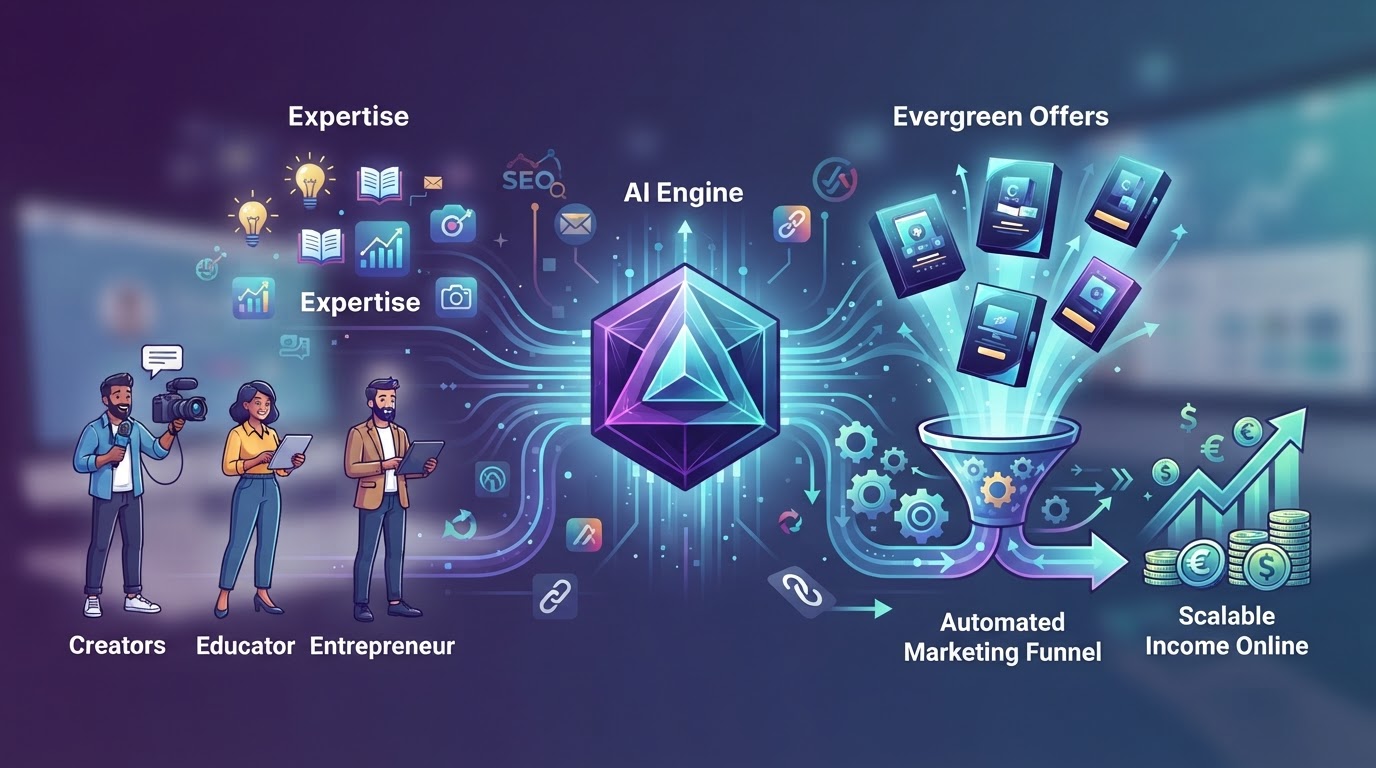
If you publish useful advice but still depend on the next post to bring in customers, generative engines can make your business feel harder to predict. Creators who package expertise into evergreen offers give both people and AI answer engines something clearer to find, explain, and revisit: a specific solution to a recurring problem.
That does not mean an AI tool will recommend your course or cite your website just because you built one. It means you can improve your chances of being understood by connecting durable answers, demonstrable expertise, and a well-defined offer. For an affiliate marketer or home-based entrepreneur, the opportunity is to build an asset that remains useful after a social post disappears from the feed.
Why generative engines can favor evergreen offers
Generative engines are more likely to find useful source material when a creator clearly answers a question, shows relevant expertise, and explains a repeatable solution. An evergreen offer gives that solution a stable destination, but citations and recommendations are never guaranteed.
Traditional search usually presents a list of links for someone to evaluate. Generative search can instead assemble an answer and choose which sources to show alongside it. A 2026 paper on generative engine optimization, or GEO, describes how systems such as ChatGPT, Gemini, and Perplexity select web pages as sources. That selection makes being easy to cite a practical business concern, not just a technical SEO exercise.
The shift matters even if your existing search traffic looks healthy. HubSpot cites 900 million weekly active ChatGPT users, reports that 60% of Google searches end without a click, and says AI-referred traffic has risen 600% since January 2025. Those figures describe different measures and should not be treated as a forecast for an individual creator. Together, they illustrate why discovery can happen inside an answer before a visitor reaches your site.
The GEO research offers a useful clue about what an answer engine may find helpful: within a website, pages whose titles and paragraphs closely match users’ questions are cited more often. A clear page answering “How do I build an affiliate welcome sequence?” is easier to connect to that question than a vague post titled “My Latest Marketing Thoughts.” The study does not say that selling an evergreen product automatically wins a citation. The reasonable inference is narrower: durable, question-led content can keep qualifying as relevant source material when the same problem comes up again.
There is also a difference between being cited and making a sale. An AI response might summarize your advice without sending a visitor to you, or cite a helpful article without mentioning the paid offer behind it. Your job is to make the answer genuinely useful on its own while giving interested readers a clear path to the deeper implementation you provide. That is why packaging expertise matters: it joins discoverable information to a solution people can actually use.
What counts as an evergreen offer for a creator?
An evergreen offer solves a problem that persists beyond a news cycle or platform trend. It has a defined outcome, audience, and way to buy or access it without requiring you to invent a new product for every campaign. Evergreen does not mean untouched forever. It means the underlying need stays relevant while you maintain the examples, tools, and instructions.
For an affiliate creator teaching email marketing, that might be a welcome-sequence template kit with a setup guide and editable examples. For a home-based consultant, it might be a website messaging audit with a consistent scope and deliverable. Someone teaching AI workflows could offer a playbook that helps readers decide which steps to automate and which decisions to keep human-led. Each offer makes the creator’s expertise legible in a different way.
- Templates give buyers a starting structure for a repeated task, such as planning an affiliate content calendar.
- Courses and playbooks explain a process in enough depth for someone to apply it, rather than collecting disconnected tips.
- Productized audits turn professional judgment into a clearly scoped service with defined inputs and outputs.
- Memberships or systems provide ongoing support around a stable problem, provided the core promise is understandable without a constant stream of new launches.
The format matters less than the connection between the public answer and the offer. Suppose you publish a guide explaining how to choose an email tool. A relevant evergreen offer could help buyers map their first automated sequence; a generic bundle of unrelated prompts would be a weaker next step. An answer engine can describe the first relationship more coherently because the problem, advice, and implementation all point in the same direction.
Industry reporting suggests buyers are also looking for connected solutions. An OpenAI report on Upwork describes AI-related job postings that combine tasks clients less often requested together before generative AI. Upwork separately reports growing demand for specialized AI roles, including consulting and integration. These observations do not prove that every course or template will sell. They support a practical choice: organize related skills into an outcome that a buyer can recognize, instead of presenting yourself as a list of isolated tasks.
A live coaching practice can still be valuable, and a timely campaign can still bring in customers. The evergreen advantage is that your best explanation and core offer do not have to be recreated every time you want to be discovered. You can use timely content to point toward a stable solution rather than making every post carry the full weight of your business.
Build a source page that matches the question and explains the offer
Before asking an AI system to understand your business, make the relevant page understandable to a person who has never heard of you. Start with one specific question your ideal customer would ask. Then answer it directly near the top of the page, using ordinary language that matches the question rather than clever branding that hides the subject.
If your offer is an affiliate disclosure and review-writing kit, a useful page might address “How do I write a helpful affiliate product review?” Its opening should explain the steps and judgment involved, not immediately pitch the kit. From there, show where the kit helps: perhaps it provides a review outline, a checklist for evaluating claims, and examples of how to separate personal experience from product specifications. The page can serve a reader who never buys while making the deeper resource easy to understand.
Give the page a clear job
A strong evergreen page typically has a descriptive title, a direct introductory answer, sections that follow the reader’s next questions, and a visible explanation of the intended audience. Include the limits of your advice where they affect a decision. If your workflow assumes that someone already has a mailing list, say so; a beginner building one from scratch needs different guidance.
Keep the offer description equally concrete. Name what the buyer receives, what problem it helps solve, what they will still have to do themselves, and how current the materials are. An AI answer cannot responsibly infer those details from a label such as “ultimate growth system.” A reader should not have to decode the promise either.
Use supporting structure without mistaking it for substance
The GEO paper found that FAQ blocks, structured data, summary boxes, and page speed appeared helpful mainly in comparisons across websites rather than as the clearest way to win more citations among pages on the same site. That is a reason to treat those features as supporting elements, not shortcuts. Improve loading and add appropriate structured information where useful, but first make sure your title and paragraphs answer the actual question.
Publish one strong, canonical explanation rather than several near-duplicate pages competing to describe the same offer. You can update that explanation as your process changes and link to it from narrower tutorials. This is an editorial strategy, not a promise that a particular engine will always choose your preferred page. It simply gives readers and systems a more consistent account of what you know and what you provide.
Connect educational content to a repeatable buyer journey
A helpful source page is the beginning of a pathway, not the entire business model. People may encounter your advice at different levels of readiness: one wants a definition, another wants to compare approaches, and a third is ready to implement. Your content should help each person move to the next sensible decision without forcing every question into a sales pitch.
Imagine you teach solo business owners to automate routine customer emails. A short article could explain which messages are worth automating. A deeper guide could walk through the logic of a welcome sequence, including what to personalize and when a manual response is better. Your evergreen offer could then provide templates, a setup walkthrough, and a review checklist. These pieces have distinct jobs, but they share the same practical subject.
- Choose a recurring question. Write down the exact problem a buyer faces before they know your product exists.
- Publish the useful answer. Explain the decision, method, or criteria clearly enough that a reader can take a first step for free.
- Show the implementation gap. Identify the work involved in applying the advice, such as drafting, customizing, testing, or getting feedback.
- Introduce the offer as an aid. Explain how your template, audit, course, or service helps with that work without claiming it replaces the buyer’s judgment.
- Keep the path current. Check that your links, product details, examples, and instructions still match what a buyer will receive.
This structure also gives you a sensible way to use AI in your own production process. An AI assistant can help group customer questions, propose an outline, or identify gaps in a draft. You still need to check the claims, demonstrate the workflow, and decide whether the offer really solves the problem. Adobe reports that 75% of creators in its 2026 Creators’ Toolkit Report say creative AI is integrated or essential to their work, while 85% say the final creative decision should remain with the creator. Faster production and human accountability can coexist.
OpenAI’s Evernote case study offers another useful lens. It describes Evernote aligning its messaging with what people use ChatGPT for, and OpenAI says the discovery feature aims to help users find companies and offers they might otherwise miss. Evernote’s enduring jobs,saving, organizing, and finding notes,are easy to describe in relation to a user problem. A small creator cannot assume the same placement or outcome, but can apply the lesson: explain the job your offer does in the words a customer would use when asking for help.
Why niche expertise and trust matter more than a large content pile
If AI makes it easier for almost anyone to produce a polished post, polish alone becomes a weak signal. Specific knowledge helps a reader tell whether advice fits their circumstances. It also gives your public content details that a broad, generic summary may miss: what you tested, how you made a choice, and where a method stops working.
A 2026 report summarized by ScalablePod says 41% of surveyed senior brand leaders use creator content to influence what generative AI search tools share about their products. The same report says marketers increasingly seek creators with defined niches or expertise because AI-generated sameness and uncertainty about accuracy complicate online discovery. That does not mean brands will pay every specialist. It does mean a credible, focused of work can have value beyond its immediate follower reach.
For an affiliate creator, expertise is visible in the quality of the comparison, not the number of products listed. Explain who a tool suits, what you checked, what you could not verify, and when a cheaper or simpler alternative would be enough. Disclose affiliate relationships clearly. If your evergreen offer includes recommendations, update them when a product changes so your buyers are not relying on an old screenshot or outdated feature claim.
For a service creator, demonstrate your process without exposing a client’s private information. You might show an anonymized before-and-after outline, walk through your audit criteria, or explain why you rejected an apparently attractive automation. Experience becomes more useful when you show the reasoning behind a recommendation, not merely claim that you have it.
Adobe says AI is making specialist capabilities more accessible while highlighting the continuing importance of human expertise and judgment. Its creator research also found that 87% of creators using creative AI say it accelerated business or audience growth. That is encouraging, but business growth from using a tool is not the same thing as defensible authority. Your durable advantage is the ability to evaluate a situation, communicate limitations, and stand behind the result.
Digiday reports that creators are learning to pitch answer engine optimization, or AEO, and that a citation could become repeatable proof that their content is useful to AI and search systems. Treat a citation as evidence to investigate, not a badge that proves every claim you make. When you can connect a source mention to the specific question it answered, you learn what your expertise is actually recognized for.
Where an evergreen offer beats constant posting,and where it does not
Posting often can create conversations, test ideas, and build familiarity. It becomes risky when your entire income depends on each new piece of content earning attention immediately. A productized offer gives interested people a way to act on your expertise even when a particular post has a short life.
A 2026 MIT Sloan paper examining AI inspiration in the creator economy found that treated creators received 12.47% more total views while views per video fell. That finding concerns the studied setting, not a universal rule for blogs or affiliate businesses. Still, it highlights a trade-off worth planning for: AI can expand overall output and attention while making each individual item less reliable as a growth engine. Turning recurring lessons into a maintained resource is one way to avoid relying only on the next post.
There are situations where another approach makes more sense. If your niche changes rapidly, a fixed course may age too quickly unless you can maintain it. If your audience needs tailored decisions with high stakes, a scoped audit or consulting offer may be more responsible than a one-size-fits-all template. If you are still learning what customers ask, publish and talk to them before committing months to product development. Evergreen should describe the customer problem, not freeze your advice in place.
- Choose a template when the work follows a reusable pattern but buyers still need room to customize it.
- Choose a course or playbook when understanding the sequence of decisions matters as much as the final asset.
- Choose an audit when your judgment about a buyer’s specific situation is the main value.
- Choose ongoing support when the core problem persists but implementation changes often enough to justify continuing guidance.
Do not confuse an evergreen offer with passive income. You may still need to answer customer questions, update materials, fix broken links, and revise examples when tools change. Nor does packaging expertise require an expensive launch. A small paid checklist that solves a real recurring task can teach you more about demand than a large program built from assumptions.
Finally, generative discovery may not send traffic in proportion to the visibility it creates. An answer can satisfy a user without a click, and engines choose sources according to systems you do not control. Keep channels such as email, direct referrals, search, and your own website in the mix. The offer is a more stable destination for attention, not a guarantee about where that attention will come from.
How to measure citation value without chasing vanity metrics
If you are used to measuring posts by impressions alone, AI discovery calls for a broader view. A citation matters when it accurately represents your expertise and reaches someone with a relevant problem. A sale matters too, but the journey between a source mention and a purchase may not be visible in a conventional traffic report.
Start by recording the questions you want your pages to answer. For each question, note the page that gives your best answer, the offer it leads to, and the action a reader can take next. This gives you a baseline you can improve without pretending you know exactly how a model ranks sources. Review actual inquiries as well: are people asking about the topic you intended to be known for, or are they confused about what your offer includes?
When you check AI answers, use realistic prompts with different wording and note whether your content is cited, summarized accurately, or absent. Results can vary, so avoid treating one test as a stable ranking. If your brand appears in an answer that misstates your offer, the first fix may be clearer public messaging, not a bigger volume of content. If a page earns visits but buyers repeatedly ask the same basic question, make that answer easier to find.
Track indicators that relate to an actual business decision:
- Which recurring questions bring relevant readers to your educational pages?
- Which pages lead to offer views, email signups, qualified inquiries, or purchases?
- Do buyers understand what they will receive and what work remains theirs?
- Are source mentions, when you find them, accurate and relevant to your niche?
- Which sections need updating because the tools, examples, or offer details changed?
These checks keep you focused on usefulness rather than manufacturing text for a possible citation. The ARF/MSI report describes generative search as a paradigm in which AI-generated responses appear before conventional results. That placement makes source visibility worth monitoring, but your goal is not simply to appear in an answer. It is to be a trustworthy option when someone needs the kind of help you actually provide.
Set a manageable review routine instead of repeatedly rewriting every page after an isolated AI result. Revisit your most important source pages, verify the practical instructions, and compare the questions people ask today with the page titles and opening paragraphs you wrote earlier. If a new question genuinely calls for a separate guide, publish one. If the existing guide already answers it but buries the answer, improve the guide rather than creating another near-duplicate asset.
A practical way to package your expertise now
You do not need a catalog of products to apply this strategy. Begin with one recurring problem you can solve responsibly and one offer whose scope you can explain in a sentence. For example: “I help new affiliate publishers plan their first useful product comparison with a review outline and an evidence checklist.” That statement identifies an audience, a task, and the resources involved without promising search visibility or income.
Next, write the public answer you would want a skeptical beginner to find. Describe the method, show a modest example, and state what depends on the reader’s circumstances. If you recommend an affiliate tool, make the commercial relationship clear and explain why an alternative might suit a different user. Then describe the offer beneath that answer as the supported way to put the method into practice.
Ask a person outside your business to read the page and tell you what problem you solve, who the offer is for, and what they would get. If they cannot answer, simplify the wording before worrying about more advanced optimization. Clear communication helps human buyers first; its potential usefulness to generative engines follows from that clarity.
Finally, reuse the same expertise across formats without publishing the same copy everywhere. A demonstration video can show how the checklist works. An email can explain a common mistake. A short social post can direct people to the full guide. Each piece adds a perspective or example, while the evergreen page remains the dependable home for the complete answer and current offer details.
Generative engines do not favor an offer merely because it is always available. The opportunity is to pair a lasting customer need with a clear answer, credible judgment, and a repeatable next step. That combination gives your expertise a better chance to be understood wherever discovery happens.
Choose one question your audience keeps asking, build the best answer you can, and connect it to an offer that genuinely helps them act. Keep both current as you learn from customers. You will have a more useful business asset whether the next visitor arrives through an AI citation, a search result, an email, or a recommendation from another person.