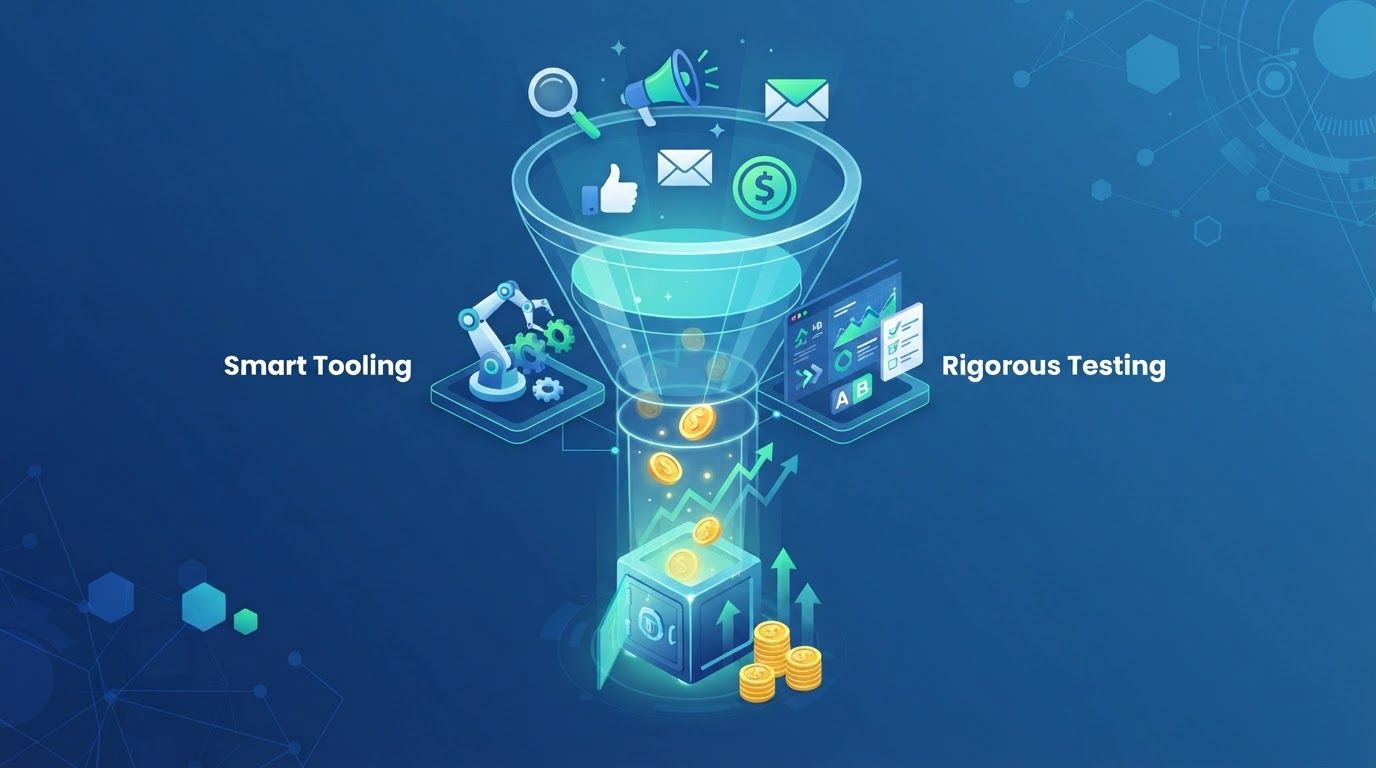
If your campaigns produce a few sales and then stall, the problem may not be your offer. You may need repeatable revenue funnels: systems that capture what works, follow up consistently, and use real results to improve the next round of traffic, content, and offers.
You do not need a complicated enterprise setup to build one. Start with a clear customer journey, connect a small set of tools, and test changes against outcomes that matter to your business. The goal is not to put every decision on autopilot; it is to make good decisions easier to repeat.
What makes repeatable revenue funnels different from one-off campaigns?
Build a repeatable revenue funnel by mapping one audience-to-offer journey, connecting lead capture and follow-up, measuring qualified leads and sales, and testing one meaningful change at a time. Feed each result back into the next campaign so the system improves rather than resets.
A traditional funnel describes stages: someone discovers you, considers an offer, and decides whether to buy. That picture is useful, but it can hide what happens after the campaign ends. If you create a new landing page, email sequence, and promotion from scratch every time, you have a series of projects, not a repeatable system.
HubSpot’s 2026 Loop Marketing framework describes a four-stage model in which each marketing action feeds the next. The useful idea for a small business is the feedback loop: questions from prospects inform your content, email replies reveal objections, and sales outcomes influence which traffic sources or offers deserve another investment. You keep the working parts and revise the weak ones.
Think of repeatability as an operating standard, not a promise that revenue will arrive on a fixed schedule. Your results still depend on demand, offer quality, traffic, competition, and execution. What you can make repeatable is the process used to attract the right people, help them decide, and learn from the outcome.
- A defined entry point: A search article, social post, referral, or paid campaign addresses a specific problem for a specific audience.
- A relevant next step: A comparison, checklist, email course, or product page helps that audience move closer to a decision.
- A recorded outcome: Your tools show what people did after the first click, not just how many people arrived.
- A review habit: You use evidence from leads and sales to adjust the next message, offer, or channel.
For an affiliate marketer, a loop might begin with a tutorial about choosing an email platform. Readers join a short onboarding sequence, compare tools, and click through to a recommended product. Their replies and click patterns then reveal which setup questions the next tutorial should answer. If the recommendations are not generating qualified interest, the answer may be a better match between audience and product, not another promotional email.
Choose an offer and map the customer journey before buying tools
It is tempting to start by connecting an AI writer, email platform, landing page builder, and analytics dashboard. First decide whom the funnel serves and what action represents progress. Otherwise, automation simply moves people through a journey that may not make sense to them.
Write a brief audience-and-offer statement: “I help [specific person] solve [specific problem] with [type of solution], and the next useful step is [action].” A home-based entrepreneur recommending bookkeeping software might focus on freelancers who want a simpler way to organize expenses. Their first useful step could be a comparison of common approaches, not an immediate purchase pitch.
Work backward from the sale
List the questions a person is likely to ask before choosing the offer. Do they understand the problem? Are they comparing alternatives? Do they need evidence that a tool fits their budget, skill level, or existing setup? Give each stage a useful asset and a measurable action.
- Discovery: Publish content that matches an actual question, such as how to organize freelance expenses. Measure relevant visits and engagement, not just total reach.
- Consideration: Offer a practical resource, comparison, or demonstration. Measure sign-ups, useful replies, and visits to decision-stage content.
- Decision: Explain who the product suits, what it costs where known, and what alternatives may be better for some readers. Measure qualified referrals, purchases, or confirmed sales when that data is available.
- Follow-through: Help new customers get value and collect recurring questions. Measure downstream outcomes you can observe, then use those questions to improve earlier stages.
Not every business needs an email opt-in between content and purchase. A reader searching for a specific product comparison may be ready for a direct, clearly disclosed affiliate link. Someone researching a complex service may benefit from an email series before making a decision. Choose the route that helps the reader, rather than adding steps merely because a funnel diagram includes them.
Document your starting assumptions: audience, main promise, traffic source, offer, likely objection, and primary conversion action. This gives future tests a baseline. When a campaign underperforms, you can ask whether the problem is attracting the wrong visitor, asking for too much too early, or recommending a poor-fit offer.
Build a smart funnel stack that shares useful data
A practical stack needs to support the journey you mapped, not the other way around. HubSpot identifies content, lead capture, automation, analytics, and data enrichment as typical components of conversion funnel optimization. For a solo operator, some of those functions may live in the same product; you do not need a separate subscription for each category.
Start with a publishing home for helpful content and a destination for each offer. Add a form or other lead capture method only where an ongoing relationship makes sense. Connect an email or customer relationship tool to handle the promised follow-up, then add analytics that show how visitors move from the entry point toward a meaningful outcome.
- Content tools help draft, edit, and maintain articles, landing pages, and messages. Keep a human review step for accuracy, brand fit, and claims about products.
- Lead capture tools record a voluntary next step, such as requesting a guide or joining an email list. Ask only for information you will actually use.
- Automation tools deliver the resource, schedule relevant follow-ups, and stop or change a sequence when a person takes the intended action.
- Analytics tools connect traffic sources and content to sign-ups, qualified actions, and sales where tracking allows.
- Data enrichment tools can add context when it is genuinely useful, but they are optional for many small businesses and require care around data quality and privacy.
Choose integrations based on the questions you need to answer. Can you tell which page generated a lead? Can you distinguish a new subscriber from a returning customer? If an affiliate network reports sales separately, can you reliably compare those reports with campaign dates and tracked referral activity? You may not get a perfect person-level view, but you should know what each dashboard does and does not prove.
Give your campaigns consistent names and keep a simple record of links, landing pages, offers, and tests. Test every form, delivery email, and purchase or referral link yourself before sending traffic. A broken confirmation page can make good content look ineffective, while inconsistent labels can turn a useful report into guesswork.
The trade-off is simplicity versus detail. An all-in-one platform can reduce integration work but may limit flexibility or cost more as you grow. A set of specialized tools may fit your workflow better but demands more maintenance. Pick the least complex setup that lets you follow a lead from first meaningful interaction to the furthest reliable outcome you can measure.
Use AI automation to repeat useful work, not generic persuasion
AI can help across the journey, but its best use is to shorten the time between an insight and a better customer experience. HubSpot reports that 43% of marketers use AI to create or refine content, 35% use it for data analysis, and 47% use it to improve efficiency through automation. Those are different jobs; a tool that drafts a line is not automatically making sound decisions about your offer.
Set up automations around clear triggers. When someone requests a checklist, send the checklist immediately and follow with a message that helps them use it. If they visit a product comparison, offer a relevant explanation of the differences. If they buy or complete the intended action, do not keep sending an introductory sales sequence as though nothing happened.
Give AI a narrow, reviewable assignment
Use AI to turn notes from customer questions into possible article outlines, summarize themes in anonymized feedback, or draft alternative subject lines for a test. Provide the audience, offer, intended action, and facts it must not change. Then check the output against the real product, your experience, and your affiliate disclosure requirements before publication.
For example, suppose readers keep asking whether a recommended tool works for beginners. AI could group those questions and propose a welcome email that explains the setup process. You should verify every product claim, remove vague promises, and decide whether that email actually helps someone make a more informed choice. Automation handles delivery; you remain responsible for the recommendation.
HubSpot’s 2026 go-to-market data says customers using its Breeze Assistant for marketing tasks such as audience definition, personalized outreach, and automated follow-ups generate four times more leads than comparable customers without it. That is a reported comparison involving a particular product and customer group, not a guarantee that adding an AI assistant will multiply your leads. The actionable lesson is that AI can support several connected funnel tasks, rather than serving only as a content generator.
Put guardrails around any automated flow. Make it easy for people to opt out of emails, avoid using sensitive details merely because a tool can store them, and review messages after an offer or product changes. HubSpot’s 2026 State of Marketing characterizes effective growth as human-led and AI-supported: use software to scale timely, relevant work while keeping human judgment in charge of trust.
Design funnel tests around decisions that could change revenue
Rigorous testing begins with a question that matters. “Will this button color get more clicks?” may be easy to answer, but it is not always useful. “Will a clearer comparison help more qualified visitors choose the right offer?” connects a change to customer understanding and a potential business outcome.
Write a test hypothesis before changing the page: “For readers arriving from the beginner tutorial, replacing the generic product pitch with a comparison of setup requirements will increase qualified offer clicks without reducing completed sales.” State the audience, change, primary outcome, and possible downside. If the test wins only on clicks but produces fewer sales, you have learned something important about the quality of those clicks.
- Choose one bottleneck: Find a stage with enough activity to inspect, such as strong article traffic but weak movement to a relevant comparison.
- Investigate before proposing a fix: Read replies, inspect the page on mobile, check load behavior, and look for mismatches between the entry message and the offer.
- Change one meaningful element: Test a clearer promise, a more helpful page structure, or a better-matched next step. Keep unrelated changes out of the experiment when possible.
- Define success in advance: Select a primary metric and note supporting and safety metrics before seeing the result.
- Run the test consistently: Send comparable visitors to each version, avoid ending it just because an early result looks exciting, and document other campaigns that could affect performance.
- Decide what to do next: Keep a credible improvement, revisit a weak hypothesis, or gather more evidence if the result is unclear.
An A/B test is useful when you can send sufficient comparable traffic to two versions and track outcomes reliably. With very low traffic, splitting visitors may leave you waiting a long time for an answer. A practical alternative is to improve the page based on usability checks and customer feedback, record the change date, and monitor results over time. That approach is less able to isolate cause and effect, so describe it as an informed iteration rather than proof of lift.
VWO notes that A/B testing can surface issues affecting key performance indicators and conversions before they prompt an urgent redesign. The deeper habit is to investigate smaller problems while they are manageable. Testing does not mean changing everything constantly; it means deciding what evidence would justify a change before investing more time or money.
Measure leads, sales, and lagging outcomes without fooling yourself
Top-of-funnel numbers tell you whether people notice your work. Revenue tells you whether the journey eventually supports the business. The space between them is where many funnel decisions go wrong: a higher sign-up rate may look impressive even if those new subscribers never engage with the offer.
Build a small measurement hierarchy for each funnel. Your primary metric should represent the main decision the test is meant to improve, such as completed purchases when you can track them. Secondary metrics can show the path toward that outcome, including qualified offer clicks or requests for a consultation. Monitoring metrics catch unintended harm, such as a rise in unsubscribes or a drop in engagement with an important page. Optimizely’s testing documentation recommends diversifying primary, secondary, and monitoring goals to evaluate impact across funnel stages.
Define lead quality for your business before optimizing for more leads. A subscriber who requests a beginner resource and engages with a relevant follow-up may be more promising than a visitor who enters an email address only to receive a broad giveaway. HubSpot notes that lead quality metrics help connect top-of-funnel activity to downstream revenue and make the sales funnel more realistic.
Revenue signals can arrive late. A reader might discover your article today, compare alternatives later, and purchase after several more interactions. Google’s experimentation playbook advises that when conversion lag is long, teams should include upper-funnel conversions or consider a different testing solution. Use those earlier actions as directional signals, not substitutes for sales: check whether a change that improves qualified visits also improves downstream outcomes as more results arrive.
Also inspect technical friction before rewriting your message. Google’s “Milliseconds Make Millions” research found that a 0.1-second site speed improvement improved engagement and progress through the conversion funnel, including a 6.5% bounce-rate improvement in the travel vertical. That result does not predict the same lift for your site, but it makes speed worth checking when mobile visitors abandon a page before they can assess the offer.
For affiliate businesses, attribution can be incomplete. A network may show a sale without revealing the full visitor journey, and not every platform reports the same events. Compare only metrics with clear definitions, note missing data, and avoid claiming a test caused revenue growth when a promotion, seasonal change, or tracking issue could also explain it. Honest measurement is more useful than a polished dashboard with uncertain meaning.
Turn funnel reviews into a repeatable improvement rhythm
Once the journey is live, give it a regular review process. A funnel becomes repeatable when findings move into the next piece of content, follow-up sequence, or offer decision. HubSpot’s lead generation guidance emphasizes that funnels can make working steps visible, automate repetitive tasks, and align teams around shared measures such as conversion rate and cost per lead. Even if you work alone, those shared definitions keep your decisions consistent from month to month.
Keep a lightweight experiment log. For each change, record the problem, hypothesis, page or sequence affected, start and end conditions, primary and supporting metrics, what happened, and what you will do next. Include context such as a new traffic source or offer change. This prevents you from repeating failed ideas and makes a genuine win easier to reproduce.
Use a review that leads to action
- Check the mechanics: Are pages loading, forms working, links going to the intended destinations, and follow-ups arriving?
- Check the journey: Where do qualified visitors stop progressing, and is the next step appropriate for their level of intent?
- Check the business outcome: Which sources and messages produce useful leads, referrals, or sales rather than activity alone?
- Choose one priority: Select the most consequential problem you can realistically investigate and change.
- Capture the lesson: Update your audience notes, content brief, automation rules, or testing plan so the next campaign starts smarter.
Consider a tutorial that attracts relevant visitors but produces few qualified referrals. Your review might find that readers are looking for a low-cost starting option while the recommended product targets established businesses. No amount of button testing can repair that mismatch. You could change the offer, explain the fit more clearly, or publish a separate guide for the more advanced audience. The right decision may reduce raw clicks while improving trust and sales relevance.
Optimizely describes experimentation tooling as moving toward self-improving digital experiences and an autonomous optimization loop. Its 2026 buyer guidance also emphasizes connecting tests to revenue, retention, and growth rather than stopping at clicks. Small operators do not need autonomous software to adopt the principle: review outcomes, carry forward what worked, and keep a human decision-maker responsible for what gets scaled.
Know when to simplify, rebuild, or expand your funnel
Smart tooling can make a weak funnel run faster, which is not the same as making it profitable. Before adding another sequence or channel, decide whether the current journey has a clear offer, a functioning path to conversion, and evidence that the audience values what you provide. Expansion is easier to evaluate when those basics are stable.
Simplify if you cannot explain why a subscriber receives each email, if multiple tools report conflicting versions of the same event, or if people are pushed through steps that do not help them decide. Remove unnecessary branches, keep the most useful messages, and track a smaller number of meaningful actions. Fewer moving parts make it easier to find broken links and understand test results.
Rebuild the offer path if visitors engage with your information but repeatedly show that the recommendation does not fit their needs. Ask what problem they hoped to solve, compare alternative products or approaches, and make your suitability criteria explicit. For affiliate marketers, a candid “not for you if” explanation can be more valuable than a polished but indiscriminate pitch.
Expand when you can see a working journey and have a specific reason to reach more people. Repurpose a successful tutorial into a useful email lesson, add a comparison for a common objection, or test a new traffic channel with its own tracking. Do not assume that performance on one channel will transfer automatically to another; audience intent and acquisition costs can differ.
HubSpot’s Q1 2026 marketing data reports that 29% of marketers prioritize improving sales, 23% focus on closing more deals, and 28% name increasing conversion rates as their primary objective. Those priorities reinforce a practical rule: judge a funnel by the business outcome it is designed to support, while using earlier signals to diagnose what needs work. More content, more automation, and more traffic are options, not goals in themselves.
Set a threshold for how much complexity you are willing to maintain. Every new tool, segment, or test adds work: someone must verify it, interpret its data, and update it when the offer changes. For a home-based business, a modest funnel that you understand and improve may be more valuable than an elaborate one you cannot reliably audit.
Repeatable revenue funnels are built through clear offers, connected tools, useful follow-up, and tests tied to real customer behavior. Start with one audience and one journey, then make the next improvement where the evidence points rather than where a new tool promises the most features.
Choose one existing campaign this week and map its path from first visit to the furthest outcome you can measure. Check that every step works, identify one meaningful bottleneck, and write down a testable change. That small review is the beginning of a system you can run, learn from, and improve again.