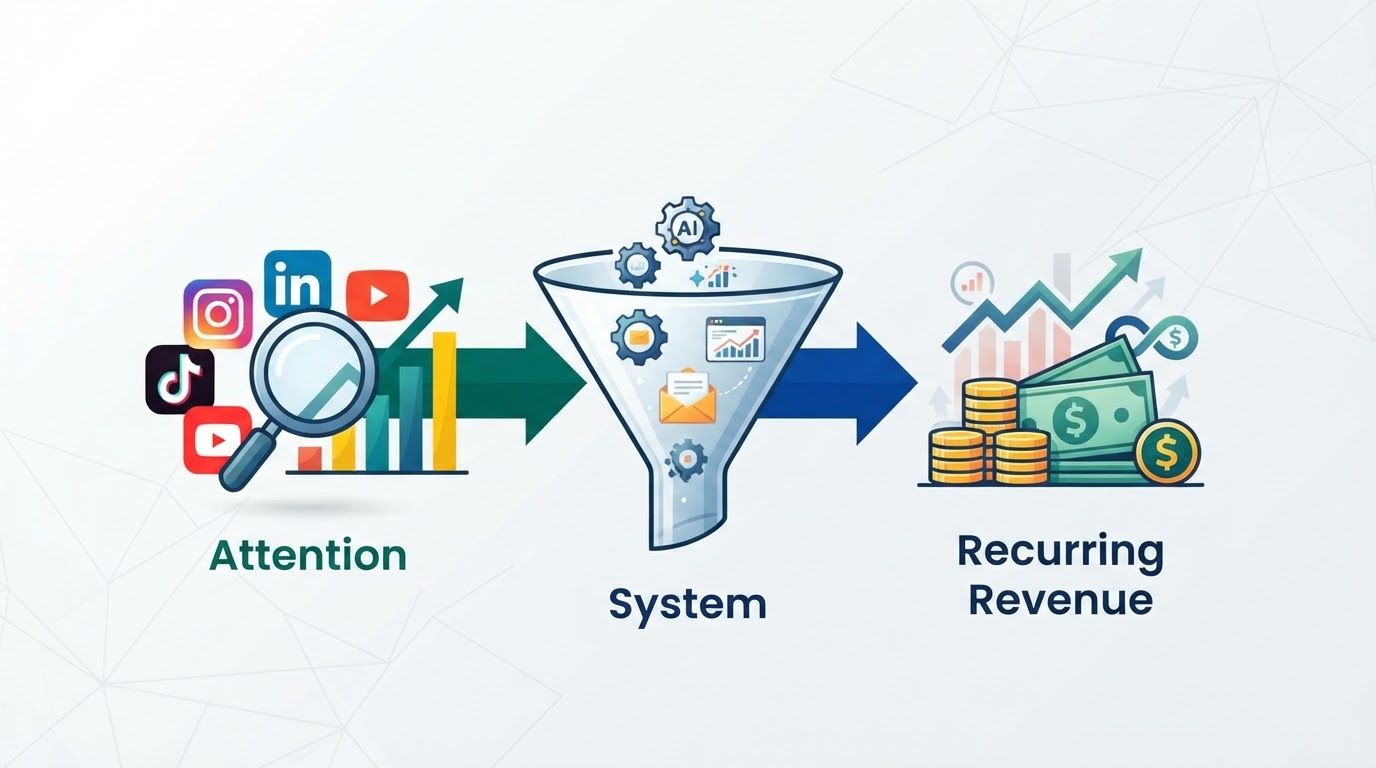
Getting attention is not the same as earning dependable income from it. If you want to turn attention into recurring revenue, you need a simple path from useful content to an ongoing offer that people value enough to keep.
That path can work for an affiliate marketer recommending subscription tools, a creator running a paid community, or a home-based entrepreneur selling continuing support. The goal is not to put a payment request behind every post. It is to connect the right audience with a recurring solution, then make the experience worth renewing.
How to turn attention into recurring revenue
Publish content that attracts a specific audience, invite interested people into a permission-based relationship, recommend a relevant recurring offer, and keep delivering value after they join. Measure retained revenue alongside clicks and sign-ups so you can improve the whole path, not just the first conversion.
Think of this as a small system with connected jobs. Public content helps someone discover you. An email list or another permission-based channel lets you continue the conversation. A subscription, membership, service retainer, or eligible recurring affiliate offer creates the opportunity for repeat income. Onboarding and ongoing help give people a reason to stay.
The connections matter more than the number of posts you publish. A video may receive plenty of views but bring in people who have no need for your offer. A narrower tutorial that answers a buying question may attract fewer people yet lead to more useful conversations. Both pieces can have a place in your strategy, but they do different jobs.
That distinction is consistent with McKinsey’s analysis of the attention economy: consumption time does not translate into revenue equally across media. McKinsey also projects annual growth in monetization revenue per hour from 2024 to 2028 of 10% for social media and 7% for social video. Those are market-level projections, not a forecast for your account or proof that posting more will pay more.
For a small business, the useful question is therefore not simply, “How do I get more reach?” Ask, “Which people am I helping, what ongoing problem do they have, and what would make them comfortable taking the next step?” If you cannot answer those questions, choose a narrower audience before investing in automation or a paid offer.
- Attention: Someone discovers an answer you provide through search, social content, a referral, or another channel.
- Permission: They choose to receive a useful resource or continued guidance from you.
- Fit: You show how a recurring solution addresses the problem that brought them in.
- Retention: You help them get value after the purchase, rather than treating the sale as the end of the relationship.
This sequence is deliberately modest. You do not need a complicated funnel before you have evidence that the audience wants the solution. You need a clear promise, an easy next step, and a way to learn what happens after someone takes it.
Capture useful attention without depending on one platform
Choose a discovery channel based on where your audience asks questions, not where everyone else seems to be posting. Search content is useful when people describe a problem in detail. Short social posts can surface an idea to someone who was not actively looking. A video demonstration can show a workflow more clearly than text. Each format should lead to a next step that fits the question it answers.
There is a strong commercial case for paying attention to social distribution. EMARKETER reports that social platforms collect nearly 30% of U.S. advertising dollars while accounting for 12.5% of adults’ daily media time. That contrast shows where advertiser budgets concentrate; it does not tell you that social followers are necessarily ready to buy, or that paid social ads will be profitable for a small business.
Start with one core topic and create content for different levels of intent. An introductory post might explain a common mistake. A more specific tutorial can show how to fix it. A comparison can help someone choose between tools. Give each piece a natural invitation: read the deeper guide, get a checklist, join an email series, or view the offer if they are ready.
Give people a reason to move from a feed to your list
A platform controls how and when followers see your posts. An email list gives people a way to request future help from you directly, although delivery and engagement still require care. The invitation should promise something specific enough that the right reader recognizes its value.
For example, if you help home-based business owners automate lead follow-up, offer a simple workflow checklist rather than a vague invitation to “get updates.” The checklist should solve a small problem on its own. It can then lead naturally to tutorials about the email or automation tools needed to put the workflow into practice.
- Match the invitation to the content: a post about choosing an email tool should not abruptly pitch an unrelated membership.
- Explain what someone will receive after signing up, including whether you will send ongoing messages.
- Use a clear link or landing page so people do not have to search for the next step.
- Track which topic or channel brought someone in without collecting more personal information than you need.
Do not abandon a channel because its first posts get limited engagement, and do not keep one merely because it produces views. Look at whether the channel attracts questions, sign-ups, and eventual customers who fit your offer. If a topic generates attention but no relevant next steps, improve the invitation or reconsider the audience it reaches.
Repurposing helps when it preserves the underlying answer. A detailed tutorial might become a short demonstration and a concise email tip, each pointing to the same useful resource. Copying an identical promotional message into every format usually misses the reason people use those channels in the first place.
Build an email sequence that helps before it sells
Once someone signs up, do not leave them waiting for a generic sales pitch. Use a short welcome sequence to deliver what you promised, establish what problem you help solve, and make the appropriate next action easy to find. This is where attention starts becoming a relationship.
The sequence does not need elaborate software logic. You can begin with an email platform, a sign-up form, a small number of useful messages, and links that tell you which topics people choose to explore. Add branches only when you have a clear reason, such as separating beginners who need setup help from readers comparing advanced tools.
- Deliver the requested resource. Put the checklist, tutorial, or guide where subscribers can access it immediately. Briefly explain the first action they can take with it.
- Explain a common obstacle. Show what tends to prevent people from using the advice. Offer a practical fix they can try without buying anything.
- Demonstrate a repeatable workflow. Walk through the process your recommended tool, membership, or service supports. Focus on the result and the work involved, not just features.
- Present the relevant offer. Explain who it suits, what the continuing payment covers, and when a free or simpler alternative may be enough.
- Help with the decision. Answer questions you have actually received, point to your comparison or setup guide, and let people choose whether to continue learning or visit the offer.
This order is a starting framework, not a script to copy regardless of context. Someone reading a detailed product comparison may be ready for an offer immediately. Someone downloading an introductory worksheet may need more explanation. Keep the path flexible so helpful content does not become an obstacle to someone who already knows what they want.
If you recommend an affiliate product, make the commercial relationship clear near the recommendation. Describe the product’s limitations as carefully as its strengths, and check the program’s current terms before calling its commissions recurring. Some programs pay only once, change their rules, or stop paying when a customer cancels.
After the purchase, change the conversation. Send setup help, an example of a first useful workflow, or a pointer to support resources instead of continuing to send acquisition messages. If you own the membership or service, your onboarding can directly shape the experience. If you are an affiliate, you may not control the product, but you can still create tutorials that help your audience use it responsibly.
Finally, make opting out straightforward and honor the expectations set at sign-up. A smaller list of people who want your help is more useful than a large list that feels trapped in a promotion cycle.
Choose a recurring offer people can justify keeping
Recurring revenue begins with an ongoing job, not a payment schedule. If the customer solves the problem once and never needs the solution again, a one-time product may be a better fit. If they need continued access, fresh guidance, maintenance, accountability, or a tool they use regularly, a recurring offer may make sense.
For an affiliate marketer, a subscription tool can fit when it supports a workflow you already teach. Examples include software for email campaigns, site operations, or business processes. The responsible recommendation is the one that fits the reader’s needs and budget, not necessarily the program with the most attractive commission terms.
If you control the offer, consider what you can reliably deliver on an ongoing basis. A small membership might provide access to a focused resource library and periodic help. A service retainer might cover a clearly defined maintenance task. Premium support could be an optional upgrade rather than a promise made to everyone. Each model creates different work for you, so price must reflect delivery and support as well as demand.
Budget sensitivity is a real design constraint. In Deloitte’s 2026 digital media research, 61% of respondents said they would cancel their favorite service if its monthly price increased by $5. The survey concerns media services, not your particular audience, but it is a useful warning against assuming subscribers will tolerate price increases without seeing additional value.
Make the entry point clear, not merely cheap
A lower-priced tier can reduce the decision required to start, provided it offers a worthwhile result on its own. A premium tier can serve people who need deeper support or convenience. An annual option may suit customers who already understand the value and prefer fewer renewal decisions, but it should not be used to hide unclear monthly value.
Describe the difference between tiers in terms of what a member can do. “Access the templates and self-serve lessons” is clearer than “basic.” “Get individual feedback on your implementation” is clearer than “premium.” Also say what is not included, particularly if support time or direct access to you is limited.
McKinsey’s comparison of media consumption value per hour underscores how much the context of attention can matter: it reports that live sports can reach $33 per hour, while digital music, radio, and podcasts are far lower at $0.12, $0.11, and $0.05 per hour, respectively. These are comparisons across media categories, not prices a creator should charge. The lesson for a small business is to understand the specific value of the activity your offer supports rather than price it based on audience size alone.
Ask current readers what they return for: a repeatable template, trustworthy recommendations, feedback, community, or saved effort. Then build the smallest recurring offer that consistently delivers that benefit. Adding features can make an offer harder to operate without making it more valuable to the people it is meant to serve.
Use a hybrid revenue model without confusing your audience
A subscription is not the only way to earn from attention, and it does not have to stand alone. Free educational content can introduce your work. Relevant affiliate recommendations can serve readers who want a tool. A paid tier can provide continued access or support for those who need more. Sponsorships or advertising may be another option if they fit the experience and your audience’s expectations.
There is a useful analogy in streaming, but it has limits. Deloitte reports that around 68% of streaming subscribers now pay for an ad-supported tier, up more than 20 percentage points from 2024. That shows that some consumers accept a mix of payments and advertising in exchange for a different price. It does not mean a small blog should immediately add ads, or that a low-priced tier will automatically retain subscribers.
Likewise, EMARKETER forecasts worldwide ad spending growth of 13.0% in 2026, with AI-driven gains and retail media contributing to growth. Its U.S. ad forecast shows online marketing rising from 56.4% of total spending in 2022 to 65.1% in 2025. These figures describe broad advertising markets, not guaranteed earnings for an individual publisher. They support paying attention to digital monetization choices, while leaving the choice of model to your audience and economics.
A practical hybrid path keeps the roles distinct:
- Free resources answer discovery questions and let people judge whether your guidance is useful.
- Affiliate recommendations point to products that genuinely fit a reader’s workflow, with the relationship disclosed.
- Paid access delivers something continuing and distinct from the free material, such as organized resources or support.
- Premium help offers a more involved option when a customer needs direct assistance and you can provide it sustainably.
Do not stack every monetization method onto the same page without considering the experience. Ads may distract from an important tutorial. A long list of affiliate links may weaken trust in a product comparison. A paid tier that withholds essential setup information may frustrate people before they see its value.
If you are beginning, choose a primary path and one complementary option. For instance, teach a free workflow, recommend an appropriate subscription tool for implementation, and consider a paid support offer only after readers ask for help using it. That order lets demand inform the offer instead of requiring you to build and maintain a membership before you know what members need.
Automate the repeatable work and keep judgment in human hands
Automation is most helpful when it removes delays and repetitive admin from an experience you already understand. It cannot decide whether a recommendation is appropriate, invent proof that an offer works, or replace the judgment needed when a customer has a specific problem. Start by writing down the path a subscriber should experience before you connect tools.
A simple workflow for a small operation
- Capture the request. A form records what someone asked for and where they signed up.
- Deliver the promised help. An automatic welcome message provides the resource and explains the next useful action.
- Route by interest. If a subscriber chooses a topic or follows a relevant link, the next resources can match that interest.
- Handle the purchase transition. Where your tools allow it, stop inappropriate sales reminders after a purchase and start a suitable onboarding sequence.
- Surface exceptions. Unanswered support questions, broken links, cancellations, and payment issues go to a person rather than disappearing into a workflow.
You do not need to automate every step at once. Test the form and welcome message yourself. Follow the links. Confirm that a subscriber receives what the page promised and that an unsubscribed person does not continue through the sequence. These checks are less exciting than designing a complex funnel, but they protect the experience people are trusting you to provide.
AI can help draft a first version of an email, turn a tutorial into a concise checklist, or group recurring questions into themes. Review every output for accuracy, tone, and fit with the offer. If an AI draft claims a tool has a feature you have not verified, remove the claim until you check it. If it produces generic advice, add the concrete steps you would give a real reader.
Use automation to identify opportunities for human help as well. A reply explaining why a subscriber is stuck may reveal a missing onboarding step or an unclear promise. Record the pattern without turning someone’s private message into public content without permission. Repeated questions are valuable input for tutorials, product improvements, and better support.
This balance matters especially for recurring offers. Automation can make delivery consistent, but people continue paying because the service remains useful. Treat automated messages as part of that service, not as a machine for sending more promotions.
Measure retained value, not just views and first sales
A basic dashboard should show whether each part of the system is doing its job. Views and clicks tell you about distribution. Sign-ups tell you whether the next step appeals to the people who see it. Purchases tell you whether the offer and explanation fit. Renewals, cancellations, and support requests tell you what happens after the initial yes.
Track a few measures you can interpret and act on:
- Relevant sign-up rate: Sign-ups divided by visitors to a specific resource or landing page. Compare pages serving similar intent rather than treating every visitor as equally ready.
- Offer conversion: Purchases divided by people who reached the offer. Check whether they understood the price, deliverables, and next steps.
- Active recurring revenue: Revenue from subscriptions or retainers that are currently active. If you are an affiliate, distinguish confirmed recurring commissions from projected ones.
- Retention and cancellation: Which customers remain active and which leave, grouped by when they joined and what offer they chose.
- Support signals: Questions, complaints, and requests that reveal friction or unmet needs, even when they are not easy to reduce to a single number.
These measures need context. A high sign-up rate from a broad giveaway may not help if subscribers never engage with the subject of your offer. A lower sign-up rate from a detailed buying guide could still be useful if it brings in people who need the solution. Read the numbers alongside the questions and replies you receive.
Revenue per unit of attention can also be a helpful diagnostic, as long as you define it consistently. For example, you might compare confirmed revenue associated with a content topic against the visits or engaged subscribers that topic produces. Do not pretend you can assign every future renewal to a single post: people may encounter several pieces of content before buying, and the ongoing product experience affects whether they stay.
When you find a weak point, change one part of the path before rebuilding everything. If people read but do not sign up, test a more relevant invitation. If they sign up but do not explore the offer, check whether the emails address their actual problem. If they buy and then leave, examine onboarding, product fit, and the continuing value before trying to drive more traffic.
McKinsey’s emphasis on the unequal value of attention is most useful here as a decision principle, not a target number for your dashboard. You are looking for a smaller set of people whose needs you can serve well and repeatedly. That is a sturdier basis for recurring income than optimizing impressions alone.
Launch a small system before you scale it
The simplest way to begin is to choose one audience, one ongoing problem, and one offer you can explain plainly. Then build only the content and follow-up needed to test that connection. A polished collection of disconnected posts is less useful than a modest path a real reader can follow from question to solution.
Write a short statement for yourself: “I help this type of person accomplish this recurring task, and this offer supports that work in this specific way.” If the statement relies on broad claims such as “make more money with AI,” narrow it until you can picture the person’s immediate challenge. A useful starting point could be helping a solo business owner organize inquiries and follow up reliably.
Next, make one substantial piece of free content that solves part of that challenge. Add an invitation to a related checklist or guide, then create a welcome message that delivers it. Prepare a clear offer page or recommendation that explains the ongoing benefit, cost, limitations, and who should skip it. If you recommend an affiliate tool, verify the current features and payment terms rather than relying on old promotional copy.
Walk through the path as a reader would. Can you understand the promise without knowing your business already? Does the resource arrive? Is the recurring payment easy to recognize? Is it obvious how a new customer gets started? Ask for candid feedback from people who resemble your intended audience, and look for confusion rather than compliments.
Once the path works, distribute the core answer through the channels you can maintain. Search content may take work to develop, while social content can be easier to test but can move quickly out of view. Choose the mix you can support consistently. Then review sign-ups, sales, onboarding questions, and cancellations before deciding whether to publish more, revise the offer, or add another tier.
Resist scaling a weak promise with extra tools. If people want the free guide but do not understand why they should keep paying, improve the continuing benefit first. If customers like the offer but struggle to get started, improve onboarding. Automation and paid promotion become more useful after you know which experience you are trying to repeat.
Turning attention into recurring revenue is less about capturing every possible view and more about building a dependable path for the right people. Start with a useful answer, make the next step clear, and choose an ongoing offer that solves an ongoing problem.
Keep the system small enough to inspect. When you can see where people discover you, why they join, what helps them succeed, and why they stay or leave, you can improve revenue without losing the trust that made the relationship possible.