
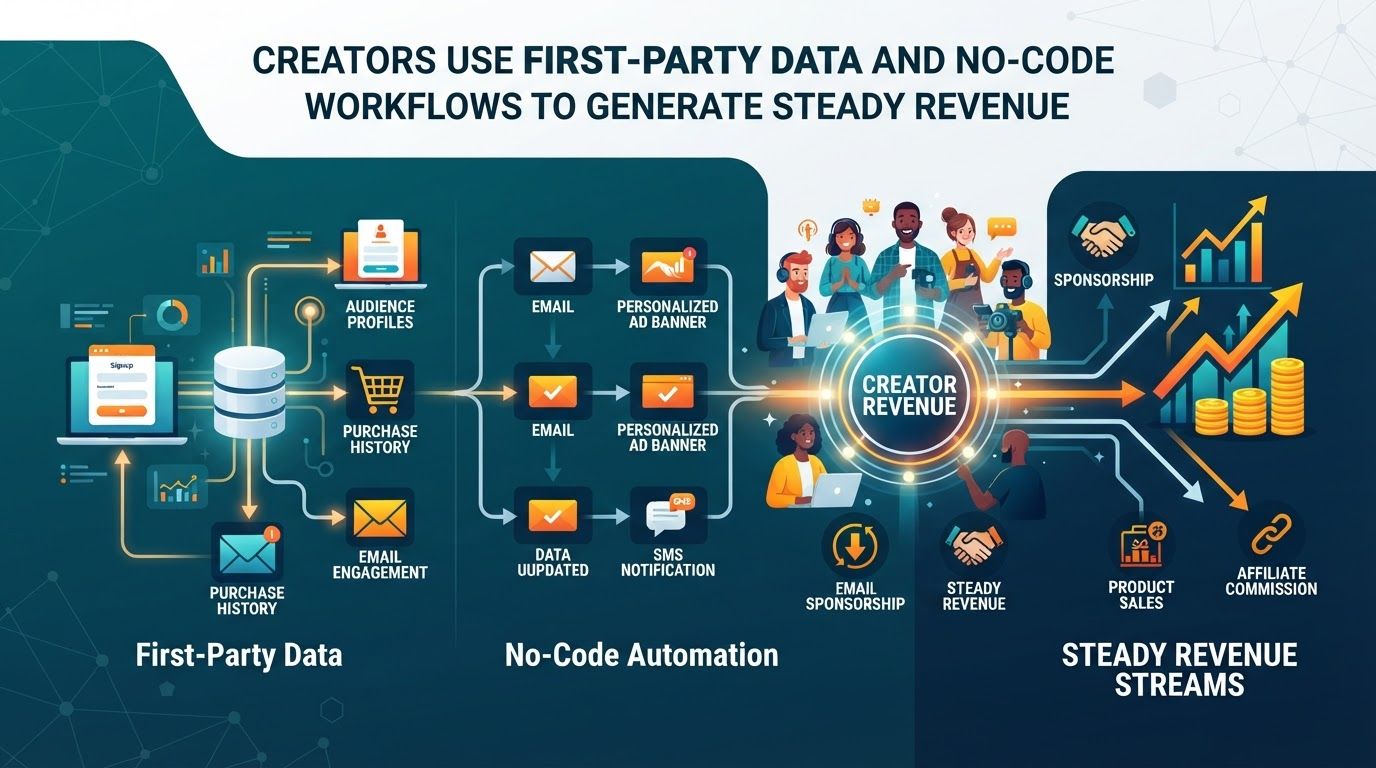
A creator can have a growing audience and still struggle to predict next month’s income. Turning first-party data into steady revenue streams starts by building a direct relationship with that audience, then using no-code workflows to make useful offers and follow-up more consistent.
You do not need a complicated technology stack to begin. An opt-in form, a simple way to organize what subscribers want, and a few carefully chosen automations can connect your content to affiliate recommendations, digital products, memberships, or commerce sales. The goal is not to automate every interaction; it is to make the helpful ones repeatable.
What first-party data gives creators that follower counts cannot
First-party data is information you collect through your own direct interactions with an audience. For a creator, that might include an email address someone gives you on a signup form, the content they click in your newsletter, a purchase from your store, or a reply to a question you send them. It differs from a follower count because it tells you something about a person’s relationship with your business, not just their presence on a platform.
Zero-party data is a useful companion: it is information people intentionally tell you about themselves. If a subscriber chooses “I’m starting an affiliate site” on a preference form, that answer is more useful for tailoring future emails than a guess based on a social media impression. Shopify’s 2026 direct-to-consumer trends piece highlights product quizzes as one way to collect stated preferences and use them for recommendations and marketing messages.
Consider a creator who teaches home-based entrepreneurs. A short quiz might ask whether visitors want help with choosing a niche, creating content, or setting up email automation. Those answers can guide which beginner resource appears next and which optional email sequence a person receives. The creator is not collecting data for its own sake; each question has a clear job in the customer experience.
- Contact details let someone receive the resource or updates they requested.
- Stated interests help the creator send more relevant lessons and offers.
- Engagement signals show which topics deserve more attention, without requiring assumptions about every individual.
- Purchase and membership history helps avoid promoting an entry-level product to someone who already bought it.
That direct relationship can be especially valuable when a creator earns affiliate commissions. Shopify notes that affiliate programs are moving toward first-party data and consent-driven tracking as third-party cookies phase out. An email list does not solve every attribution problem, and tracking requirements vary by partner. It does give creators a reliable place to communicate with people who chose to hear from them, rather than depending entirely on a platform feed.
Collect only the information you can explain and use to make the next interaction more helpful.
Start small. If you cannot describe how a field will improve a subscriber’s experience, leave it out for now. A shorter, more understandable signup can be a stronger foundation than an elaborate form that asks beginners for details before they know whether they trust you.
Build an opt-in that starts a useful relationship
A lead magnet works best when it solves a narrow problem that naturally leads to what you teach or sell. For an affiliate marketer, that could be a checklist for evaluating a tool before buying it. For a digital-product creator, it might be a worksheet that helps visitors identify which skill they need to learn first. The resource should stand on its own, even if the subscriber never makes a purchase.
Mailchimp’s 2026 report, The Art of the Opt-In, emphasizes that trust, timing, and restraint at signup shape engagement, data quality, and retention. In practice, that means explaining what someone will receive, how often you expect to write, and what kind of recommendations may appear. An opt-in should feel like an informed choice, not a hurdle placed between the reader and an answer.
Choose one promise and one next step
Suppose you publish a tutorial on setting up an email welcome sequence. An accompanying template is a closer match for that reader than a broad “join my newsletter” popup. The confirmation page can then point to a related tutorial, while the first email delivers the promised template. Each step continues the same conversation.
Keep any optional preference question easy to answer. A creator serving both bloggers and online shop owners could ask which path a subscriber is working on. The answer can determine whether subsequent examples focus on affiliate articles or product pages. If you have only one useful email path, skip the question until you have enough distinct material to justify it.
- Match the invitation to the content. Offer a resource that addresses the reason someone arrived, rather than using the same generic signup pitch everywhere.
- State the exchange plainly. Tell people what they will get now and what kinds of emails may follow.
- Make the first delivery immediate and relevant. Send the promised resource before introducing a paid offer.
- Provide control. Make it easy to change preferences or leave the list, and honor those choices across your tools.
This is also where acquisition quality matters more than collecting the largest possible list. Someone who asks for a specific checklist has given you context for a useful follow-up. Someone added without a clear expectation has not. The first approach gives both the reader and the business a better chance of a lasting relationship.
Connect content, data, and offers with no-code workflows
A no-code workflow is a set of connected actions that runs when something happens: a person submits a form, selects a quiz answer, buys a product, or joins a membership. Instead of copying information between tools by hand, you define what each event should trigger. Zapier reports that 34% of AI builders have no formal training, a reminder that workflow building is no longer limited to engineering teams.
For a beginner, the best starting workflow is usually small enough to draw on a sheet of paper. You might connect a signup form to an email platform, apply an interest tag based on one answer, and deliver the matching resource. After that works reliably, add a short follow-up sequence and a relevant offer. Building in layers makes errors easier to spot.
A practical example: from tutorial to affiliate recommendation
Imagine you publish a tutorial about choosing a newsletter platform. A visitor downloads a comparison checklist and selects “I have not started my list” on the signup form. Your no-code setup records that preference and delivers the checklist. A later email explains which features matter for a new creator, then offers a disclosed affiliate link to a tool if it fits the reader’s needs.
Someone who selects “I’m moving an existing list” needs a different explanation. Their follow-up might cover migration questions rather than beginner setup. The point is not to create an email for every possible combination of answers. It is to stop sending obviously mismatched advice when a simple, volunteered preference gives you a better option.
- Trigger: A person takes an action, such as submitting a form or completing a purchase.
- Condition: A stated preference or existing customer status determines which path applies.
- Action: The workflow delivers a resource, adds a relevant tag, or sends a follow-up.
- Check: The creator reviews the experience as a subscriber would and confirms that each message is accurate.
Use the tools you already have before adding new ones. Many email, commerce, and membership platforms include forms, tags, automations, and basic reporting. A separate connector can help when essential tools do not communicate, but every additional connection creates another place to check permissions, troubleshoot failures, and manage costs.
Mailchimp found that brands with highly aligned messaging and timing across channels were more likely to report high value from organic social, paid social, and generative-engine channels. For an individual creator, the practical lesson is to keep the promise consistent. If a video invites viewers to get a beginner checklist, the landing page and follow-up emails should not abruptly switch to an advanced sales pitch.
Test a workflow with your own address before sending traffic to it. Check what happens when someone selects each answer, already owns the product, or unsubscribes. Then review it whenever an offer, link, or tool changes. A modest workflow that runs correctly is more useful than an elaborate funnel that quietly sends the wrong message.
Turn the same audience insight into several revenue streams
Steadier revenue does not require selling everything at once. It comes from understanding a recurring audience problem and offering sensible ways to solve it at different stages. Your content can help someone for free, introduce a suitable affiliate tool, lead to your own product, or support an ongoing membership. Each offer should have a distinct purpose.
Affiliate recommendations
Affiliate income fits naturally when a creator teaches a process that uses outside tools or services. Data from signup preferences and content engagement can reveal which tutorials deserve a tool comparison or setup walkthrough. The recommendation still needs to be honest: explain who the product suits, where it may fall short, and that you may earn a commission when applicable.
A sequence can make those recommendations available long after a post is published. For example, someone downloading a website-planning worksheet might first receive guidance on choosing a format, then a tutorial on publishing, followed by an optional recommendation for a relevant service. That is a repeatable path, not a guarantee that every subscriber will buy.
Digital products and owned commerce
Templates, mini-courses, guides, and merchandise give creators an offer they can price and improve themselves. A quiz or preference form can help point people to the right starting product. Shopify describes product quizzes as a way to gather zero-party data for recommendations, but the simplest version could be a single question that distinguishes beginners from experienced buyers.
Shopify reports that AI-referred sessions in its data convert 80% better than organic search, with average order values 14% higher; it also says AI channels convert nearly twice as many first-time customers as other channels. These are Shopify-reported channel comparisons, not a forecast for an individual creator. They reinforce the value of having a clear product page and a useful way to continue the relationship when discovery happens through new channels.
Memberships and repeat purchases
A membership can fit when the audience benefits from ongoing access, fresh material, or a continuing community. It is less suitable when a one-time download fully solves the problem. Before launching one, ask what you can reliably deliver after the initial excitement fades and whether members will understand that ongoing value.
Patreon says its Insights dashboards show a creator earnings funnel and how content drives new revenue and new free members. That makes it possible to compare the content that attracts people with the content that prompts them to support the creator. Free-member growth alone is not the same as paid-member retention, so examine both the path into the membership and the experience after joining.
Owned commerce can also become substantial infrastructure. Shopify reported that American businesses on its platform generated $688 billion in economic activity and supported 2.3 million U.S. jobs in the last year it measured. That broad economic figure is not a typical creator outcome. It illustrates that selling through established commerce tools is a real business route, while your own pricing, demand, and fulfillment determine whether it works for you.
Choose a first offer based on the problem your audience has already shown you, not on which revenue model sounds most scalable. If people repeatedly ask how to choose software, a carefully disclosed affiliate guide may be a sensible starting point. If they ask for your exact process, a template may be more useful. Let the questions shape the offer before you automate its promotion.
Use AI to improve the workflow without handing it the business
AI can reduce the time spent drafting, organizing, and checking a creator funnel. HubSpot’s 2026 social media report says 94% of social media marketers use AI in some part of their workflow, including ideation, caption generation, image creation, and editing. Adobe’s 2026 Creators’ Toolkit Report found that 87% of creators using creative AI said it accelerated business or audience growth, while 75% said it was integrated or essential to how they work.
Those findings explain why AI belongs in the operating plan, but they do not tell you which tasks to delegate. A useful test is whether the task benefits from speed without requiring the tool to make a sensitive judgment alone. Turning a long tutorial into several draft email subject lines is different from allowing an agent to choose products to endorse or send messages to customers without review.
- Good drafting support: Outline a welcome sequence from a resource you already created, then edit it for accuracy and tone.
- Good organizational support: Summarize recurring, permissioned audience questions into themes you can review before planning content.
- Good quality-control support: Help identify broken links, inconsistent offer names, or gaps in a draft sequence before a human tests it.
- Decisions to retain: Approve claims, choose endorsements, set prices, handle sensitive customer issues, and decide what data a tool may access.
Adobe also found that 85% of creators said the final creative decision should remain theirs. Its report describes interest in being able to review, edit, or undo actions and define the data and tools an AI agent can access. Apply that principle to revenue workflows: draft with assistance, but approve the recommendation, check the destination link, and decide whether the message deserves to be sent.
Stripe says 58% of surveyed SaaS platforms are rebuilding workflows around agents. That points to more automation becoming available inside everyday business software. Availability is not a reason to connect an agent to every account. Start with limited access and an action you can inspect, then expand only when the benefit is clear and the controls are adequate.
AI is most valuable here when it helps you maintain a useful publishing and follow-up rhythm. It cannot replace an accurate understanding of your audience or the responsibility to make fair offers. A polished automated email that recommends the wrong thing is still the wrong email.
Measure the steps that connect attention to revenue
Revenue can look unpredictable when you measure only views and sales. A creator funnel has several decisions in between: whether someone accepts an invitation, receives the promised resource, engages with a relevant follow-up, and decides an offer is worth buying. Tracking those steps helps you find a specific problem to fix instead of posting more content and hoping for a different result.
Begin with a short set of questions tied to actions you can take. Which content brings people to the opt-in? Which signup promise leads to readers who stay engaged? Which offer is relevant to each audience segment? If you sell a membership, which content attracts free members, and what helps them understand the value of paid support?
- Acquisition: Note which content or channels lead to signups, rather than judging a post by reach alone.
- Engagement: Look for signs that subscribers use the material they requested, while remembering that any single email metric is incomplete.
- Conversion: Compare offers in the context of the audience and message that led to them, not as isolated sales totals.
- Retention: Review repeat purchases, membership continuation, replies, and reasons people leave where your tools provide that information.
Use a simple review rhythm: inspect the funnel, choose one bottleneck, make one meaningful change, and give it enough exposure to learn something. If people sign up but do not understand the next email, improve the transition before creating another lead magnet. If readers engage but avoid an offer, investigate fit, price, clarity, or trust before adding more reminders.
Data can also inform partnership pricing. A creator-economy brief reported that Companion’s pricing benchmark drew on $173 million in verified creator campaign spend and more than 180,000 deal data points. The same brief said a commissioned survey found 45% of marketing and procurement leaders admitted mispricing creator partnerships, while 49% cited managing budgets across teams and regions as a leading concern. Those figures describe a market seeking more consistent decisions, not a rate card you can apply directly to your own work.
If brand partnerships are part of your income, keep records of deliverables, the time required, agreed usage, and results you can substantiate. That history can support better conversations about price and scope than follower count alone. A repeatable intake and reporting workflow also makes it easier to assess whether a partnership is worth accepting again.
Attribution has limits. A subscriber may watch a video, read several emails, and buy later through a different link or device. First-party records and consent-driven tracking can improve visibility, but they will not produce a perfect account of every decision. Use the information to improve your work, not to claim certainty the data cannot provide.
Protect trust while automating personalization
Personalization should feel like a service, not surveillance. If a reader explicitly says they want beginner advice, sending an introductory example makes sense. Referring to a string of observed actions in a way that feels intrusive may undermine the very relationship the automation was meant to strengthen.
Decide in advance which data each tool needs. An email platform may need an address and a preference tag to deliver the right lesson; an AI drafting tool may not need your full subscriber list. Review access before connecting accounts, especially when a tool can both read data and take actions. Give subscribers straightforward choices about the communications they receive, and make sure your workflow respects those choices.
Write rules for exceptions, not just the ideal path
A funnel diagram usually shows a happy path: someone signs up, reads, and buys. Real customers change their minds, make purchases halfway through a sequence, ask for help, or stop wanting messages. Your automations need to respond appropriately rather than continuing as though nothing changed.
- Stop irrelevant promotions after a purchase. If your tools can identify an existing buyer, move them to helpful onboarding instead of continuing a sales sequence for the same product.
- Handle unsubscribe and preference changes consistently. Check that connected systems do not restart messages someone has declined.
- Review sensitive messages before they go live. Affiliate disclosures, earnings claims, product comparisons, and support responses deserve human attention.
- Provide a way to reach you. A subscriber should not have to navigate an automation loop to ask a real question.
These safeguards are operational, not just ethical. A mismatched offer can waste attention; a confusing preference process can make subscribers less willing to share information; and an unchecked AI-generated claim can damage credibility. Mailchimp’s emphasis on trust and restraint at signup applies throughout the relationship, including after someone becomes a customer.
You can still keep the system manageable. Document each workflow’s trigger, purpose, data used, and stopping point in a brief note. When you change a product or partnership, that note tells you which automations need review. Clear documentation matters more as the business adds new offers and tools.
Launch a small revenue system, then improve it deliberately
If your current process is mostly posting and hoping, do not try to build every revenue stream at once. Start with one audience problem, one useful resource, one place to collect permission, and one appropriate offer. This creates a complete path you can test before adding complexity.
A practical order of operations
- Choose the audience question. Pick a problem people already raise in comments, replies, customer messages, or search-driven content. Write down the outcome your free resource will help them reach.
- Create the opt-in and delivery. Publish a clear signup promise, collect only necessary information, and automatically deliver the resource. Test the entire experience yourself.
- Add one relevant follow-up. Send a lesson that helps readers use what they received. Invite a reply or offer a simple preference choice if it would improve the next message.
- Introduce one fitting revenue option. This might be a disclosed affiliate recommendation, your own template, or a membership invitation. Explain why it fits and who may not need it.
- Review and refine. Look at signups, engagement, sales, and reader feedback together. Fix the weakest transition before expanding the funnel.
There are alternatives if email is not the right center of your business. A membership platform may already provide free-member tools, content delivery, and conversion insights. A commerce platform may offer customer records and product recommendations. You can begin inside one platform and add separate tools only when a real need emerges. The important question is whether you can understand and improve the customer journey, not how many applications are connected.
Platform features are evolving, too. A September 2026 creator-economy brief said YouTube introduced brand discovery tools and an AI pitch assistant in creator workflows. Such tools may simplify partnership work, but platform-native convenience comes with platform-defined rules and access. Keep your direct audience relationships, offer information, and business records organized so you can make informed choices as features change.
A steady revenue system is not one that never needs attention. It is one where useful content leads to a clear next step, subscribers know what they agreed to receive, offers fit their needs, and the creator can see what to improve. No-code workflows make that system easier to run; first-party data helps you keep it relevant.
Begin by auditing one piece of content that already attracts the right people. Add a specific opt-in, deliver on its promise, and build one thoughtful follow-up before introducing more automation. That small, testable path gives you a better foundation for affiliate income, product sales, or memberships than another disconnected campaign.
As the system grows, keep the human parts visible: listen to questions, check your claims, disclose partnerships, and respect audience choices. Revenue becomes more dependable when people have a reason to return and your workflows help you serve them consistently.

No comments:
Post a Comment